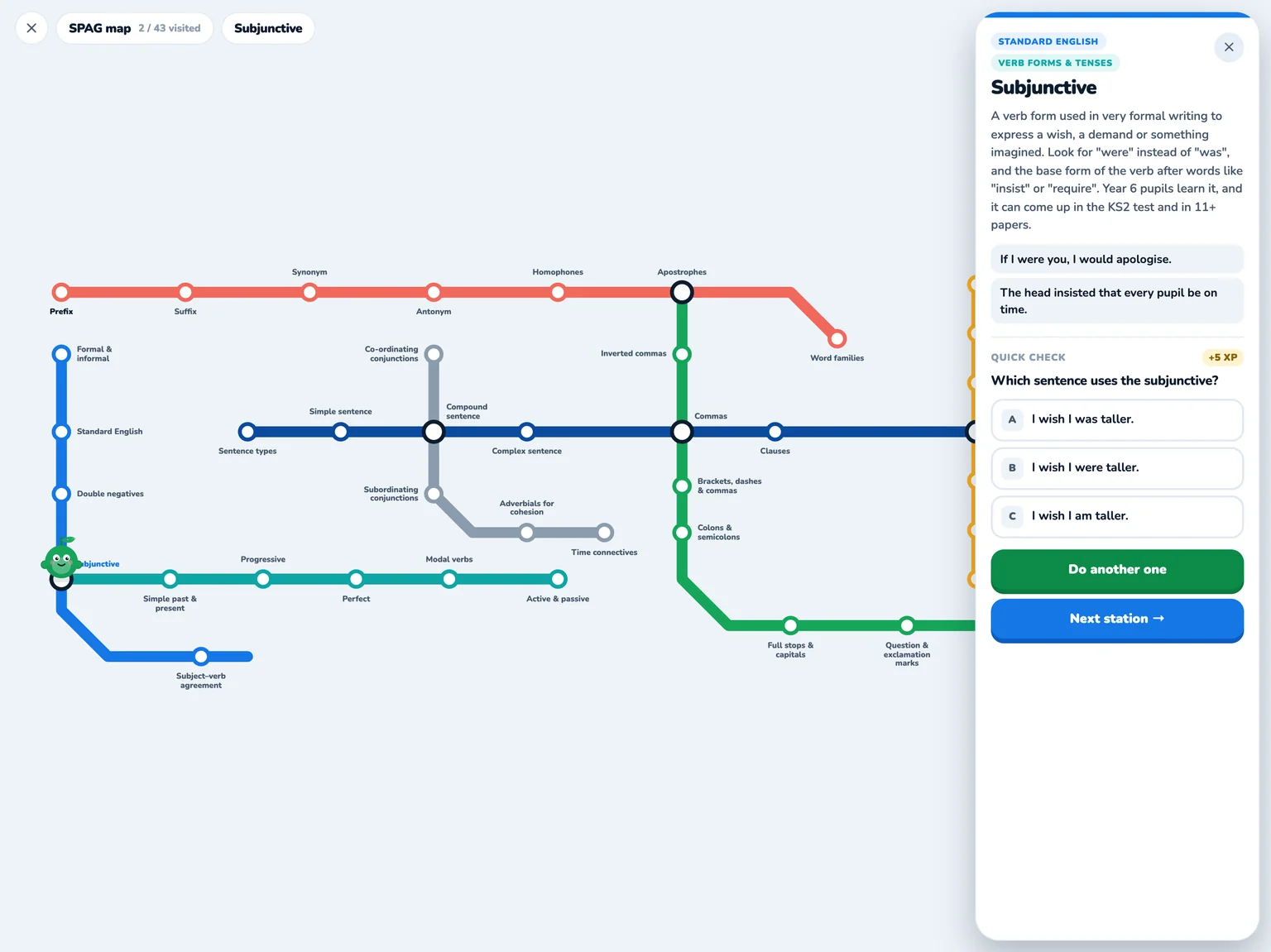
The subjunctive is a verb form for things that are wished for, imagined or formally demanded, not stated as fact. It has two forms: were for imagined things (If I were you) and the plain base verb after a demand (I insist that he be on time). Year 6 pupils learn it, and the 2025 and 2026 KS2 grammar papers both tested it. This page is part of the SPaG glossary.
- The subjunctive is a verb form for wishes, imagined things and formal demands.
- Form one: were for every person when something is imagined: If I were you.
- Form two: the base verb after a demand and that, with no -s: I insist that he be on time.
- Real facts use the ordinary past: If Sam was late, he missed the bus.
What is the subjunctive?
The subjunctive is a verb form used for something wished for, imagined or demanded rather than stated as a fact. English has very few subjunctive forms. The English glossary says they are used in rather formal styles, and it gives three examples.
- Base form The school requires that all pupils be honest.
- Base form The school rules demand that pupils not enter the gym at lunchtime.
- Were If Zoë were the class president, things would be much better.
Those three sentences are the whole idea. The first two use the plain verb after requires that and demand that. The third uses were because the class president is only imagined. The picture below shows the two forms side by side.
The would in I would apologise is a modal verb, which is a different Year 5 topic. Our modal verbs page explains how those work.
When do you use "were" instead of "was"?
Use were when the sentence is imagined, wished for or not true, whoever the subject is: If I were you, If she were taller. Use was when the sentence talks about something that really happened or could be true: If it was raining, they stayed in.
Was or were?
More pairs to compare. The first group is imagined and uses were. The second group is real and keeps was.
- Were If I were you, I would apologise.
- Wish I wish it were Saturday today.
- As if She talked as if she were the boss.
- Were If Zara were taller, she could reach the shelf.
- Was If it was raining, they stayed in.
- Was If the lake was frozen, we skated across it.
- Fact We were at the park on Saturday.
The last sentence uses were, but it is not a subjunctive. It is a plain fact about the past with we, so it follows the ordinary past tense.
Pip gives short SPaG questions, shows the rule and brings back the types your child misses.
- Missed types return
- Phone and tablet
- Short daily sessions



Free, with optional Pro
What is the base-form subjunctive?
After a verb of demand or suggestion and the word that, the next verb stays in its base form. That means no -s and no past tense. We write I insist that he be on time, not that he is. Press Play to watch the -s fall off.
- Insist The head teacher insists that every pupil be on time.
- Ask We ask that the match be replayed.
- Require The rules require that each player wear a shin guard.
- Vital It is vital that the door remain locked.
- Suggest I suggest that he take a map.
- Fact The doctor says that Grandad rests every day.
- Adds -s The doctor recommended that Grandad rests for a week.
The last two sentences are ordinary English. The first states a fact, so the -s belongs. The second keeps the -s after recommended that, which formal writing avoids.
Which words trigger the subjunctive?
Verbs of demand or suggestion, such as insist, demand, require, recommend, suggest, propose, request, urge and ask, set up the base form. So does It is essential, vital or important that. The words if, wish and as if set up were.
Check the pattern before you circle anything. For the base form you need the trigger word, then that, then a subject, then the plain verb. A sentence such as She insisted on a coat. has the trigger word but none of the pattern, so it holds no subjunctive.
What do "Were I..." and "If I were to..." mean?
Both are formal ways to talk about something imagined. If I were to help means "if I helped". Were I the captain starts with the verb and means the same as If I were the captain. The Year 6 programme of study names If I were and Were they to come as examples of subjunctive forms in some very formal writing and speech.
- Were I Were I the captain, I would change the plan.
- Were they to Were they to arrive early, we would start the show sooner.
- If I were to If I were to win, I would share the prize.
Look for a sentence that begins with Were and has a comma. A question that begins with Were, such as Were you at the park? is an ordinary question and holds no subjunctive.
How do you make the subjunctive negative?
Put not straight before the verb. Do not add do or don't. The glossary example is The school rules demand that pupils not enter the gym at lunchtime.
- Negative The club asks that members not park on the grass.
- Negative It is essential that Sam not arrive late.
- Everyday The club asks that members do not park on the grass.
The everyday version with do not is perfectly good English. The test and formal writing use the form without it.
Is the subjunctive formal or informal?
The subjunctive is formal. The Year 6 programme of study sets it inside the difference between informal speech and formal speech and writing. In everyday talk, most people say If I was you and I suggest he takes a map. Formal writing uses were and the base verb. The passive voice is another Year 6 feature of formal writing.
Many people in Britain also say should instead of the base verb, as in I suggest that he should take a map. That choice is common, but it is not one of the statutory examples, so learn the plain forms above.
Where does the subjunctive appear in KS2 tests?
The subjunctive is a Year 6 grammar topic, and it appeared in both the 2025 and the 2026 KS2 grammar, punctuation and spelling papers. The test framework files it under two content codes: G4.3 for subjunctive forms and G7.4 for formal and informal structures. Here are the questions we found in the published papers on gov.uk.
| Year | Question | What it asked |
|---|---|---|
| 2025 | Q46 | Circle the subjunctive verb in If I were to help, I would start by clearing the tables. The verb is were. Content codes G4.3 and G7.4. 2025 paper 2025 mark schemes |
| 2026 | Q44 | A tick-box question. The correct choice is If I were to look inside the box, what would I find? Content code G4.3. 2026 paper 2026 mark schemes |
Both questions use If I were to, which is why the were form earns its own level in the quiz below. For the full Year 6 list, see our Year 6 SPaG guide. The statutory wording comes from English Appendix 2 and the test framework.
Free subjunctive quiz
This quiz has six levels, from spotting the subjunctive verb to a mixed challenge. Each level has 8 questions, and your child sees why an answer is right or wrong. Answer with a tap, or press 1 to 4 on a keyboard.
Free printable subjunctive worksheet
The worksheet gives 10 questions on one A4 page and the answers on the next. Choose a level, make a new sheet and press Print.
How can I help my child at home?
Short and regular beats long and rare. Try these three habits.
- Make a wish. Start with I wish and finish with were: "I wish the dog were bigger." Ask your child to make three more.
- Be the head teacher. Write three rules that begin I insist that or I demand that. Check that the verb after the subject has no -s.
- Say it twice. Say a sentence the everyday way, then the formal way: "If I was you" and "If I were you". Ask which one a speech would use.
Children who like to practise on a screen can try the interactive SPaG map, and parents can browse more guides in the SPaG resources.
The subjunctive: questions parents ask
What is the subjunctive in simple terms?+
The subjunctive is a verb form for things that are wished for, imagined or formally demanded rather than stated as fact. It has two forms at KS2. One is were, as in If I were you. The other is the plain base verb after a demand, as in I insist that he be on time.
How do I identify a subjunctive?+
Look for a wish, an imagined situation or a formal demand. Then check the verb. If it is were where you would expect was, or a plain verb with no -s after words such as insist that, it is a subjunctive.
Is I wish a subjunctive?+
The word wish sets up the subjunctive, but the subjunctive is the verb that follows. In I wish it were Saturday, the subjunctive verb is were.
How many types of subjunctive are there at KS2?+
Two. The were form is used for imagined or wished-for things, and the base form is used after verbs of demand or suggestion. Children are not expected to know more.
What is an example of the base-form subjunctive?+
The glossary gives The school requires that all pupils be honest. Another is I suggest that he take a map. The verb after the subject has no -s and no past tense.
Which year learns the subjunctive?+
The subjunctive is part of the Year 6 grammar programme in England. Children learn that it is used in some very formal writing and speech.
When do I use was and when do I use were?+
Use was for something real or possible, such as If Sam was late, he missed the bus. Use were for something imagined or wished for, such as If Sam were late, he would run. Were is used with every subject in the imagined form, including I, he and she.
Has the subjunctive been in the KS2 SATs?+
Yes. In the 2025 paper, question 46 asked pupils to circle the subjunctive verb in If I were to help, I would start by clearing the tables. In the 2026 paper, question 44 was a tick-box question where the correct sentence was If I were to look inside the box, what would I find?
Why does the subjunctive have no -s?+
After a demand, the verb goes back to its base form. So we write I suggest that he take a map. The usual -s ending for he, she and it is dropped, and is becomes be.
What is the difference between the subjunctive and a modal verb?+
A modal verb, such as would or should, is a helper that shows possibility or obligation. The subjunctive is a form of the main verb itself. In If I were you, I would apologise, were is the subjunctive and would is the modal verb.
How do I make a subjunctive negative?+
Put not directly before the verb and do not add do. The glossary example is The school rules demand that pupils not enter the gym at lunchtime.

The Pip team builds Pip, the 11+ and KS2 practice app for children in years three to six. We write these guides from real exam formats and past papers.