Telling the Time Worksheets and Games for Reading Clocks, Analogue and Digital, the 24-Hour Clock and Roman Numerals
by Pip Learning · Paperback
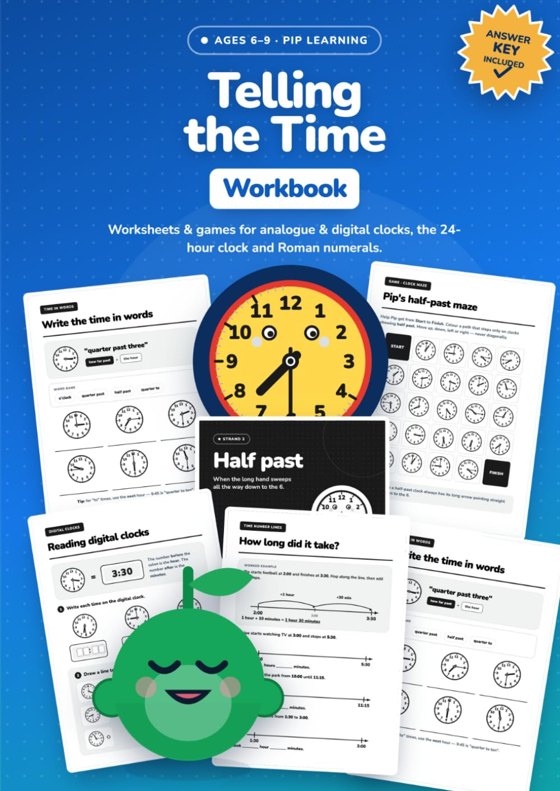
The Telling the Time Workbook from Pip Learning turns telling the time from a guessing game into a skill children understand. Built for ages 6 to 9, this large A4 write-in book has 162 black and white pages, a friendly cartoon mascot called Pip throughout, and a full answer key so children can check their own work. Whether you call it telling the time or telling time, this is calm clock practice for kids and reading the clock for kids, following the order time is taught in school, from o'clock right through to the exact minute.
Buy on Amazon →As an Amazon Associate, Pip earns from qualifying purchases. Price and delivery shown on Amazon.
Pip uses a simple teach then practise method, so a child can begin without help. No rushing, just steady steps up a clear difficulty ladder.
Pip teaches the idea and shows a worked example.
You work through one together as a guided step.
The child practises on their own with confidence.
The telling the time worksheets climb through 9 skill strands, the skills children need to read a clock:
Children practise both reading clocks and drawing the hands, across analogue and digital clocks and time in words, plus matching clocks to digital times. Every page is purposeful telling the time practice.
Skill drills are mixed with fun so children stay keen. A telling the time game like the clock maze, cut-out time dominoes, "Oops Pip" spot-the-mistake puzzles, write-the-time and make-the-clock-match tasks, and real-life word problems all keep practice playful. You also get units of time conversions (seconds, minutes, hours, days, weeks), the calendar (days, months, dates and reading a month grid) and sensible-units estimation.
This is a proper UK Maths workbook: it uses quarter past and quarter to, the 24-hour clock and Roman numerals throughout. It suits KS1 and KS2, roughly Year 1 to Year 4. A diagnostic check near the start and a final Time Champion test at the end make progress provable, while badges to colour, a progress map and a certificate keep children motivated.
Children aged 6 to 9 in Years 1 to 4 who are learning to tell the time, and any KS1 or KS2 child who needs steady, confidence-building clock practice. A few pages a day is all it takes. When your child is ready for the 11+, keep maths sharp with the free Pip app at pip11plus.com.
It is designed for ages 6 to 9. The difficulty ladder starts at o'clock and builds to the minute, so younger children begin gently and older ones are stretched, useful telling the time practice across a wide age range.
Yes. Children read and draw analogue and digital clocks, write the time in words, and match clocks to digital times, then progress to am and pm, noon and midnight, and the 24-hour clock.
Yes, with answers throughout. The full answer key shows little clock faces for draw-the-hands questions and worked number lines for elapsed-time answers, so checking is quick for any grown-up.
Yes. A dedicated strand covers telling the time to 5 minutes, sitting between quarter past and quarter to and the harder to-the-minute work, so children build up in steps.
| Format | Paperback, A4 write-in |
| Print length | 162 pages, black and white |
| Reading age | 6 to 9 years (Years 1 to 4) |
| Topics | Analogue & digital clocks, 24-hour clock, Roman numerals, elapsed time |
| Series | Pip Learning |
| Language | English |
| Dimensions | A4, 21.0 x 29.7 cm |
| Published | 2026 |