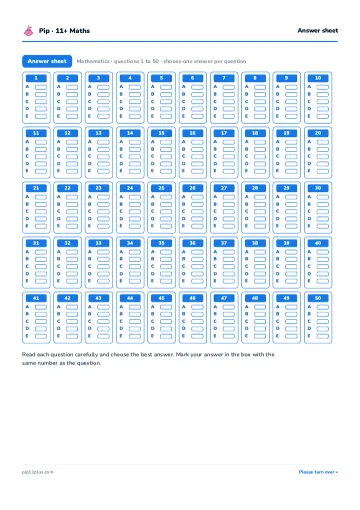
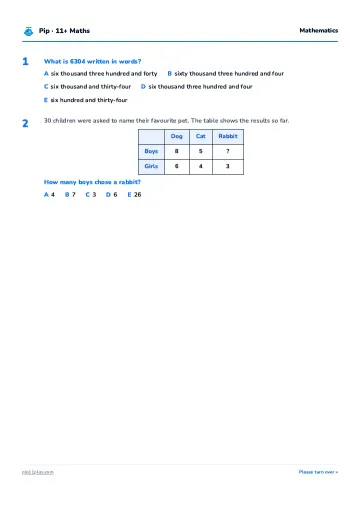
A complete, original 11+ Maths paper in the standard multiple-choice format: number, fractions, data, shape and word problems, with a printable answer sheet and a worked answer key. Free to download.
Thanks! Your download is on its way.
We'll only use your email to send this and, if you tick the box, our tips.
The short version. Both 11+ maths practice papers on this page are free PDFs you can print at home.
Each has 50 multiple choice questions, a printable answer sheet and a worked answer key, so the paper marks itself and your child can see the method behind every answer. Between them they cover the Key Stage 2 maths the 11+ draws on: number and place value, the four operations, fractions, decimals and percentages, ratio and proportion, simple algebra in the form of number machines and sequences, measurement and unit conversion, geometry, statistics and multi-step word problems.
Two full-length 11+ Maths papers. Each has 50 multiple choice questions, a printable answer sheet and a fully worked answer key, in the standard 11+ format.
Once it is marked, our 11+ standardised score calculator turns the raw mark into an age-adjusted estimate. They are mixed practice papers, drawing on every maths topic that comes up, rather than drilling one topic at a time.
Same level and question types, completely different questions, so your child can sit one, then the other.
50 mixed questions across number, fractions, data, shape and word problems, with a worked answer key. About 50 minutes.
Download Paper 1 (PDF)A second full paper at the same level, with all-new numbers, contexts and figures. 50 questions, answer sheet and worked answers.
About 50 minutes.
Download Paper 2 (PDF)Mark the paper, choose the maths skill that caused trouble, then let your child try fresh questions in Pip. Free practice adjusts the next question's level and gives feedback after each answer, so one finished PDF can start the next useful session.
Free to start: repeatable 11+ Maths practice. Pip Pro: interactive Pip Teaches lessons and timed mock papers.
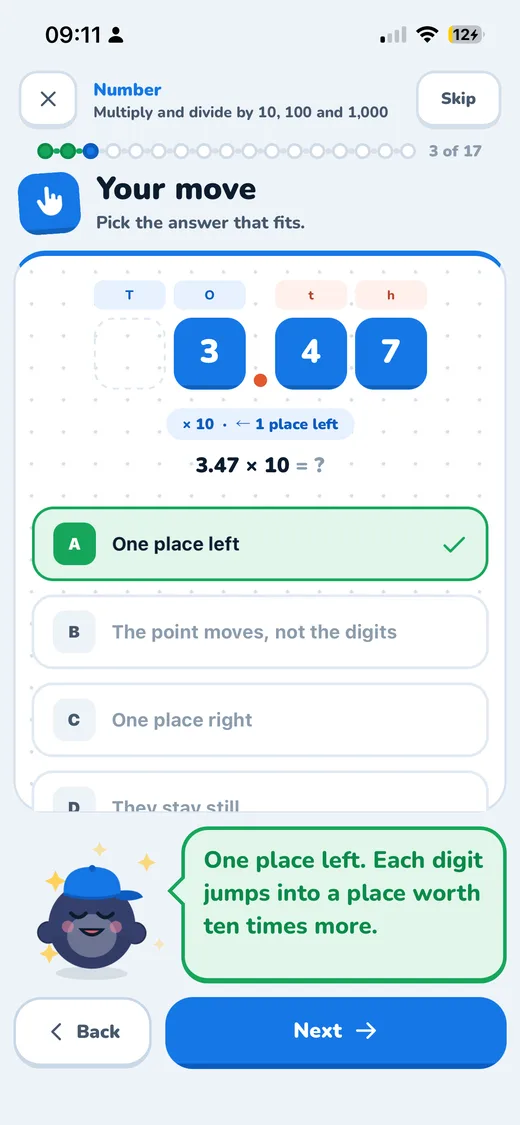 Actual Pip app feedback
Fifty questions across the strands the 11+ tests most, in the same multiple-choice format children meet on the day, marked on a separate answer sheet.
Place value, fractions, decimals and percentages, plus multi-step money and division word problems.
Read a two-way table, a bar chart and a pie chart, and interpret a Venn diagram and a number line.
Angles in a triangle, area on a grid, coordinates and the properties of 2D shapes.
11+ maths is built on the Key Stage 2 curriculum, mostly the Year 5 and Year 6 content, with more problem solving layered on top. These are the strands our own papers test, with the kind of question each one produces.
| Topic | What comes up | A question in that style |
|---|---|---|
| Number and place value | The value of a digit in a large number, ordering, rounding and negative numbers. | What is the value of the 5 in 258,431? |
| The four operations | Mental and written methods, and the order of operations when a calculation mixes them. | Work out 9 + 6 × 5 − 7. |
| Fractions, decimals and percentages | Equivalence, adding and subtracting fractions, simplest form, and finding a fraction or percentage of an amount. | Work out 2⁄3 + 1⁄6 in its simplest form. |
| Ratio and proportion | Sharing an amount in a given ratio, scaling quantities up and down, and comparing value for money. | Share 45 counters in the ratio 2:3. |
| Algebra in disguise | Number machines, missing numbers and number sequences, which are early algebra without the letters. | A machine doubles a number then adds 7. What goes in to give 25? |
| Measurement and conversion | Grams and kilograms, millilitres and litres, millimetres up to kilometres, plus time and money. | How many grams are there in 3.2 kilograms? |
| Geometry: shape, angles and area | Angles in a triangle, in a quadrilateral and on a straight line, area and perimeter, coordinates and the properties of 2D shapes. | A triangle has angles of 55° and 72°. Find the third angle. |
| Statistics | Reading tables, bar charts and pie charts, interpreting a Venn diagram, and calculating the mean. | Five scores are given. What is the mean score? |
| Multi-step word problems | Money, time and measures problems that need two or three linked steps before an answer appears. | Two pack sizes are priced. Which is better value per item? |
Children who are comfortable in class can still find their first 11+ paper a shock. Almost none of that is new content.
It is the format.
A school question usually asks for one operation. An 11+ question hides the operation inside a story, and often needs a second calculation on the result of the first.
The maths is Year 5 and Year 6 level; the reading and planning are the hard part.
Fifty questions in about fifty minutes leaves roughly a minute each, including reading. Children who are accurate but slow lose marks simply by not reaching the end, which is why timing practice matters as much as topic practice.
The options are not random. They are the answers you get from the common slips: adding before multiplying, forgetting the second step, or answering the question that was not asked.
A wrong answer that appears on the list feels right, so it never prompts a check.
These are written the way the answer key in each paper is written: the method first, then the trap. Method is what transfers to the next question; an answer is not.
A pack of 6 pens costs £2.70. A pack of 10 of the same pens costs £4.20.
How much cheaper is one pen in the larger pack?
The commonest distractor is £1.50, which is simply £4.20 minus £2.70. That compares the packs rather than the pens, and it answers a question nobody asked.
Another is 42p, the price per pen in the larger pack, which is a correct number stopped one step early. Both feel plausible because both come from real working.
The habit worth building: after finding an answer, re-read the final sentence of the question and check that your number is the thing it asked for.
A school has 240 children. Three eighths of them walk to school.
Of the children who do not walk, 20% come by bus. How many children come by bus?
The trap answer is 48, which is 20% of the original 240. It is the mistake almost every child makes once, and once only, because the phrase "of the children who do not walk" is easy to skim past.
The other tempting option is 150, the size of the group rather than the answer.
The habit worth building: underline the group a percentage refers to before calculating it. In 11+ papers the percentage very often applies to a remainder rather than the headline number.
A rectangle measures 14 cm by 9 cm. A square of side 5 cm is cut out of one corner.
What area of the rectangle is left?
One distractor will be 46, the perimeter of the rectangle, offered to any child who reaches for the wrong formula under time pressure. Another will be 126, the area before the square is removed.
A third may be given in cm rather than cm², which is worth pointing out to your child: an area is always in square units, so a unit that is not squared is a signal that something has gone wrong.
The habit worth building: say out loud whether the question wants a length, an area or a number of things, before choosing a method.
When you mark a paper together, most lost marks fall into a handful of repeating patterns. Naming the pattern is more useful than correcting the sum.
Two full papers can teach a lot, or almost nothing, depending on how you run them. This sequence gets the most out of them.
Print Paper 1 and the answer sheet and let your child work through it with no clock at all, with rough paper for working. The aim here is to find out what they can do, not how fast.
Anxiety about the timer hides real gaps.
Use the worked answer key and go through every question they got wrong, plus any they guessed. Ask what the question was actually asking for.
Sort the errors into topic gaps and method slips; they need different fixes.
Leave a gap of a week or two, fill it with short daily practice on whatever Paper 1 exposed, then sit Paper 2 in one sitting of about 50 minutes as a mock. Mark it the same way and compare the pattern of errors, not just the score.
We publish fresh 11+ Maths, English and Reasoning papers regularly. Pop your email in and we will send the next ones the moment they are ready.
11+ Maths papers stretch the Key Stage 2 curriculum a little further and add the time pressure of the real exam. Expect number and place value, fractions, decimals and percentages, data handling, shape and space, and plenty of multi-step word problems.
Many 11+ Maths tests use multiple-choice questions, but topics, timings and response formats differ by provider and school. These original papers are subject practice, so check your own test format before treating either as a mock.
The best way to use a practice paper is little and often. Give your child a calm 50 minutes with some rough paper, then mark it together with the answer key and talk through any they found tricky.
Securing number facts and times tables first makes the word problems far easier, so it is worth pairing papers with short, regular maths practice.
If the arithmetic is sound but the wording slows your child down, use the free 11+ Maths word-problem worksheets to practise drawing the situation, choosing the steps and checking the result.
Papers are great for rehearsing exam day, but they run out fast. For everyday practice, the free Pip 11+ Maths app generates unlimited fresh questions that adapt to your child and mark themselves, so a finished paper is never the end of the practice.
You can also browse all our free 11+ printables, or explore the full 11+ Info Hub for guidance on scoring, timing and exam day.
Yes. You can download the paper as a PDF for free, with a full answer key included.
Yes. Every paper has a worked answer key with a short explanation for each question, so your child learns from any mistakes.
The paper uses the standard multiple-choice format common to both GL Assessment and CEM-style 11+ exams, covering number, data, shape and word problems, marked on a separate answer sheet.
About 50 minutes for the 50 questions. You can run it untimed first to build confidence, then timed once your child is comfortable.
Real exam timings differ by test and region, so check the format your child is actually sitting on the relevant 11+ exam types page.
Yes. Both papers use the standard multiple choice layout, with five options per question and answers marked on a separate printable answer sheet, which is how most 11+ maths papers are set.
Practising on the separate sheet is worth doing in its own right, because on the day the mark comes from the box on the sheet rather than the working.
Both. Each PDF contains a printable multiple choice answer sheet for your child to fill in, and a worked answer key for you to mark with, which explains the method for every question rather than only giving the letter.
Number and place value, the four operations and order of operations, fractions, decimals and percentages, ratio and proportion, number machines and sequences, measurement and unit conversion, geometry including angles, area, perimeter and coordinates, statistics including tables, charts and the mean, and multi-step word problems that combine several of these. The topic table above shows the question style each strand produces.
The content is broadly the Key Stage 2 curriculum, mostly Year 5 and Year 6. What makes an 11+ paper feel harder is the packaging: questions take two or three linked steps, the pace is roughly a minute a question, and the wrong options are built from the mistakes children commonly make, so an error rarely looks like an error.
Yes. Each paper is a PDF laid out for plain A4 home printing in black and white, including the answer sheet.
Nothing needs to be printed in colour for the questions to work.
Our free 11+ printables hub has the full library, including papers written to specific exam formats such as the GL Assessment, Kent Test and CSSE formats, plus verbal reasoning, non-verbal reasoning and English papers. All are free and all come with worked answers.
There is no published pass mark for a practice paper, and real 11+ results are standardised and age-adjusted rather than being a raw percentage, so treat the raw mark as a starting point rather than a verdict. What is far more useful is the pattern: which topics the errors cluster in, and whether the same method slip keeps recurring.
Actual pass marks and scoring rules vary by school and local authority, so confirm those with the school directly.
Pip gives your child fresh 11+ Maths questions every day, free, with instant feedback and adaptive difficulty. Download the app: