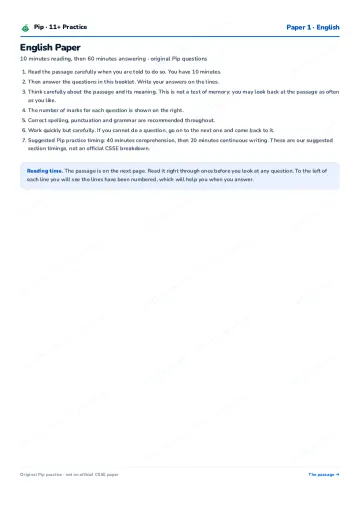
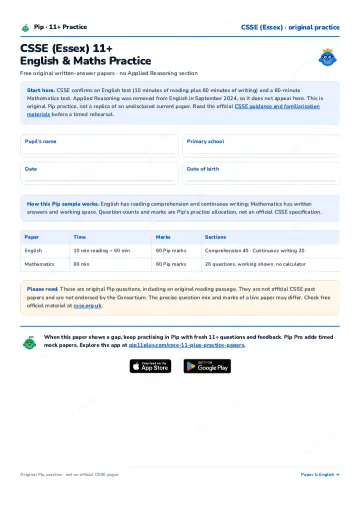
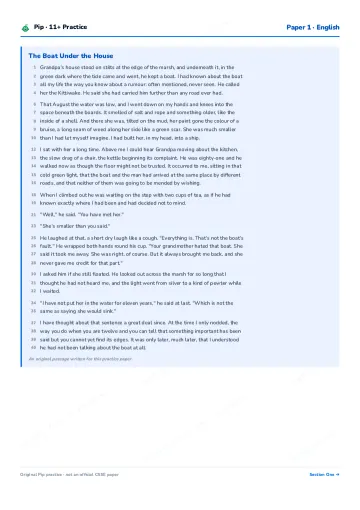
Download original written-answer English and Maths practice, with a reading passage, writing prompts, working space and answer guidance.
The retired Applied Reasoning section is gone. These are Pip questions and marks, not an official CSSE paper.
Pair the PDF with official CSSE familiarisation papers for the closest exam rehearsal.
Thanks! Your download is on its way.
We'll only use your email to send this and, if you tick the box, our tips.
Essex is unusual. Instead of buying a paper from GL Assessment or CEM, the selective schools in Essex write their own, through the Consortium of Selective Schools in Essex.
That one fact changes almost everything about how a child should prepare.
Ten schools use the test, across Colchester, Chelmsford and Southend. They are not all grammar schools, which is worth knowing before you apply: alongside seven grammar schools there is a mixed comprehensive and two Roman Catholic bi-lateral schools.
| School | Type | Area |
|---|---|---|
| Colchester County High School for Girls | Girls grammar | Colchester |
| Colchester Royal Grammar School | Boys grammar | Colchester |
| King Edward VI Grammar School | Boys grammar | Chelmsford |
| Shoeburyness High School | Mixed comprehensive | Southend |
| Southend High School for Boys | Boys grammar | Southend |
| Southend High School for Girls | Girls grammar | Southend |
| St Bernard's High School | Girls RC bi-lateral | Southend |
| St Thomas More High School for Boys | Boys RC bi-lateral | Southend |
| Westcliff High School for Boys | Boys grammar | Westcliff |
| Westcliff High School for Girls | Girls grammar | Westcliff |
School list and types checked against the official CSSE Information Guide for 2027 Entry.
Children sit an English paper and a Mathematics paper. The English paper gives 10 minutes of reading time and then 60 minutes; Mathematics gives 60 minutes.
Each paper is standardised and weighted equally in the final score. CSSE removed applied reasoning from English in September 2024, so older papers that include it do not reproduce today's English question mix.
| Paper | What CSSE confirms | This original Pip PDF |
|---|---|---|
| English | 10 min reading + 60 min; no Applied Reasoning | Written comprehension on an original passage and continuous writing, with a Pip practice mark split of 40 + 20 |
| Mathematics | 60 min | 20 written-answer questions with working space and 60 Pip practice marks |
Our new PDF removes the retired coded-word section altogether. Its mark split is clearly labelled as Pip's practice allocation so no family mistakes it for a current CSSE specification.
The two raw scores are mathematically standardised, weighted equally, and combined. Every candidate's result is also analysed by date of birth so that a statistical age adjustment can be applied where needed, which stops summer-born children being penalised for being up to eleven months younger.
This is why chasing a target number is unhelpful. The useful question is not "what score do we need" but "where is my child losing marks", which is exactly what a marked paper tells you.
Our 11+ score calculator explains how standardised scores work if the arithmetic is new to you.
Two original written practice papers and answer guides, in a 16-page A4 PDF. The English paper contains no retired Applied Reasoning questions.
An original passage with 16 written-answer questions on inference, vocabulary in context, quotation analysis and writer's technique.
Two original writing prompts, plus a Pip practice band guide covering ideas, vocabulary, spelling, structure and punctuation.
Twenty written-answer questions on number, percentages, reasoning, geometry and multi-step problems. Your child has room to show how they worked.
Indicative answers show what each comprehension question is looking for. A separate key covers every Maths answer.
English and Mathematics only. No retired Applied Reasoning section or separate VR and NVR paper.
Clean A4 with proper writing space and working space, so your child answers the way they will in the hall rather than on a screen.
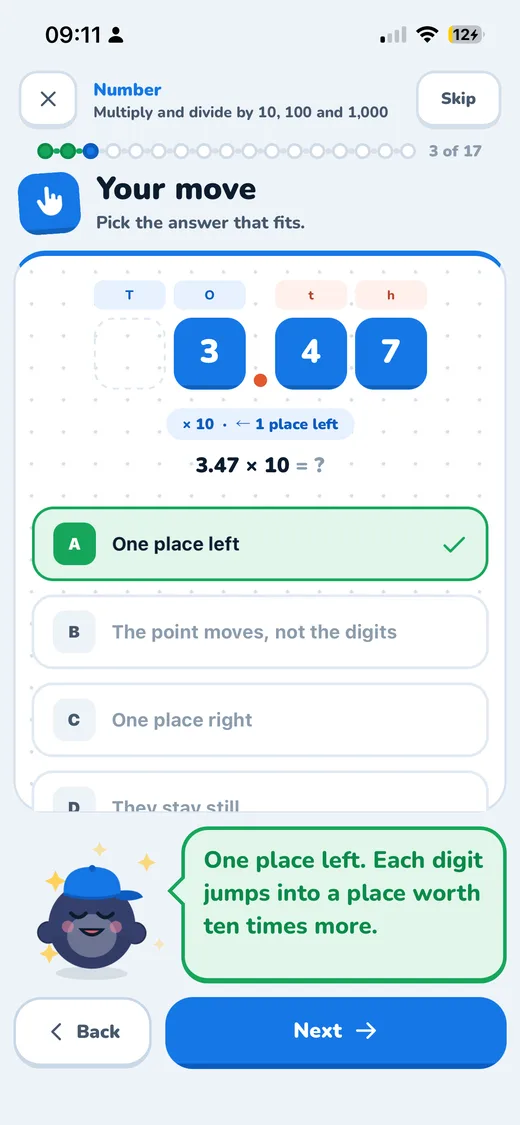
After marking this original written paper, use free Pip practice to work on the underlying English or Maths skill with fresh questions and feedback. For the closest official timed rehearsal, use CSSE's own familiarisation material.
The distinction matters: Pip's everyday skill questions do not replace the written answers, working and continuous writing required by the CSSE test.
 Everyday skill practice in Pip
The September 2026 test for 2027 entry has already taken place. CSSE says registration dates for 2028 entry will be published by Easter 2027.
For your child's intake, use the official CSSE examination page for the guide, registration window, test day and access-arrangements deadlines. Do not rely on last year's dates.
Checked against the CSSE website on 24 September 2026. Dates can change.
A practice paper is worth very little if it is simply sat and scored. It is worth a great deal if it is used to find out what a child does not yet know.
If your child is also sitting a test outside Essex, the format changes completely. These are the other free Pip papers.
The CSSE 11+ is the entrance test used by the ten schools in the Consortium of Selective Schools in Essex, across Colchester, Chelmsford and Southend. Unlike most areas, the consortium writes its own papers rather than buying them from GL Assessment or CEM.
Children sit two written papers: English, which allows 10 minutes reading time and then 60 minutes, and Mathematics, which lasts 60 minutes. Answers are written out by hand, not marked as multiple choice.
CSSE standardises English and Mathematics scores and weights the papers equally in the final result. Our PDF gives each paper 60 Pip practice marks, but this is not a statement of the live paper's raw marks or section split.
Check CSSE's latest familiarisation papers and guidance for official marking information.
There is no fixed pass mark. The CSSE states that no offer is made to any child scoring under a total standardised score of 303.
Above that, places are allocated by each school in order of score and its own admissions criteria, so the score that actually secures a place at a particular school changes every year and is only known after national offer day in March.
No. This is a major difference from tests like the Kent Test or the Buckinghamshire Secondary Transfer Test.
Children write answers in the booklet, explain comprehension in their own words, show working in Maths and do continuous writing. Our practice booklet includes two writing tasks; check official material for the live paper's exact tasks.
There is no separate verbal or non-verbal reasoning paper. CSSE removed Applied Reasoning from English in September 2024.
Our updated PDF contains no coded-word section.
CSSE says it will publish 2028-entry dates by Easter 2027. The September 2026 test for 2027 entry has passed.
Check CSSE's official examination page for the next guide, registration window and test day rather than using last year's dates.
Find genuine CSSE past papers and mark schemes on the official practice material page, and free current familiarisation material on the CSSE examination page. The listed 2021 to 2023 past papers predate the applied-reasoning change, so compare them with the latest material before treating them as current-format mocks.
No. This is an original Pip practice set with our own comprehension passage.
CSSE did not produce or endorse it. It covers written English and Maths without retired Applied Reasoning, but its specific questions and mark split are Pip's own practice design.
Use the latest official CSSE familiarisation papers for the closest exam rehearsal.
The full parent guide: the two written papers, why continuous writing matters so much, the 303 minimum and how to prepare.
Read the guideFree written comprehension and Maths practice for Essex, with retired applied-reasoning codes clearly identified if an older example appears.
Practise by subjectEvery free Pip paper in one place: English, maths, verbal and non-verbal reasoning, plus the Bucks and CSSE style papers.
See all printablesPip is not affiliated with, endorsed by or connected to the Consortium of Selective Schools in Essex. These practice papers are original material and contain no official questions.
The comprehension passage is our own writing. Genuine past papers and current familiarisation material are available from CSSE.