Skip to content
Part of Pip's adaptive learning

The Pip Score: how Pip knows a skill is really mastered.

Every skill in Pip has its own score from 0 to 100. It goes up and down with each answer, and it looks at more than right or wrong: how hard the question was, how your child has been doing lately and whether they get it right again and again.

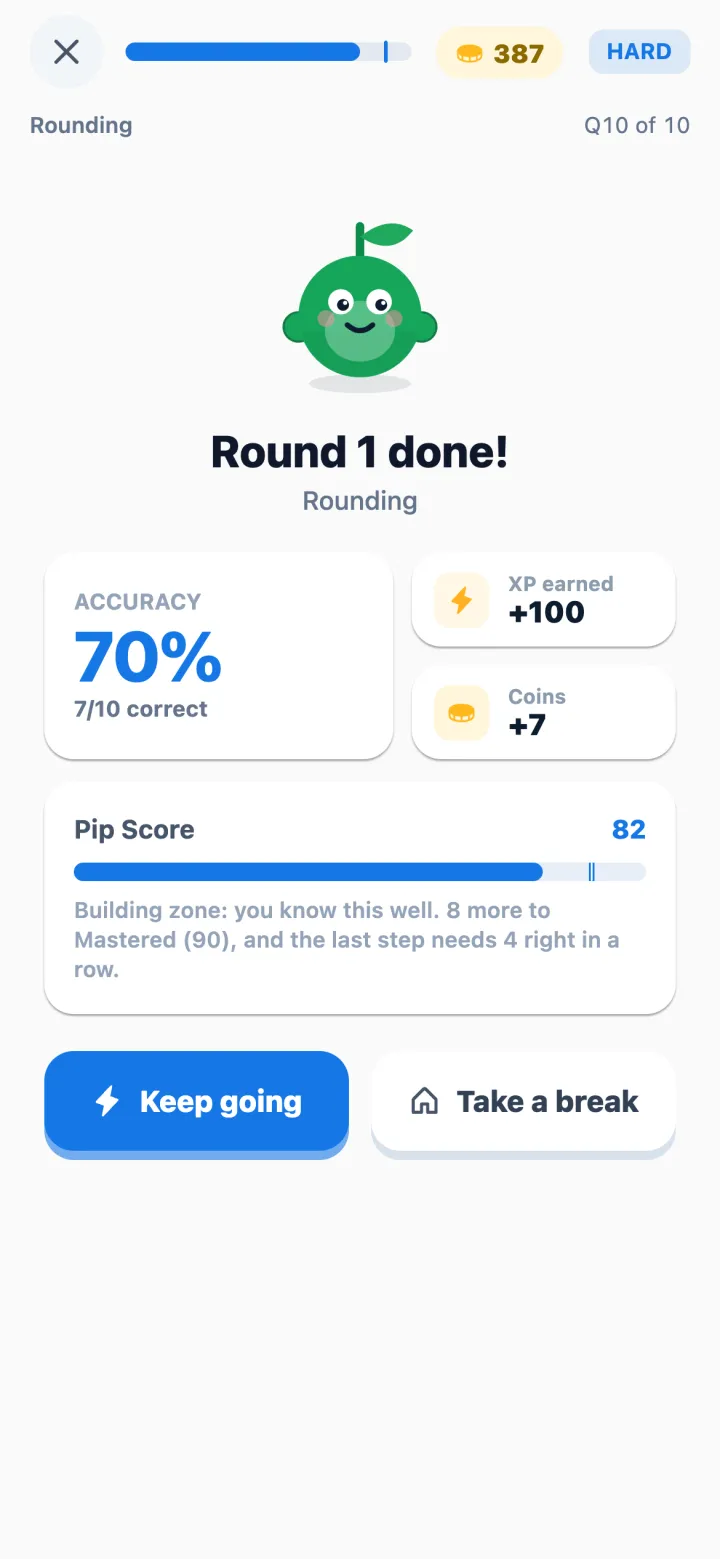
Pip app at the end of a round of Rounding: 7 out of 10 correct, Pip Score 82, with the line: Building zone, you know this well, 8 more to Mastered.
Actual Pip app screen · end of a round
In plain words

What is the Pip Score? A live picture of one skill.

The Pip Score is Pip's own mastery score. Your child does not get one score for "maths". They get a separate score for each skill, like fractions of amounts, hidden words or cube nets, so a strong skill never hides a weak one.

What moves it

Every answer counts, but not equally.

A right answer moves the score up and a wrong answer moves it down. How far depends on where the score already is, so the same mistake matters more once a skill is nearly mastered.

New skills are treated gently: the first few answers on a skill cost less if they are wrong, while Pip is still getting to know your child.

What it decides

The score sets the next question.

Pip uses each skill's score to choose how hard the next question is. As the score climbs, questions get harder and start to look like real exam questions. If it falls, questions ease off.

So the score is not just a number to look at. It is what keeps practice at the right level for your child.

Three zones

Quick to start. Hard to fake at the top.

The score behaves differently as it rises. Early on it rewards progress quickly. Near the top it asks your child to prove the skill is secure.

0 to 69

Learning zone

Getting going. The aim here is confidence.

  • Right answers move the score up in big steps.
  • Mistakes only take a little off.
  • Early questions teach by doing: typing, dragging and building.
70 to 89

Building zone

Harder questions and steadier progress.

  • Questions get more exam-like.
  • A score of 80 means your child knows the skill well.
  • Getting to 90 needs a run of right answers in a row.
90 to 100

Challenge zone

Mastered. Now it has to be kept.

  • Right answers add a little at a time.
  • A wrong answer takes off more.
  • 100 needs another run of right answers in a row.
80 knows it well90 mastered, with a celebration100 top score, earned with a run in a row
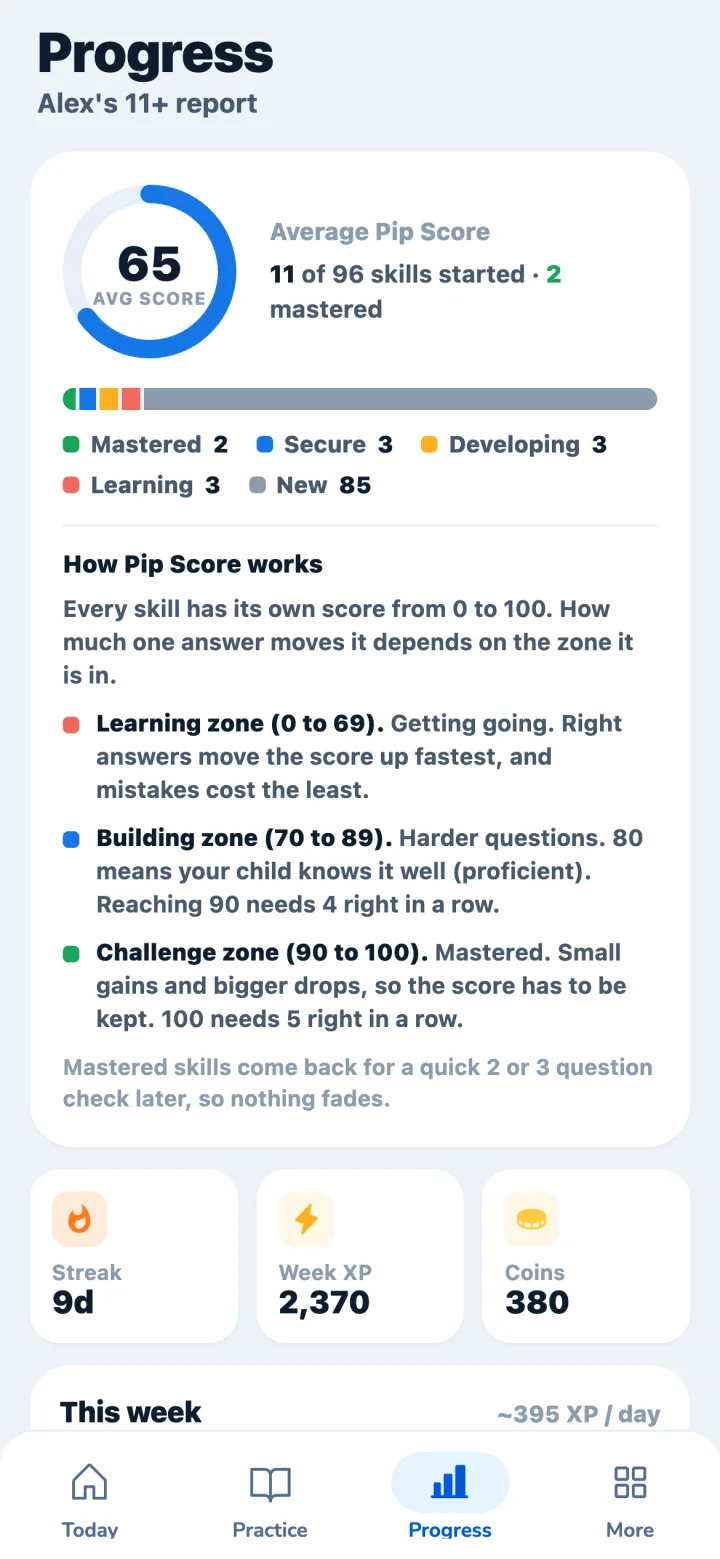
Pip Progress screen: an average Pip Score of 65, skills sorted into Mastered, Secure, Developing and Learning, and a How Pip Score works box explaining the Learning, Building and Challenge zones.
Actual Pip app screen · Progress
Beyond the number

What Pip does when the score tells a story.

A falling score can mean different things. Pip looks at how the answers went wrong before it decides what to do next.

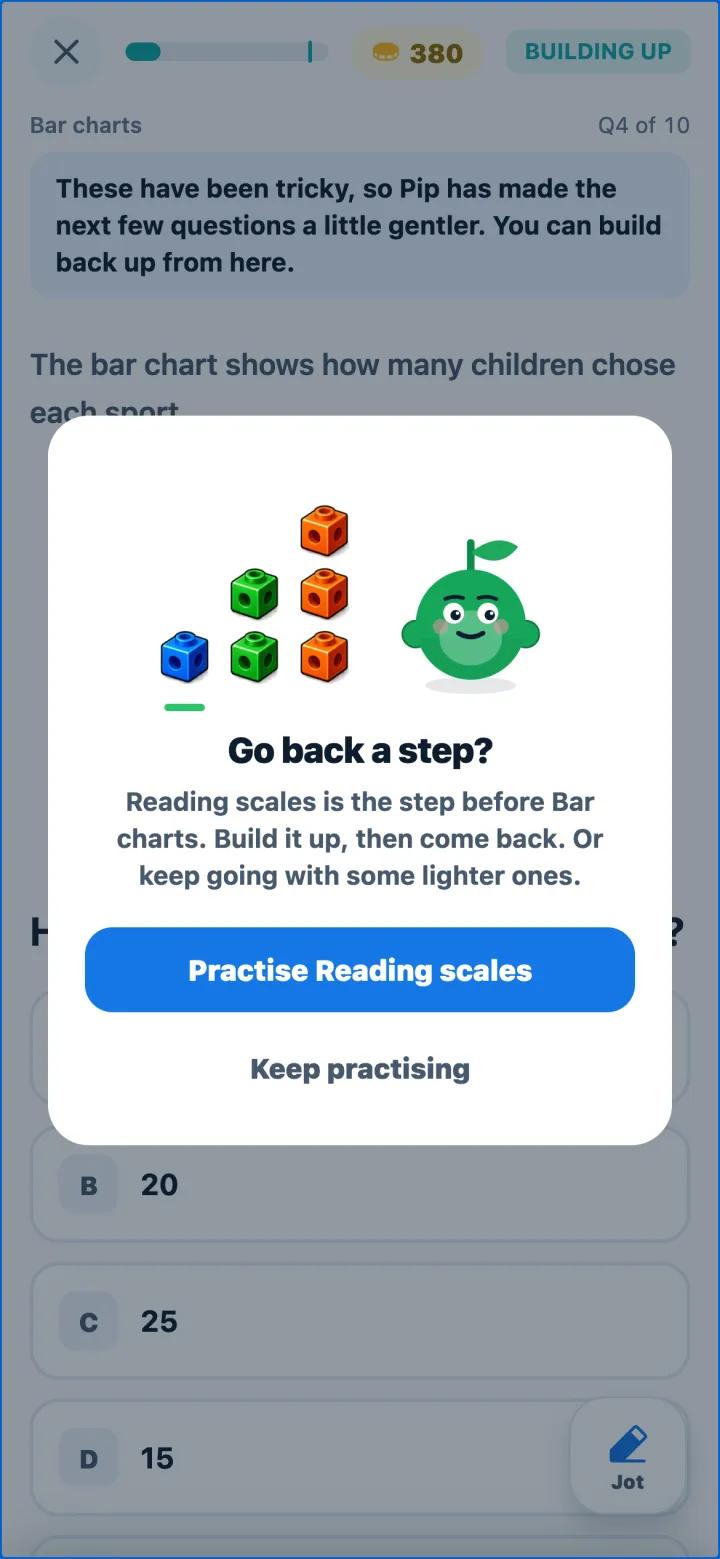
Stuck

Go back, not down.

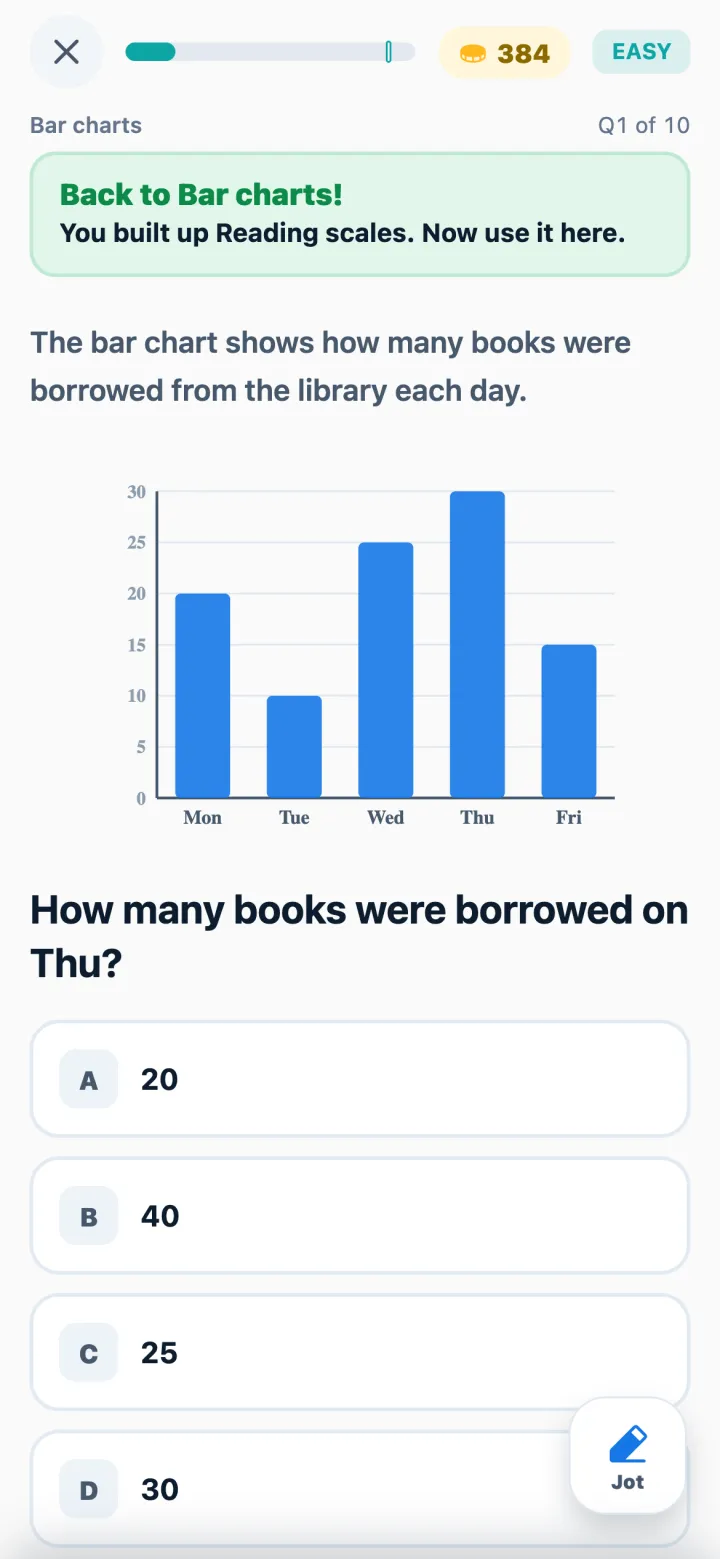
When your child gets several wrong in a row, Pip eases the next few questions and offers the building block underneath, such as equivalent fractions before adding fractions.

Once they have a solid run on the building block, Pip brings them back to the original skill. With Pip Pro, a short Pip Teaches lesson is offered too.

Rushing

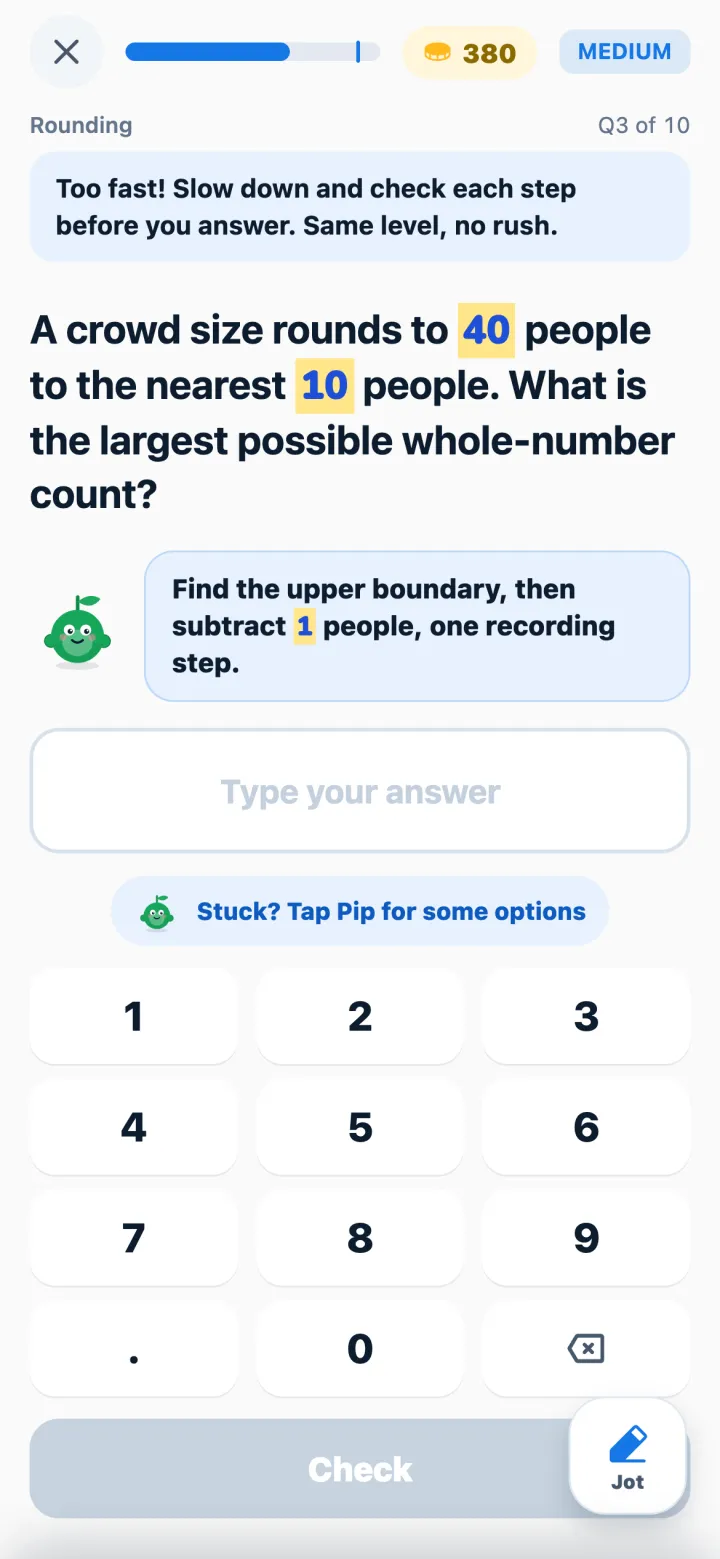
"Slow down and check."

A child who answers very fast and slips is not the same as a child who is stuck. When Pip sees quick, careless mistakes, it says slow down and check, and keeps the questions at the same level.

Children who take their time are never marked down for being careful.

Mastered

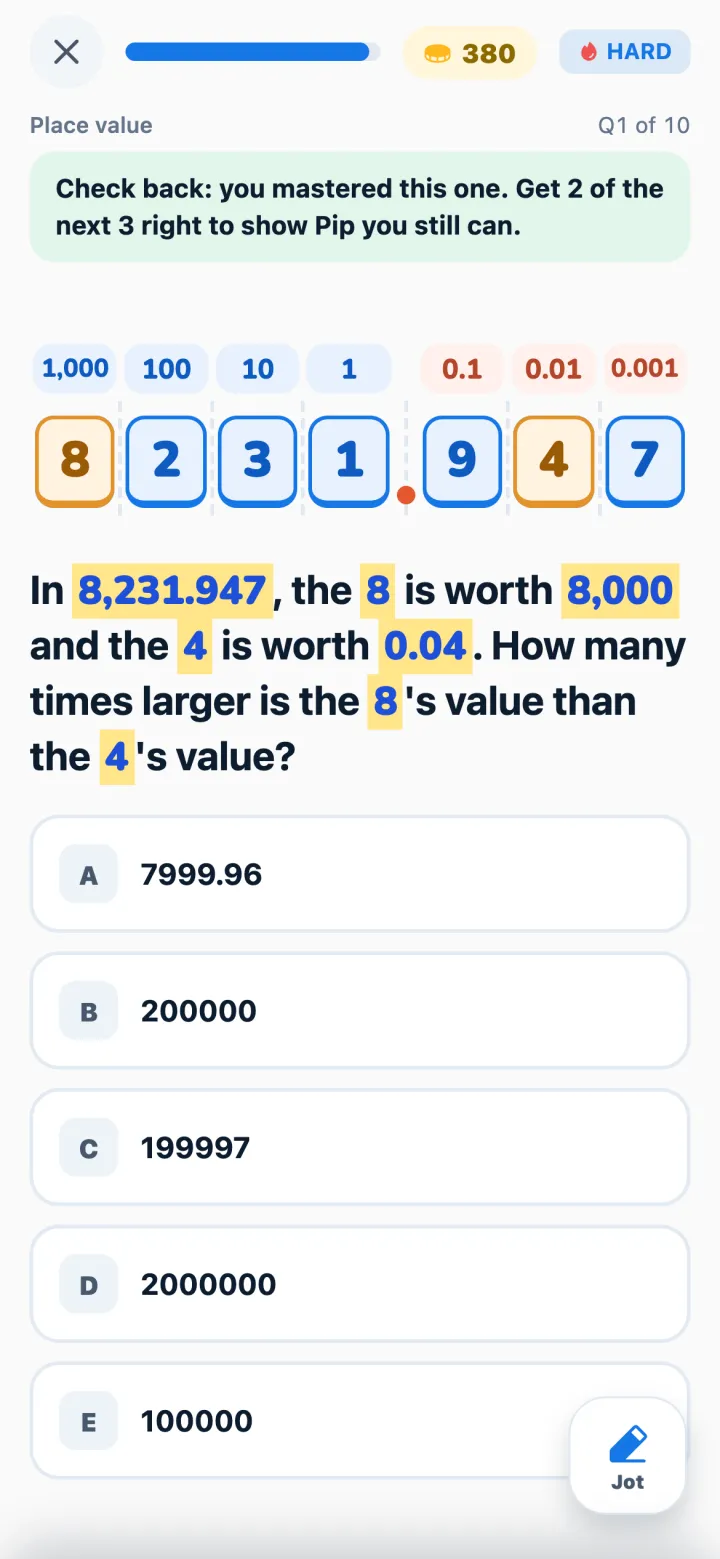
Mastered skills come back.

After a skill reaches 90, Pip brings it back for short review checks over the following days and weeks. Each passed check pushes the next one further away.

If a check is missed, the skill goes back into everyday practice until it is secure again. Review checks sit inside Today's 10, so they never crowd out new learning.

Pip Pro

Extreme mode, for more challenge.

Children who have mastered a skill and want more can try Extreme mode: harder questions above the normal top level, against the clock, for extra coins.

It is a stretch, not a test. Missing an Extreme question costs very little and cannot knock a skill out of mastered on its own.
Why a new score?

Why a percentage is not enough.

"8 out of 10" sounds good. But it does not say how hard those questions were, whether the two mistakes came at the end, or whether your child could do it again tomorrow.

A percentage

Counts right answers. Ten easy questions right looks the same as ten hard ones. One lucky streak can look like mastery, and a skill learned months ago still shows its old score.

The Pip Score

Weighs how hard each question was, leans on recent answers, and asks for a run of right answers before calling a skill mastered. Review checks make sure a mastered skill is still mastered weeks later.

For parents

What you see in progress and reports.

In the app's progress screens and in your parent reports, each skill shows its Pip Score, so you can see at a glance what is mastered (90 and above), what is building and what needs another look. You also see an average Pip Score across topics, which shows how the whole picture is moving.

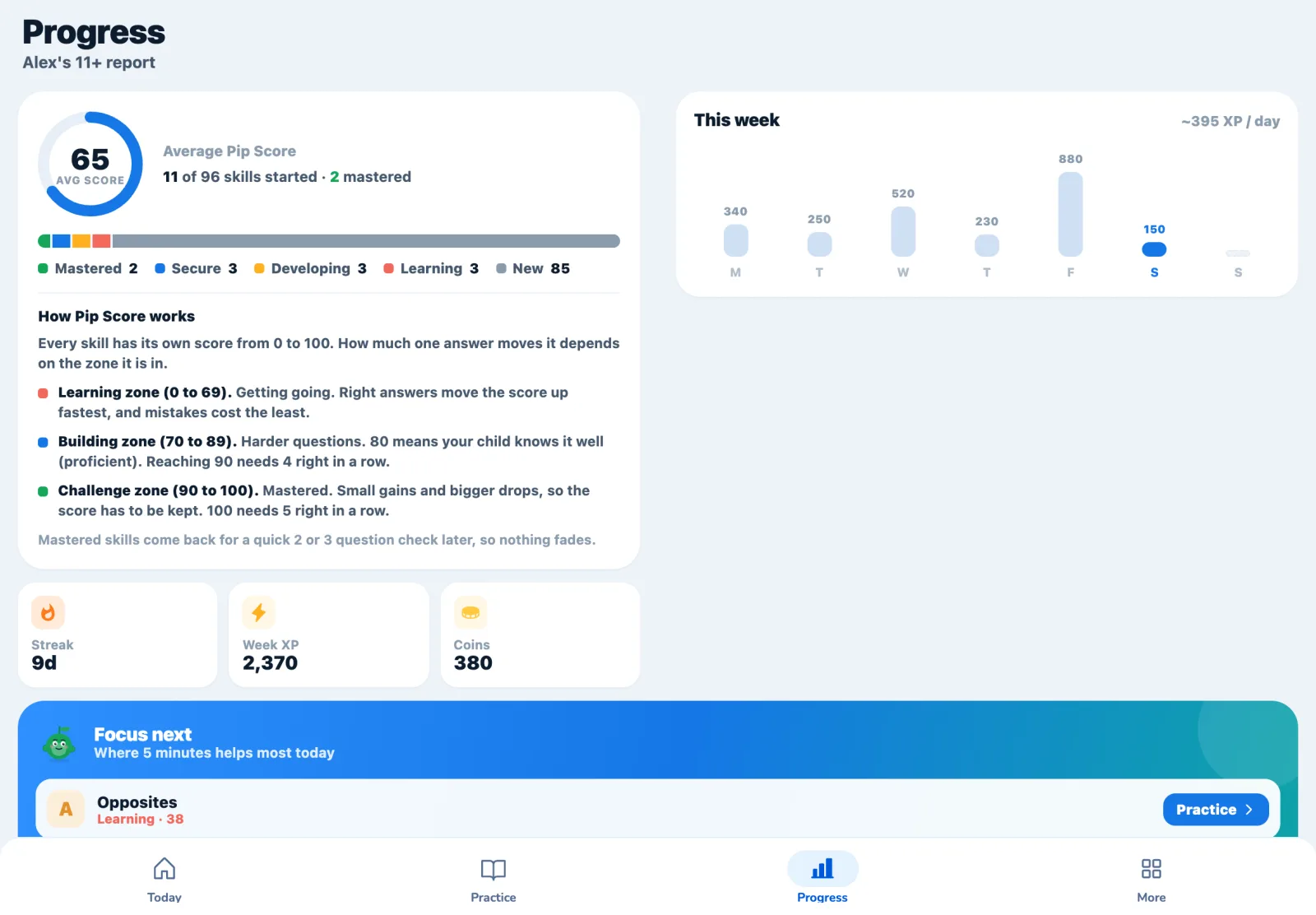
Pip Progress screen on an iPad in landscape: average Pip Score, skills by level, the How Pip Score works box, streak, coins and the skills to focus on next.
Actual Pip app screen · Progress on iPad

The Pip Score is an in-app practice measure, not an exam prediction. It tells you how secure each skill is in Pip's practice today, so you know what to work on next. It does not forecast an 11+ or SATs result.

Questions parents ask

Pip Score questions, answered.

What is the Pip Score?

The Pip Score is Pip's own mastery score. Every skill has a score from 0 to 100 that goes up and down with each answer. It weighs right and wrong answers, how hard the questions were, the child's recent answers and how consistent they are.

What Pip Score means my child has mastered a skill?

90. A score of 80 means your child knows the skill well. Reaching 90 needs a run of right answers in a row, so one lucky answer cannot tip a skill into mastered.

Why did my child's Pip Score drop after one mistake?

Near the top of the scale, in the Challenge zone from 90 to 100, gains are small and drops are bigger. A high score has to be earned and kept. Lower down, in the Learning zone, mistakes cost much less so children can build confidence.

Is the Pip Score a percentage?

No. A percentage only counts how many answers were right. The Pip Score also looks at question difficulty, recent answers and consistency, so it shows how secure a skill is now.

Does the Pip Score predict my child's 11+ or SATs result?

No. The Pip Score is an in-app practice measure, not an exam prediction. It shows how secure each skill is in Pip's practice so you and your child know what to work on next.

What happens when my child gets stuck?

Pip does not just push the level down. It goes back to the building block underneath, such as equivalent fractions before adding fractions. Once your child has a solid run on the building block, Pip brings them back to the original skill.

Do mastered skills ever come back?

Yes. Mastered skills come back for short review checks over the following days and weeks. A passed check pushes the next one further out. A missed check brings the skill back into everyday practice.

Keep exploring

The Pip Score is one part of the picture.

See how Pip uses it to choose the next question, the next skill and the right time to review.

Watch every skill climb.

Download Pip free and see your child's Pip Score grow, skill by skill, for 11+ or KS2 SATs. No in-app ads.

Download Pip on the App StoreGet Pip on Google PlayAvailable at Amazon Appstore
Free to download · Parent accounts optional · Years 3 to 6