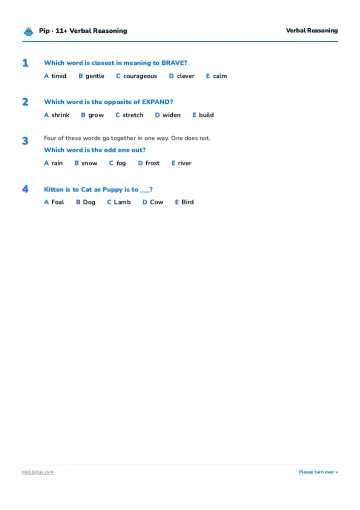
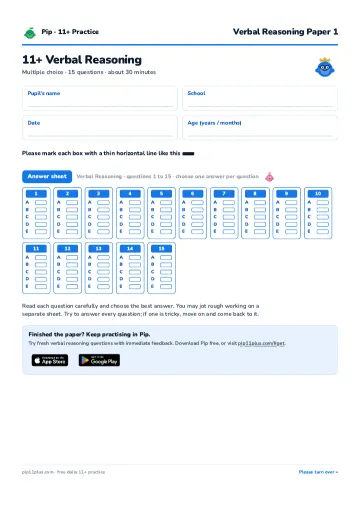
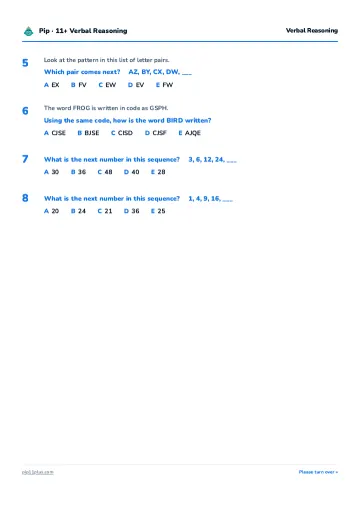
A complete, original 11+ Verbal Reasoning paper in the standard multiple-choice format: synonyms and antonyms, letter and number sequences, codes, analogies and word logic, with a printable answer sheet and a worked answer key. Free to download.
Thanks! Your download is on its way.
We'll only use your email to send this and, if you tick the box, our tips.
The short version. This is a free, original 11+ verbal reasoning practice paper with answers, as a printable PDF: 15 multiple choice questions, a printable answer sheet and a worked answer key that explains the rule behind every question.
It takes most children about 30 minutes. Exam boards rarely release real past papers, so practice written to the same question types is the realistic option, and the paper here is built around the families that recur: codes, analogies, hidden words, letter sequences, odd one out and word logic.
Fifteen questions across the core verbal reasoning skills, in the same multiple-choice format children meet on the day, marked on a separate answer sheet. Because real 11+ past papers are rarely released by the exam boards, these practice examples are written to match the question types those past questions use.
Synonyms, antonyms, odd-one-out and word analogies that test vocabulary and how words relate to one another.
Letter sequences, letter codes and hidden or compound words that reward careful, logical working.
Number series and letter-value puzzles where children spot the rule, then apply it to find the answer.
Verbal reasoning is built from a fixed set of question types rather than a syllabus, which is what makes it so coachable. For GL-based schools in particular there are around 21 verbal reasoning question types, and six families come up again and again: codes, analogies, hidden words, letter sequences, odd one out and word logic.
Here is one worked example of each, with the method rather than just the answer.
If CAT is written in code as DBU, how is DOG written in the same code?
Children often find the shift from the first letter alone and stop checking. Some codes move each letter by a different amount, such as one, then two, then three, so always confirm the rule on every letter of the example before applying it.
Writing the alphabet out along the top of the rough paper turns this from a memory task into a counting task, and counting is far more reliable under time pressure.
Kitten is to cat as puppy is to: bark, dog, kennel, bone, tail.
The wrong options are all connected to puppies in some way: they bark, they live in kennels, they chew bones, they have tails. Association is not the same as the relationship being tested.
If the sentence your child builds is vague, such as "goes with", the distractors all fit and the question becomes a guess. A precise sentence makes exactly one option work.
A four-letter word is hidden across the end of one word and the start of the next. Find it: You must arrive before dark.
The commonest error is finding a word that sits inside a single word, such as "must" or "dark" itself, which never counts. A hidden word must use letters from both sides of a space.
A useful drill is to cover everything except a four-letter window and slide it along the sentence one letter at a time, which is exactly what a child should do mentally in the exam.
What comes next in this sequence? AB, DE, GH, JK, ...
Trying to spot the pattern by looking at the letters as letters is slow and error prone, especially in the middle of the alphabet. Converting to numbers takes a few seconds and makes the jump obvious.
Watch for sequences where the two letters in a pair move in opposite directions; the numbering method handles those just as well, one column at a time.
Which is the odd one out? rose, tulip, daisy, oak, daffodil.
Children often pick the word they find most unusual rather than the one outside the pattern, and in a harder question the category can be about the letters rather than the meaning, for example four words that all contain a smaller word. Naming the shared property of the other four before answering keeps the reasoning honest, and it also gives you something to say when you mark the paper together.
Aisha is taller than Ben. Ben is taller than Chloe.
Chloe is taller than Dan. Who is the second tallest?
The information usually arrives in the wrong order on purpose, and the final question often asks for second or third rather than first, or flips to "shortest" at the last moment. Two habits fix nearly all of it: sketch the order on the rough paper instead of reasoning in your head, and re-read the actual question after you have the order.
Parents searching for 11+ verbal reasoning past papers usually come away disappointed, and it is worth knowing why before you spend an evening looking. Exam boards very rarely release real papers.
The same question banks are reused across years and regions, so publishing a paper would undermine the test itself. Some schools and local authorities publish a short familiarisation booklet showing the layout and a handful of sample questions, which is genuinely useful for the format, but it is not a full paper and it is not a mock.
That leaves original practice written to the same question types as the practical option, and it is what everything on this site is. We do not have official past papers and would not claim to.
What we can do is match the format your child will meet: the multiple choice layout, the separate answer sheet, the mix of word, letter and logic questions, and the pace. If you see a site advertising real 11+ verbal reasoning past papers as free PDFs, it is worth asking where they came from.
If you want the practice to look like a specific exam rather than verbal reasoning in general, our format-specific papers are the closest match: the free GL Assessment style practice paper, the Kent Test practice paper, the Sutton SET paper and the Buckinghamshire Secondary Transfer Test paper all include reasoning in the shape those tests use.
Search results are full of "30 minute" verbal reasoning papers, and the number is a reasonable working target rather than an official standard.
Fifteen questions in around half an hour is a comfortable, realistic pace for practice at home, and it is short enough to fit into a weekday evening without the whole thing becoming a battle.
Actual verbal reasoning timings are set by the test and the region, and some tests fold reasoning into a longer mixed paper rather than timing it separately. Check the format your child is sitting on our 11+ exam types guide, and confirm the detail with the school or local authority.
Run the paper untimed the first time so your child meets each question type without pressure, then repeat the timing on the next paper. Speed in verbal reasoning comes from recognising the type instantly, not from reading faster.
Verbal reasoning is not on the national curriculum, so nearly all of it is learned deliberately. Two things move the needle: vocabulary, and knowing the question types by name.
Synonyms, antonyms, analogies and odd one out all rest on knowing what words mean. Reading widely is the main engine, and our free Year 6 vocabulary list gives a structured word bank to work through alongside it.
Have your child say which family a question belongs to before touching it: code, analogy, hidden word, sequence, odd one out or word logic. Naming the type recalls the method, and the method is where the speed comes from.
When you mark the paper, ask your child to explain the rule behind each answer, including the ones they got right. A right answer reached by guessing is a mark today and a lost mark in the exam.
We publish fresh 11+ English, Maths and Reasoning papers regularly. Pop your email in and we will send the next ones the moment they are ready.
Verbal Reasoning tests how well a child works with words and logic: spotting how words relate, breaking codes, completing sequences and reasoning through puzzles under time pressure. Most grammar and independent schools set it in the multiple-choice format from GL Assessment or a CEM-style provider, where children mark their answers on a separate sheet.
This free paper follows that format exactly, so the practice feels like the real thing.
The single biggest lever in Verbal Reasoning is vocabulary, because synonym, antonym and analogy questions all rest on knowing what words mean. The next is method: most question types have a reliable approach, and once a child can name the type and recall the steps, accuracy and speed climb together.
Our guide on how to prepare for Verbal Reasoning walks through each type, and our free Year 6 vocabulary list builds the word bank these questions draw on.
Papers are brilliant for rehearsing exam day, but they run out fast. For everyday practice, the free Pip 11+ Verbal Reasoning app generates unlimited fresh questions that mark themselves, so a finished paper is never the end of the practice.
You can also browse all our free 11+ printables, try our free letter and number codes game, or explore the full 11+ Info Hub for guidance on scoring, timing and exam day.
Yes. You can download the paper as a PDF for free, with a full answer key included.
Yes. Every paper has a worked answer key that explains the rule behind each question, so your child learns the method, not just the answer.
The paper uses the standard multiple-choice format common to both GL Assessment and CEM-style 11+ exams: word meaning, letter and number sequences, codes and analogies, marked on a separate answer sheet.
About 30 minutes for the 15 questions. You can run it untimed first to build confidence, then timed once your child is comfortable with the question types.
Real exam timings are set by the test and the region, so confirm those with the school or local authority.
Very few. Exam boards reuse their question banks and so rarely release complete past papers.
Some schools and local authorities publish a short familiarisation booklet with a few sample questions, which is useful for seeing the layout. Everything on this page is original practice written to the same question types, not an official past paper.
For GL-based schools there are around 21 verbal reasoning question types. Six families recur most: codes, analogies, hidden words, letter sequences, odd one out and word logic.
The worked examples above show the method for each, and our guide on how to prepare for verbal reasoning goes through them in more detail. Our guide to what verbal reasoning is lets your child try a live example of all 21 types.
Yes. The PDF contains a printable multiple choice answer sheet for your child to fill in, and a separate worked answer key for marking, which explains the rule behind each question rather than just giving the letter.
It is written for children preparing for the 11+, so typically Year 5 and Year 6. Year 4 children can use it untimed as an introduction to the question types, since verbal reasoning is not taught in school and the earliest work is simply meeting each type for the first time.
Papers run out quickly. Build vocabulary through reading and our free Year 6 vocabulary list, drill the code questions with our free letter and number codes game, and use the free Pip verbal reasoning practice for unlimited fresh questions that mark themselves.
Our free 11+ printables hub has the whole library, including maths papers, English papers, non-verbal reasoning papers and papers written to specific exam formats. Every one is free, printable and comes with worked answers.
Pip gives your child fresh 11+ Verbal Reasoning questions every day, free, with instant feedback and adaptive difficulty.
Get Pip free 🚀