Verbal reasoning is a big part of most 11+ tests, yet most schools never teach it. This guide explains what it is, why grammar schools use it and which skills it tests, then lets you try a live example of every question type with your child.
- Verbal reasoning is problem solving with words: spotting patterns and rules in words, letters and numbers.
- It is one of the four main 11+ subjects, alongside English, maths and non-verbal reasoning.
- GL Assessment lists 21 question types, which fall into five families. You can try one of each below.
- It rewards a wide vocabulary and knowing the alphabet inside out, and it can be learned.
What is verbal reasoning?
Verbal reasoning is the ability to understand words and use them to solve puzzles. A question might ask your child to find a word hidden inside a sentence, crack a letter code, or spot the rule in a series of letters.
It does not test what your child has been taught. It tests how well they can think with language they already know, which is why grammar schools use it to look at potential.
Why schools test it
Verbal reasoning predicts how easily a child will cope with a fast academic curriculum. Children who reason well with words tend to read faster, write more precisely and pick up new subjects more quickly.
It also helps schools compare children from different primary schools. Because most schools do not teach it, it is meant to be a fairer test of thinking than a test of facts.
Try every question type
Here is one live example from each of the main verbal reasoning question types. Tap an answer to check it, or tap Show the method to see the fastest way to solve it.
Want more of one type? Our free verbal reasoning questions give a full set with answers, and the number codes guide goes deeper on codes.
Five minutes of verbal reasoning a day
Pip gives your child fresh verbal reasoning questions every day, pitched to their level and getting harder as they improve. Every wrong answer comes with a short method, just like the examples above.



The skills behind it
Every question type above leans on a handful of everyday skills. If you build these, the question types become much easier.
| Skill | Where it shows up | Easy way to build it |
|---|---|---|
| Vocabulary | Synonyms, antonyms, analogies, odd ones out | Reading widely and talking about new words |
| Spelling | Hidden words, missing letters, compound words | Word games like Scrabble and Boggle |
| Alphabet fluency | Letter series, codes, alphabet positions | Knowing each letter's number (A is 1, M is 13, Z is 26) |
| Mental maths | Number series, letter sums, connections | Times tables and quick doubling and halving |
| Careful reading | Logic questions and every instruction | Underlining the key words in each question |
Which exams include verbal reasoning?
Most 11+ tests include it in some form, but they present it differently. Always check the test used by each school you apply to.
| Test | How verbal reasoning appears |
|---|---|
| GL Assessment 11+ | Its own paper, using the 21 classic question types |
| CEM style tests | Mixed in with English as vocabulary, cloze and comprehension |
| ISEB Common Pre-Test | An on-screen section that adapts to your child's answers |
| CAT4 | A verbal battery of word classes and analogies |
| FSCE | No separate verbal reasoning paper |
For more on the boards, read the difference between GL and CEM and our guide to every 11+ exam type.
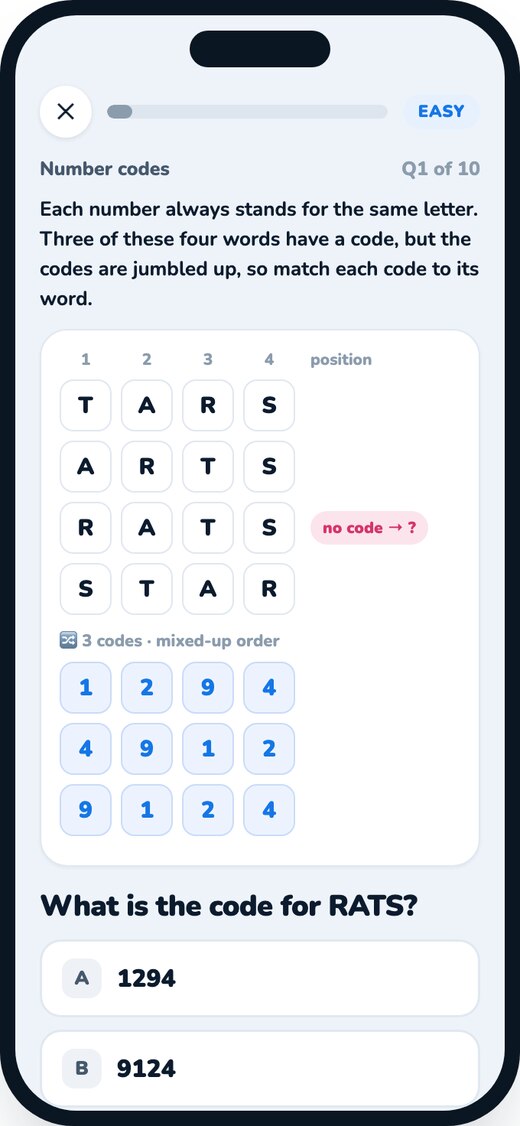
Codes, hidden words and more, in the app
This is a real verbal reasoning code question in Pip. Your child taps an answer, gets a method if they slip, and earns rewards for a correct streak.
Verbal reasoning vs non-verbal reasoning
Verbal reasoning solves puzzles made of words, letters and numbers. Non-verbal reasoning solves puzzles made of shapes and pictures, so it relies far less on vocabulary.
Many tests include both, because together they show how a child thinks in words and in pictures.
When should children start?
Most families start gentle verbal reasoning practice in Year 4 or early Year 5, with the 11+ sat in September of Year 6. Starting early matters less than practising little and often.
Ten minutes a few times a week, plus plenty of reading, beats long weekend sessions. For a full plan, read how to prepare for verbal reasoning.
Frequently asked questions
What is verbal reasoning in simple terms?+
Verbal reasoning is solving puzzles using words. Children find patterns and rules in words, letters and numbers, such as cracking a letter code or finding a word hidden in a sentence.
How many types of verbal reasoning questions are there?+
GL Assessment uses 21 standard question types. They fall into five families: word meanings, making words, letter patterns, number patterns and logic.
Is verbal reasoning taught in school?+
Not usually. The National Curriculum does not include verbal reasoning, so most children meet the question types for the first time at home or with a tutor.
Can you improve at verbal reasoning?+
Yes: learning each question type, building vocabulary and knowing the alphabet well all lead to steady gains. Short, regular practice works best.
What is the difference between verbal and non-verbal reasoning?+
Verbal reasoning uses words, letters and numbers. Non-verbal reasoning uses shapes, patterns and pictures, so it depends much less on vocabulary.
At what age do children sit verbal reasoning tests?+
Most children sit the 11+ in September of Year 6, aged 10 or 11. Families usually begin light practice in Year 4 or Year 5.

The Pip team builds Pip, the 11+ and KS2 practice app for children in years three to six. We write these guides from real exam formats and past papers.