Non-verbal reasoning puzzles can look baffling the first time you see one. This guide explains what NVR is, which exams use it and what it really tests, then lets you watch the key moves animated and try a live example of every question type.
- Non-verbal reasoning (NVR) is problem solving with shapes and pictures, with no reading needed.
- Children spot patterns, rules and changes in diagrams, then pick the answer that follows the rule.
- It appears in the GL 11+, CEM style tests, the ISEB Common Pre-Test and CAT4.
- The question types fall into three families. You can watch each move and try a live example below.
What is non-verbal reasoning?
Non-verbal reasoning is the ability to solve problems using pictures instead of words. Your child looks at shapes and diagrams, works out the rule linking them, and uses it to find the missing piece.
Because it needs so little reading, it shows how a child thinks without relying on vocabulary. That makes it useful for spotting bright children who are still building their English.
See the four big moves
Most NVR questions are built from four moves. Watch each one, because seeing it move is the fastest way to picture it in a test.
Try every question type
Here is one live example of each main NVR question type. Tap a picture to check your answer, or tap Show the method to see how to solve it.
For a bigger bank, see our non-verbal reasoning questions and the spatial reasoning guide for 3D work.
Shapes, nets and patterns, every day
Pip has animated non-verbal reasoning practice that adapts to your child. It shows the method on every slip, so tricky types like nets and rotations become familiar.



What NVR really tests
| Skill | Question types | How to build it |
|---|---|---|
| Spotting what changes | Series, analogies, matrices | Check one feature at a time: shape, size, colour, number, position |
| Spotting what stays the same | Odd one out, similarities, codes | Count sides, dots and lines on every shape |
| Picturing movement | Rotations, reflections | Use a mirror or tracing paper to check answers |
| Thinking in 3D | Cubes and nets, folding, views | Build cubes from cut-out nets and LEGO models |
Which exams include non-verbal reasoning?
| Test | How NVR appears |
|---|---|
| GL Assessment 11+ | A separate paper in many areas, usually multiple choice |
| CEM style tests | Short timed sections mixed with other subjects |
| ISEB Common Pre-Test | An on-screen section that adapts to your child |
| CAT4 | Figure classification, matrices and analogies, plus a spatial battery |
| FSCE | No separate NVR paper |
Not every area includes NVR, so check each school's test. Our guide to every 11+ exam type covers the main boards.
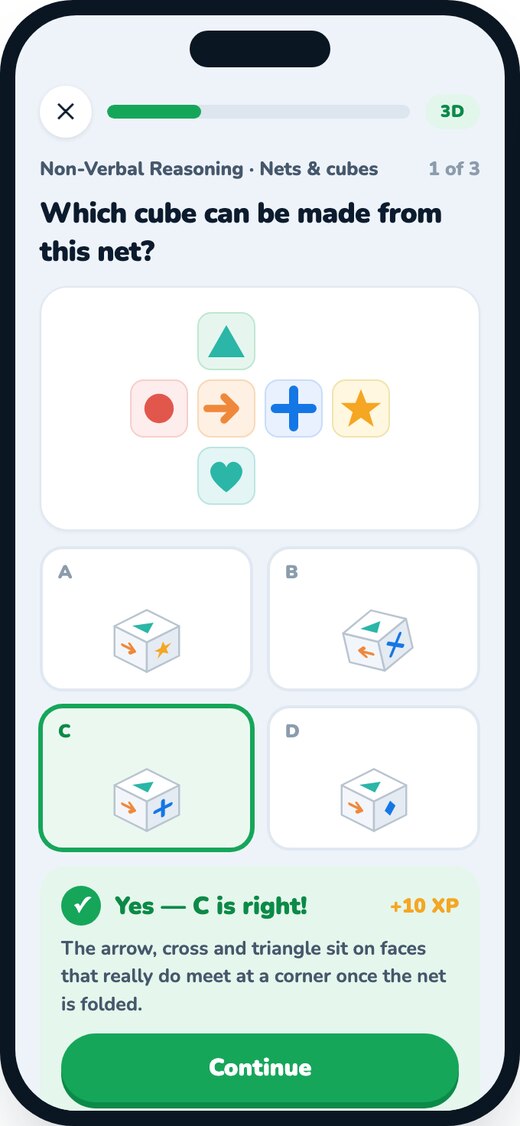
Nets and cubes that actually fold
Pip shows cubes and nets in 3D, so your child can see a net fold instead of guessing. Every slip comes with a short method.
Non-verbal vs verbal reasoning
Non-verbal reasoning uses shapes and pictures. Verbal reasoning uses words, letters and numbers, so it leans much more on vocabulary.
Many children find one much easier than the other. Practising both gives a fuller picture of how your child thinks.
When should children start?
Most families begin light NVR practice in Year 4 or early Year 5. Puzzles, LEGO, tangrams and drawing all build the same skills before any formal practice.
For a full plan, read how to prepare for non-verbal reasoning, and try our free NVR papers when ready.
Frequently asked questions
What is non-verbal reasoning in simple terms?+
Non-verbal reasoning is solving puzzles with shapes and pictures instead of words. Children find the rule that links a set of diagrams and use it to pick the missing one.
What are the main types of non-verbal reasoning questions?+
The main types are series, odd one out, analogies, matrices, codes, similarities, rotations, reflections, hidden shapes, cubes and nets, paper folding and 3D views. They fall into three families: patterns, shapes that move, and 3D and folding.
Is non-verbal reasoning an IQ test?+
Not exactly. It measures problem solving with shapes, and it can improve with practice once children know the question types.
Can you improve at non-verbal reasoning?+
Yes: learning each question type and checking one feature at a time leads to quick gains. Hands-on play with nets, mirrors and building blocks helps with the harder spatial types.
Which 11+ tests include non-verbal reasoning?+
GL Assessment papers in many areas, CEM style tests, the ISEB Common Pre-Test and CAT4 all include it. FSCE does not have a separate NVR paper.
What is the difference between non-verbal and spatial reasoning?+
Spatial reasoning is one part of non-verbal reasoning. It covers the 3D types, such as nets, folding and rotating solid shapes.

The Pip team builds Pip, the 11+ and KS2 practice app for children in years three to six. We write these guides from real exam formats and past papers.