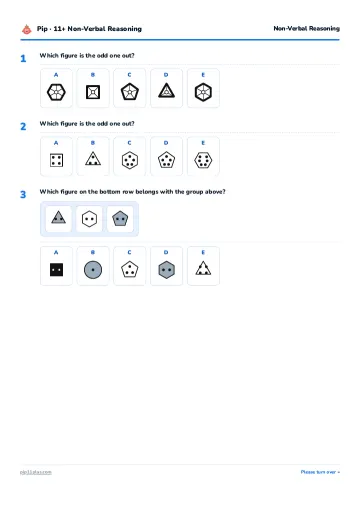
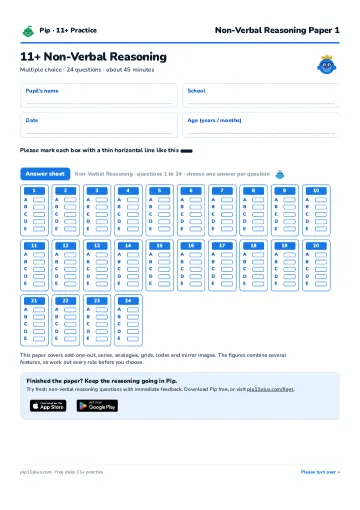
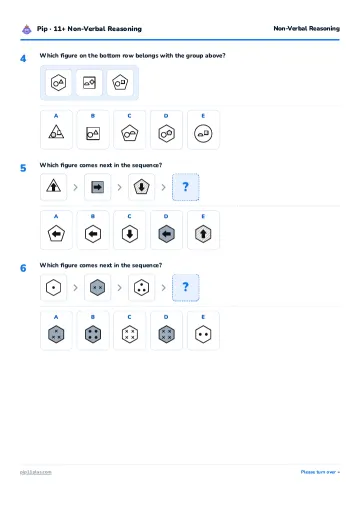
A complete, original 11+ Non-Verbal Reasoning paper in the standard multiple-choice format: odd-one-out, series, figure analogies, 3x3 grids, GL-style codes and mirror images, with a printable answer sheet and a worked answer key. Built to real exam difficulty, not simplified.
Free to download.
Thanks! Your download is on its way.
We'll only use your email to send this and, if you tick the box, our tips.
Twenty-four questions across the full range of non-verbal reasoning types, from odd-one-out and similarities to series, analogies, rotations, reflections and codes, in the same multiple-choice format children meet on the day, marked on a separate answer sheet. Figures use the shading conventions real papers rely on, including hatched fills and arrows, so nothing on the day looks unfamiliar.
Official past papers are seldom published, so these are original questions written to the same patterns. Each figure combines several features at once, so the puzzles match real exam difficulty.
If your child's test also covers the 3D types, our 11+ spatial reasoning guide walks through spatial reasoning cube nets, block counting and fold and punch paper folding separately. For focused practice before a mixed paper, try the 11+ cube nets practice worksheet PDF.
Odd-one-out and most-like questions where the figures share a hidden rule, such as the number of dots matching the number of sides. The surface details are varied so a single glance will not give it away.
Which figure comes next, figure analogies, and full 3x3 matrices where the shape, shading, spokes, dots and direction change together and the answer must satisfy every rule at once.
The classic GL code questions, where each letter stands for a feature you have to crack, plus reflection and rotation questions that test how a shape moves and flips.
The worked key explains the rule in each puzzle. If series, codes or rotations caused the missed marks, open that skill in Pip for fresh Non-Verbal Reasoning practice and immediate feedback instead of memorising a printed answer.
Free to start: repeatable NVR practice. Pip Pro: interactive lessons, timed mocks and additional stretch questions.
 Current NVR practice screen
We publish fresh 11+ English, Maths and Reasoning papers regularly. Pop your email in and we will send the next ones the moment they are ready.
Non-Verbal Reasoning tests how well a child spots patterns in shapes and figures, with no words involved. It rewards careful observation and logical thinking: working out what links a set of figures, how a pattern changes step by step, or what is missing from a grid.
Most grammar and independent schools set it in the multiple-choice format from GL Assessment or a CEM-style provider, where children mark their answers on a separate sheet. This free paper follows that format exactly.
For practice across subjects, try our free GL-style English, Maths and Verbal Reasoning papers, which complement this separate Non-Verbal Reasoning paper. These are original Pip resources, not official GL Assessment papers.
We built this paper to be genuinely exam-level rather than a gentle warm-up. Every figure merges several features at once, the shape, the shading, a pointer and the number of marks, and most questions change two or three of them together.
The wrong answers are written so each one gets all but one feature right, so your child cannot solve a question at a glance. That is exactly how real 11+ Non-Verbal Reasoning is designed, and practising at the right level is what builds genuine confidence.
Our guide on how to prepare for Non-Verbal Reasoning walks through each question type and the method behind it, and our 11+ spatial reasoning guide covers the 3D side, nets, rotations, plans and fold-and-punch, with worked examples. If the subject is brand new, start with what non-verbal reasoning is, where every type is animated.
Papers are brilliant for rehearsing exam day, but they run out fast. For everyday practice, the free Pip 11+ Non-Verbal Reasoning app generates unlimited fresh questions that mark themselves, so a finished paper is never the end of the practice.
You can also browse all our free 11+ printables, download our free Verbal Reasoning paper, or explore the full 11+ Info Hub for guidance on scoring, timing and exam day.
Yes. You can download the paper as a PDF for free, with a full answer key included.
Yes. Every paper has a worked answer key that explains the rule behind each shape puzzle, so your child learns the method, not just the letter.
The paper uses the standard multiple-choice format common to both GL Assessment and CEM-style 11+ exams: odd-one-out, sequences, analogies and matrices, marked on a separate answer sheet.
Yes, that is the point. Each figure combines several features and most questions change two or three at once, with wrong answers that each get all but one feature right.
Use the answers to spot which question types need another worked example. One raw mark on an original practice paper is not an official pass threshold.
Pip gives your child fresh 11+ Non-Verbal Reasoning questions every day, free, with instant feedback and adaptive difficulty.
Get Pip free 🚀