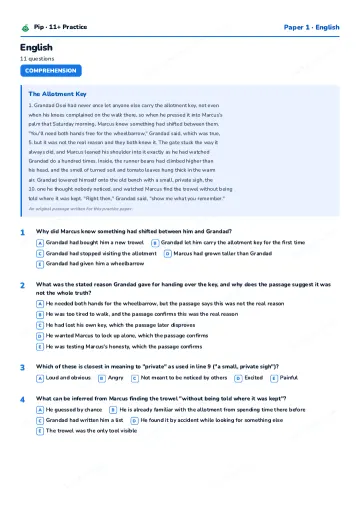
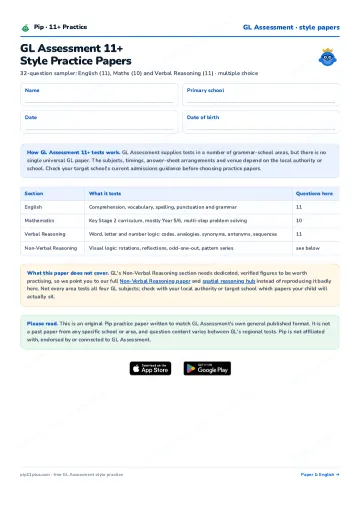
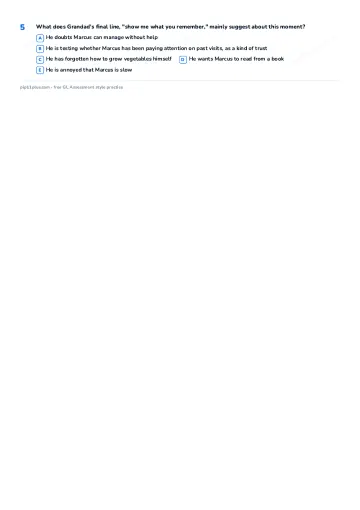
A free 32-question GL-style sample across English, Maths and Verbal Reasoning, with worked answers. It introduces published question types, not a full-length timed paper.
Non-Verbal Reasoning is in our separate free paper; the subject mix varies by area.
Thanks! Your download is on its way.
We'll only use your email to send this and, if you tick the box, our tips.
Mark the sample, then practise the English, Maths or Verbal Reasoning skill your child hesitated on. Pip gives them fresh questions, immediate feedback and a level that adapts as they go.
If your local GL test includes Non-Verbal Reasoning, that is in Pip too.
Adaptive skill practice is free. Pip Pro adds interactive Pip Teaches lessons and timed mock papers.
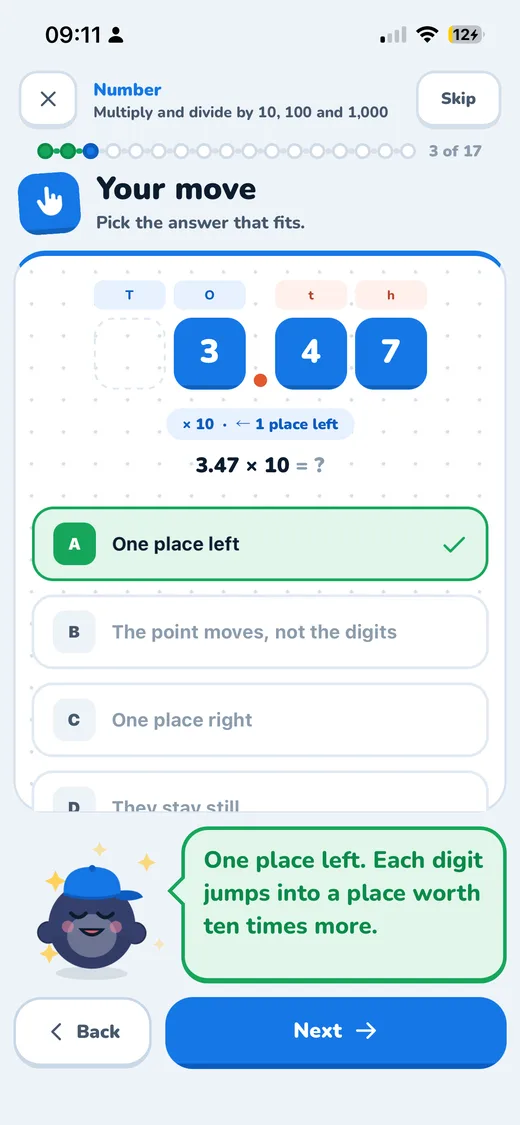 Real Pip app screen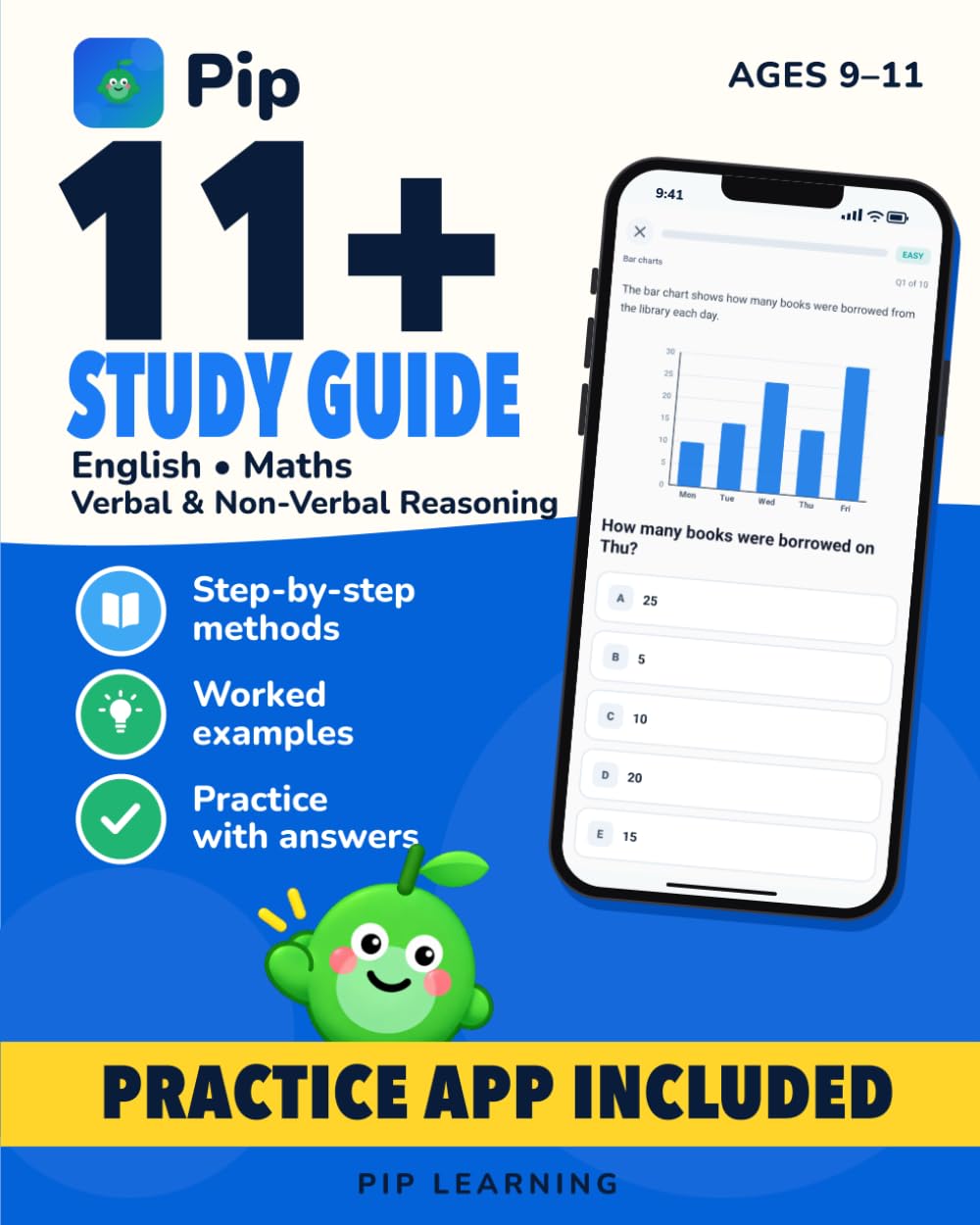
The Pip 11+ Study Guide covers English, Maths and both reasoning subjects.
GL Assessment is the most widely used 11+ provider in England, setting the papers behind most grammar school entrance tests, including several that run under a local name.
| Section | What it tests |
|---|---|
| English | Comprehension, vocabulary, spelling, punctuation and grammar |
| Mathematics | Key Stage 2 curriculum, mostly Year 5 and 6, with problem solving |
| Verbal Reasoning | Word, letter and number logic |
| Non-Verbal Reasoning | Visual logic: rotations, reflections, patterns |
Subject descriptions are drawn from our GL Assessment guide. The paper format, timings, answer-sheet arrangements, date and venue vary by area and school.
Check your target school's current admissions information.
These are the broad skills commonly assessed in GL-based 11+ tests. The exact questions and subject mix depend on the area or school.
Because children mark answers on a separate answer sheet in most areas, practising with a real answer sheet matters as much as knowing the content. This paper includes one.
A short sample across English, Maths and Verbal Reasoning, using published GL-style question types, with full mark schemes. Eleven pages; not a full timed paper.
An original passage with questions covering retrieval, inference and vocabulary in context.
Six questions on correct usage, punctuation and spelling, in the style GL tests them.
Ten questions across number, fractions, percentages, measurement, geometry, statistics and multi-step problems.
Eleven questions covering letter and number sequences, synonyms, antonyms and analogies.
A clean printable answer sheet, matching how GL papers are actually marked.
Every answer explained. Every maths and sequence answer is computed and checked in code, never typed by hand.
GL's Non-Verbal Reasoning section needs carefully built, verified figures to be worth practising, so rather than reproduce it badly here, we point you to the real thing:
| Skill | Where to practise it |
|---|---|
| Non-verbal reasoning | Free 24-question Non-Verbal Reasoning paper |
| Spatial reasoning | Spatial reasoning practice hub |
Not every area tests all four GL subjects. Check with your local authority or target school which papers your child will actually sit before building a revision plan around this paper.
GL Assessment is the most widely used 11+ test provider in England, setting exams for grammar school areas including Kent, Buckinghamshire, Birmingham, Warwickshire, Trafford and parts of Lincolnshire and Essex. It is a paper-based test, mostly multiple-choice, marked with a separate answer sheet.
Four possible subjects: English (reading comprehension, vocabulary, spelling, punctuation and grammar), Maths (Key Stage 2 curriculum, mostly Year 5 and 6, with multi-step problem solving), Verbal Reasoning (word, letter and number logic) and Non-Verbal Reasoning (visual logic). Each area or school chooses its own mix, and not every area tests all four.
GL is the default in most grammar areas that do not use a Cambridge or FSCE test. That includes much of Kent, Buckinghamshire, Birmingham, Warwickshire and parts of Lincolnshire and Essex, along with many individual grammar schools and consortia such as Trafford.
Each subject is typically a separate paper of around 45 to 60 minutes, sat on paper. In most areas children mark answers on a separate answer sheet, which is why practising with a real answer sheet matters as much as knowing the content.
Usually in September of Year 6, at the child's own primary school or at the grammar school. Exact dates are set by the local authority or school, so confirm on their admissions pages.
Regional tests like the Kent Test and the Buckinghamshire Transfer Test use GL content under a local name, with their own subject mix and timings. Our regional sample PDFs introduce some published local question types; none is a full-length replica.
This generic GL sample is useful for getting familiar with English, Maths and Verbal Reasoning, but check your target area's current test format.
No. Non-Verbal Reasoning needs carefully built, verified figures to be worth practising, so it is covered by our separate Non-Verbal Reasoning practice paper and spatial reasoning hub instead.
No. These are original Pip sample questions inspired by published GL Assessment 11+ question types, not official or full-length GL papers.
GL does not release its live question banks. Pip is not affiliated with, endorsed by or connected to GL Assessment.
The full parent guide: format, subjects, where it is used and how to prepare.
Read the guideThe GL strand this paper does not cover, built and verified as its own resource.
Download freeEvery free Pip paper in one place, including the Bucks, CSSE, Tiffin, Sutton, Kent, Medway, ISEB and FSCE style papers.
See all printablesPip is not affiliated with, endorsed by or connected to GL Assessment. These practice papers are original material matched to the published test format and contain no official questions.
The comprehension passage is our own writing.