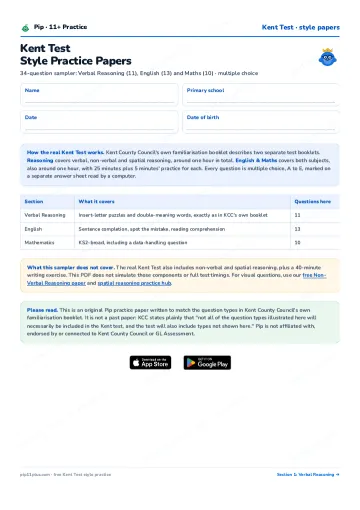
A free 34-question Kent-style sample of Verbal Reasoning, English and Maths, including insert-letter and double-meaning questions from Kent County Council's familiarisation material. It is not a full-length Kent Test: the real Reasoning booklet also includes Non-Verbal and Spatial Reasoning.
Answers and a separate answer sheet are included.
Thanks! Your download is on its way.
We'll only use your email to send this and, if you tick the box, our tips.
Use the answer key to find which Kent Test skills need another try, then give your child fresh practice in Pip. English, Maths, Verbal and Non-Verbal Reasoning all have answer feedback and levels that adjust as your child practises.
Adaptive skill practice is free. Pip Pro adds interactive Pip Teaches lessons and timed mock papers.
For Kent's missing visual section, start with our free Non-Verbal Reasoning paper.
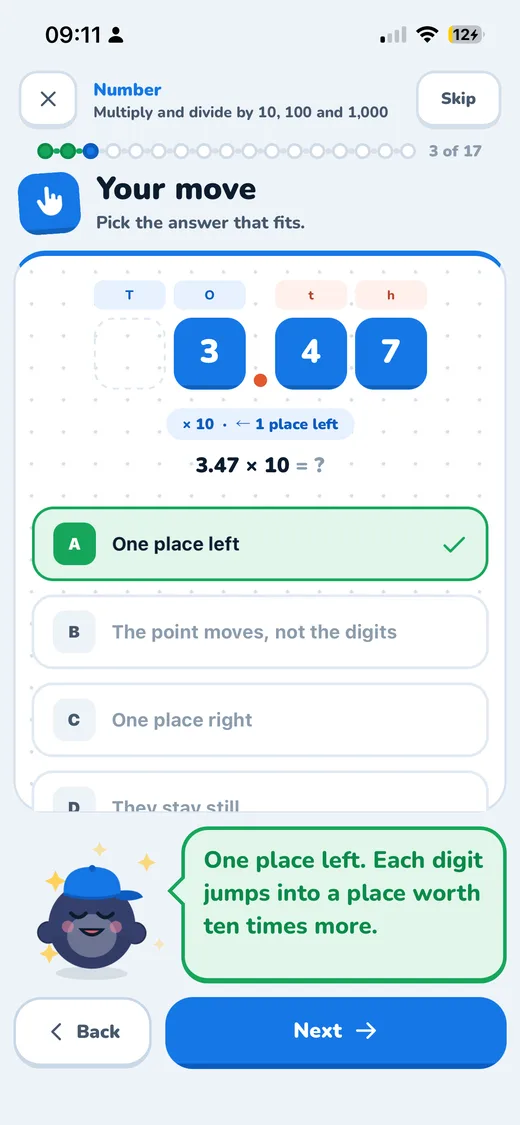 Real Pip app screen
Pip's spatial puzzle book has 240 puzzles with worked methods, including cube nets and 3D turns.
Officially the Procedure for Entry to Secondary Education, always called the Kent Test. It decides whether a child is assessed as suitable for grammar school education in Kent, and it is set by GL Assessment on behalf of Kent County Council.
Format from Kent County Council's familiarisation material. The 332/108 example is from its published 2025 test results.
Two separate test booklets, sat in one session, each around one hour.
| Booklet | Covers | Timing |
|---|---|---|
| Reasoning | Verbal, non-verbal and spatial reasoning | VR: 10 min practice + 20 min test. NVR and spatial: subtests of 4 to 5 min each |
| English & Maths | English and maths | 25 min English (+5 min practice), 25 min maths (+5 min practice) |
The English paper mixes sentence completion, spotting the grammatical mistake in a sentence, and reading comprehension with inference and vocabulary-in-context questions. The maths paper covers content taught up to the start of Year 6, with a small number of questions that apply familiar skills to less familiar situations, including a data-handling question.
A short Verbal Reasoning, English and Maths sampler based on KCC's published question types, with mark schemes and a separate answer sheet. Eleven pages; visual reasoning is separate.
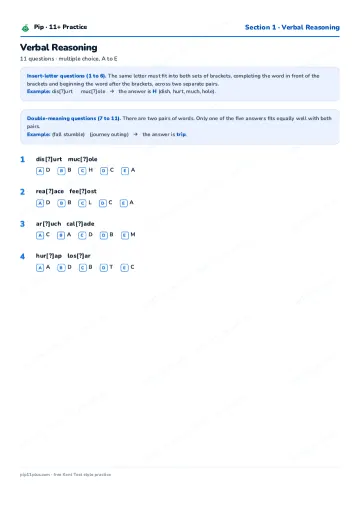
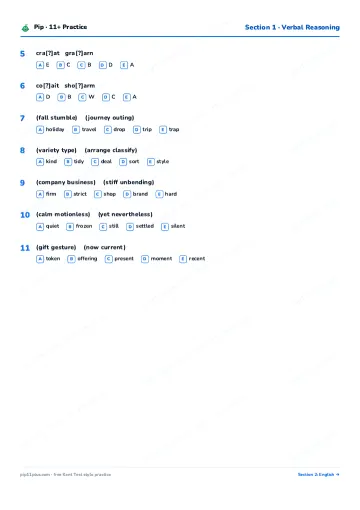
Six questions, each proven to have exactly one working letter by checking against a full dictionary, the same discipline we use for every codes question we publish.
Five questions in KCC's own second format, including the booklet's own two worked examples.
Sentence completion, spot the mistake, and a comprehension passage with inference and vocabulary questions.
Ten questions up to a Year 6 ceiling, including a data-handling chart question in the same style as KCC's own DVD-ownership example.
A printable answer sheet in the same shape as the real Kent Test sheet, so your child rehearses the recording method too.
Every answer explained. Every maths answer is computed in code, never typed by hand.
Kent's Reasoning booklet also covers non-verbal reasoning (shape sequences, codes, the odd one out) and spatial reasoning (hidden shapes, nets, mental rotation). Both need their own carefully built figures to be worth practising, so rather than reproduce them badly here, we point you to the real thing:
| Skill | Where to practise it |
|---|---|
| Non-verbal reasoning | Free 24-question Non-Verbal Reasoning paper |
| Spatial reasoning | Spatial reasoning practice hub |
| Date | What happens |
|---|---|
| 10 September 2026 | Kent Test for children at a Kent primary school |
| 12 to 13 September 2026 | Kent Test for children not at a Kent primary school, at a Kent grammar school |
| 15 October 2026 | Results released |
Dates from Kent County Council's published admissions timetable for September 2027 entry. Always confirm against kent.gov.uk before relying on them.
The Kent Test, officially the Procedure for Entry to Secondary Education (PESE), is the entrance test used to decide whether a child is assessed as suitable for grammar school education in Kent. It is set by GL Assessment and administered by Kent County Council.
Children sit two separate test booklets: Reasoning, which covers verbal, non-verbal and spatial reasoning, and English & Maths, which covers both subjects. Both booklets are multiple choice, marked on a separate computer-read answer sheet.
Kent County Council reported 332 total and at least 108 in each paper for children who took the test in 2025. Those figures are not a confirmed pass threshold for the 2026 test for September 2027 entry.
Kent publishes each year's qualifying score with its results, so check the official results page for the relevant test year.
If your child scores just below the threshold, read how the Kent Head Teacher Assessment works.
Two separate test booklets, each around one hour. The Reasoning booklet has three sections: verbal reasoning (10 minutes practice plus 20 minutes test), and non-verbal and spatial reasoning, split into short timed subtests of 4 to 5 minutes each after an untimed practice section.
The English & Maths booklet gives 25 minutes plus 5 minutes' practice for English, and the same for maths. Every question is multiple choice, A to E, marked on a separate answer sheet.
Kent County Council's own familiarisation booklet shows two main types. In an insert-letter question, the same letter completes the end of one word and the start of another, across two separate word pairs at once, for example dis[?]urt and muc[?]ole, where the answer H makes dish, hurt, much and hole.
In a double-meaning question, two word pairs are given and one word fits sensibly with both, for example (fall, stumble) and (journey, outing), where the answer is trip.
Yes. Kent County Council's Reasoning booklet covers verbal, non-verbal and spatial reasoning together.
Non-verbal reasoning tests relationships between shapes, including sequences, codes and the odd one out. Spatial reasoning tests the ability to picture and manipulate shapes, including finding a hidden target shape within a more complex figure.
This is a distinct skill from verbal reasoning, and Pip publishes dedicated free practice for both.
The content changes, but the format is stable. Kent County Council's own booklet states plainly that not every question type shown in its familiarisation material will necessarily appear in the real test, and that the test will also include types not shown at all.
The safest preparation is to master the general skill each section tests, verbal reasoning, non-verbal reasoning, spatial reasoning, English and maths, rather than memorising specific question formats.
For September 2027 entry, children at a Kent primary school sat the test on Thursday 10 September 2026. Children who do not attend a Kent primary school sat it over the weekend of 12 to 13 September 2026, at a Kent grammar school.
Results are due on Thursday 15 October 2026. Always confirm dates on Kent County Council's own website before relying on them.
No. This is an original 34-question Pip sample of Verbal Reasoning, English and Maths based on question types shown in Kent County Council's familiarisation material.
It is not a past paper or a full-length Kent Test; the real Reasoning booklet also includes Non-Verbal and Spatial Reasoning. Pip is not affiliated with, endorsed by or connected to Kent County Council or GL Assessment.
The full parent guide: format, scoring, key dates and how to prepare.
Read the guideThe reasoning strand this paper does not cover, built and verified as its own resource.
Download freePip is not affiliated with, endorsed by or connected to Kent County Council or GL Assessment. These practice papers are original material written in the style of the published format and contain no official questions.
The comprehension passage is our own writing.