
CSSE Essex 11+ practice at a glance
Short answer: The CSSE examination uses written English and maths papers rather than a standard four-part GL test. English preparation should include reading and continuous writing, while maths needs clear written working and strong KS2 problem solving.
- Paper 1
- Mathematics
- Paper 2
- English reading and writing
- Writing
- Continuous writing is part of English
- Official resources
- CSSE publishes familiarisation papers
These are original Pip materials, not official exam questions. Arrangements can change.
Confirm the current format and dates with the Consortium of Selective Schools in Essex.
Try four free CSSE Essex 11+ written tasks
CSSE needs written responses. Work on paper, then open the discussion notes below.
Review the writing together; it is not automatically scored.
“The bell rang. Elin kept her eyes on the empty chair beside her, then folded the spare programme carefully.” What suggests Elin had expected somebody to join her? Give two details.
Write your response on paper before opening the notes.
Show answer or discussion notes
A suitable answer identifies the empty chair beside Elin and the spare programme. These suggest she had saved a place and a programme.
Do not award yourself an official mark: this is a discussion guide.
A cinema sells 18 adult tickets at £8.50 and 24 child tickets at £5.75. It pays £95 to hire the room. How much ticket money remains after the hire cost? Show your working.
Write your response on paper before opening the notes.
Show answer or discussion notes
Adult sales: 18 × £8.50 = £153. Child sales: 24 × £5.75 = £138.
Total £291; subtract £95 to leave £196. Check both multiplications and label the final amount.
Describe a school playground just after everyone has gone indoors. Write one paragraph using specific details to suggest the sudden quiet.
Write your response on paper before opening the notes.
Show answer or discussion notes
There is no single correct paragraph. Look for selected details, such as a ball still rolling or a coat hanging from a bench.
Check that sentences connect and punctuation helps the reader. A list of impressive adjectives is not enough.
A ribbon is 2.4 m long. Six pieces, each 28 cm long, are cut off. How many centimetres remain?
Write your response on paper before opening the notes.
Show answer or discussion notes
Convert 2.4 m to 240 cm. Six pieces use 6 × 28 = 168 cm.
The remainder is 240 − 168 = 72 cm.
These written tasks are not automatically marked. The notes explain the maths and offer English discussion points; they are not official mark schemes.
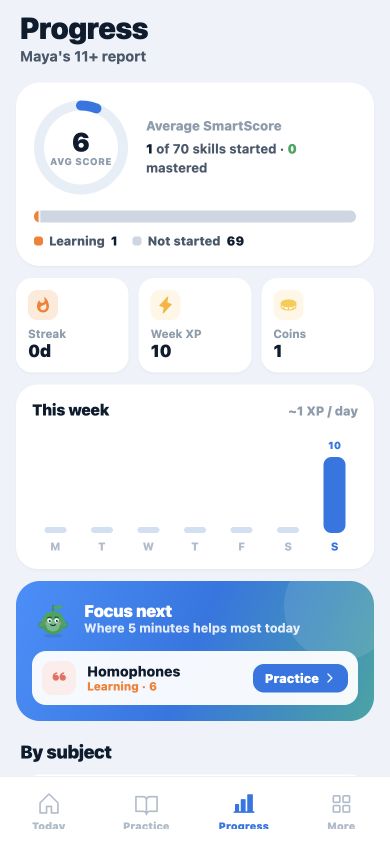
Fresh questions, instant explanations and a clear next step
Use Pip for supporting English and maths skills between written sessions. Keep writing on paper and review it with an adult; these tasks do not receive an automatic writing mark.
- Free daily English, maths and reasoning practice
- No ads or child data collection
- Optional timed mock papers and progress reporting



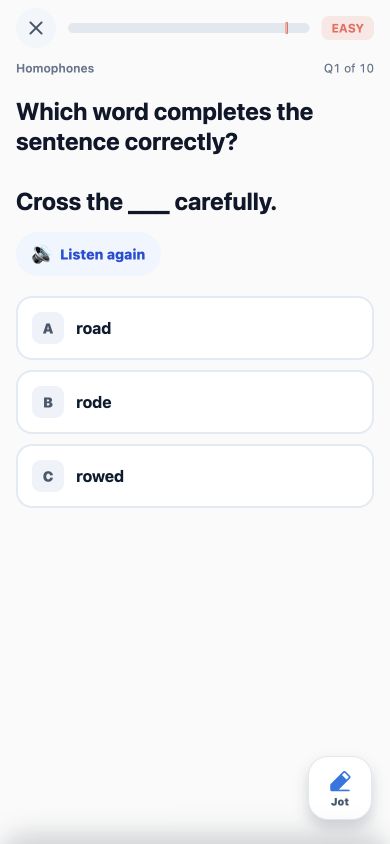
Free CSSE Essex 11+ practice papers by subject
Use CSSE’s official familiarisation papers for the response format. Our English and maths hubs add topic practice, but an instant-marked quiz cannot replace continuous writing.
What should CSSE Essex 11+ practice cover?
| Practice area | What to work on | Good first step |
|---|---|---|
| Reading | Comprehension, vocabulary and inference | Quote or point to evidence before answering |
| Continuous writing | Ideas, structure, accuracy and control | Plan briefly, then leave time to proofread |
| Maths fluency | Secure arithmetic without a calculator | Show a clean method for every multi-step problem |
| Maths reasoning | Interpreting unfamiliar problems | Estimate first to catch unreasonable answers |
How to use CSSE Essex 11+ practice papers effectively
- Use the actual CSSE familiarisation papers to see how written responses are presented. The tasks here are shorter skill checks, not copies of those papers.
- For reading, answer the question before adding explanation. If it asks for two details, make both easy to find.
- Set continuous writing as its own activity. Read it together for clarity, organisation and accuracy; a multiple-choice score cannot assess it.
- In maths, retain the working when an answer is wrong. A correct first calculation followed by a unit error tells you what to practise next.
Turn paper practice into a five-minute daily habit
Note the skill behind a missed answer, such as inference, unit conversion or rotation. Choose that topic for the next practice session, then return to a fresh paper question.
CSSE Essex 11+ written tasks: FAQs
Are these official CSSE Essex 11+ questions?+
No. These are original Pip written tasks covering the relevant broad skills.
Pip is not affiliated with the Consortium of Selective Schools in Essex. Use the official familiarisation material for the exact current instructions.
What should my child practise for the CSSE Essex 11+?+
The CSSE examination uses written English and maths papers rather than a standard four-part GL test. English preparation should include reading and continuous writing, while maths needs clear written working and strong KS2 problem solving.
How should we use CSSE Essex 11+ practice papers?+
Use the actual CSSE familiarisation papers to see how written responses are presented. The tasks here are shorter skill checks, not copies of those papers.
For reading, answer the question before adding explanation. If it asks for two details, make both easy to find.
Does passing the CSSE Essex 11+ guarantee a grammar-school place?+
No. Test qualification and school allocation are separate.
Each school applies its published admissions and oversubscription rules, and parents must complete the required school application.