
Lincolnshire 11+ practice at a glance
Short answer: The shared Lincolnshire 11+ focuses on verbal reasoning plus non-verbal and spatial reasoning. The two tests are normally held on separate dates, so preparation should build stamina for each paper without adding irrelevant subjects.
- Test 1
- Verbal reasoning
- Test 2
- Non-verbal and spatial reasoning
- Format
- Multiple-choice with separate answer sheet
- 2027 tests
- September 2026 on separate dates
These are original Pip materials, not official exam questions. Arrangements can change.
Confirm the current format and dates with the Lincolnshire Consortium of Grammar Schools.
Try four free Lincolnshire 11+ practice questions
Lincolnshire’s shared tests focus on reasoning, rather than separate English and maths papers. The examples distinguish vocabulary, coding, rotation and opposite cube faces.
Which word means the opposite of expand?
Contract means become smaller. The other options describe making something larger or longer.
In a code, each letter moves two places backwards in the alphabet. HAT becomes FYR. What does LIP become?
L moves to J, I to G and P to N, giving JGN. Apply the same movement separately to each letter.
Which arrow comes next?
The arrows turn 90 degrees anticlockwise: up, left, down, right, then up.
A cube has opposite face pairs A/D, B/E and C/F. If A is on top and B is at the front, which face is at the back?
Front and back are opposite faces. B is opposite E, so E is at the back; the top face does not change that pair.
Answer the four starter tasks. This score is not an admissions prediction.
Fresh questions, instant explanations and a clear next step
After these tasks, choose one missed skill to practise in Pip. Ask your child to explain the new answer before moving on; remembering the answer here is not the same as learning the method.
- Free daily English, maths and reasoning practice
- No ads or child data collection
- Optional timed mock papers and progress reporting



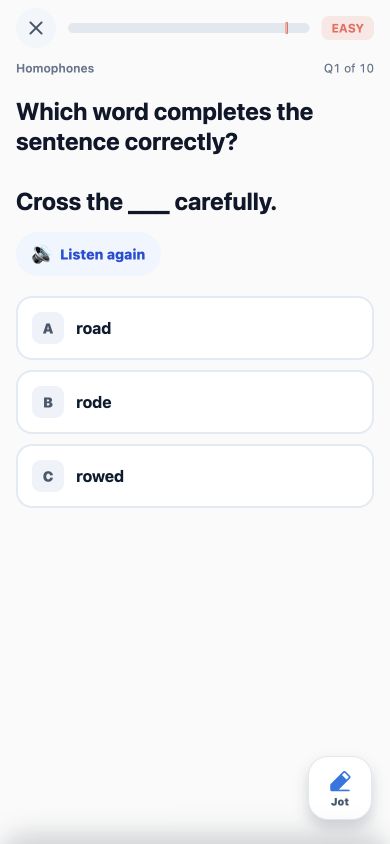
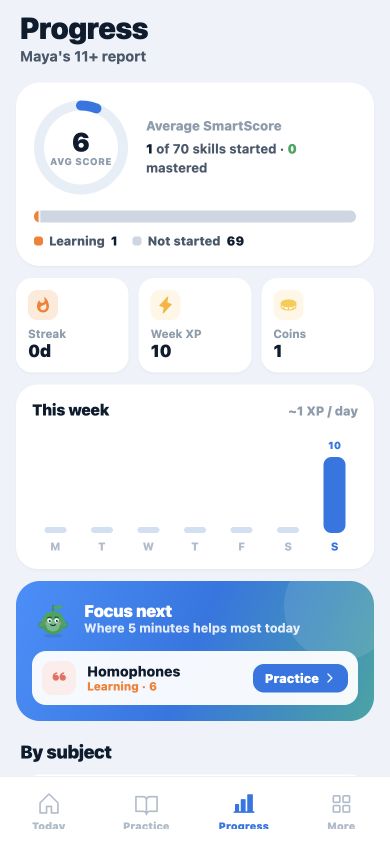
Free Lincolnshire 11+ practice papers by subject
Choose verbal and visual/spatial reasoning materials for this shared test. General English and maths can support learning, but they are not separate papers in the published Lincolnshire format.
What should Lincolnshire 11+ practice cover?
| Practice area | What to work on | Good first step |
|---|---|---|
| Vocabulary | Synonyms, antonyms and word precision | Read daily and record unfamiliar words |
| Verbal reasoning | Codes, sequences and relationships | Learn the logic, not a memorised answer |
| Non-verbal reasoning | Matrices, odd-one-out and sequences | Compare position, shape, number and shading |
| Spatial reasoning | Rotations, nets and folded shapes | Visualise each movement before choosing |
How to use Lincolnshire 11+ practice papers effectively
- Keep the two test dates separate in your calendar. Bourne’s 2027-entry guidance lists verbal reasoning on 12 September 2026 and non-verbal/spatial reasoning on 19 September.
- For verbal work, separate word-meaning errors from code errors. A child who can decode JGN may still need help with expand and contract.
- Draw and turn simple shapes on paper. For cube questions, record opposite pairs before trying to imagine every face at once.
- Use the school’s familiarisation session if offered. Both tests must be sat for a valid full score; practising only the favourite paper leaves a gap.
Turn paper practice into a five-minute daily habit
Note the skill behind a missed answer, such as inference, unit conversion or rotation. Choose that topic for the next practice session, then return to a fresh paper question.
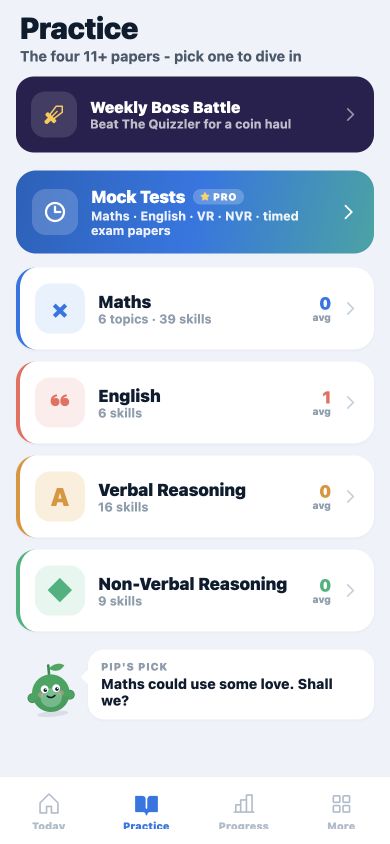
Lincolnshire 11+ practice questions: FAQs
Are these official Lincolnshire 11+ questions?+
No. These are original Pip practice questions covering the relevant broad skills.
Pip is not affiliated with the Lincolnshire Consortium of Grammar Schools. Use the official familiarisation material for the exact current instructions.
What should my child practise for the Lincolnshire 11+?+
The shared Lincolnshire 11+ focuses on verbal reasoning plus non-verbal and spatial reasoning. The two tests are normally held on separate dates, so preparation should build stamina for each paper without adding irrelevant subjects.
How should we use Lincolnshire 11+ practice papers?+
Keep the two test dates separate in your calendar. Bourne’s 2027-entry guidance lists verbal reasoning on 12 September 2026 and non-verbal/spatial reasoning on 19 September.
For verbal work, separate word-meaning errors from code errors. A child who can decode JGN may still need help with expand and contract.
Does passing the Lincolnshire 11+ guarantee a grammar-school place?+
No. Test qualification and school allocation are separate.
Each school applies its published admissions and oversubscription rules, and parents must complete the required school application.