
ISEB Common Pre-Test practice at a glance
Short answer: ISEB Common Pre-Tests are adaptive online multiple-choice assessments in English, maths, verbal reasoning and non-verbal reasoning. Build secure skills first, then practise answering accurately on screen.
- Format
- Online and adaptive
- Subjects
- English, maths, verbal and non-verbal reasoning
- Candidates
- Usually Years 6 or 7
- Use
- One result can be shared with multiple schools
These are original Pip materials, not official exam questions. Arrangements can change. Confirm the current format and dates with ISEB.
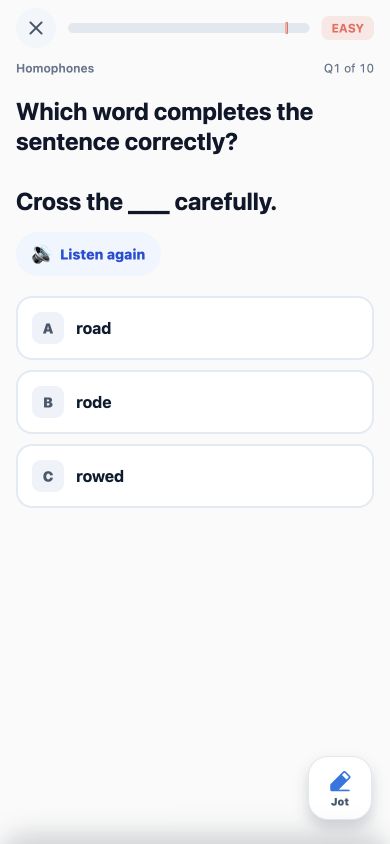
Try four free ISEB Common Pre-Test practice questions
Choose an answer to see the explanation immediately. These original questions demonstrate the broad skills involved and do not reproduce an official paper.
Which word is closest in meaning to reluctant?
Reluctant means unwilling or hesitant to do something.
Three fifths of a number is 24. What is the number?
One fifth is 24 ÷ 3 = 8, so five fifths is 8 × 5 = 40.
Complete the letter sequence: AB, DE, GH, JK, ___
The first letter moves forward three places each time: A, D, G, J, M.
Which shape completes the alternating sequence? ● ▲ ● ▲ ● ___
The sequence alternates circle and triangle, so the missing shape is a triangle.
Answer the questions above to build your score.
Fresh questions, instant explanations and a clear next step
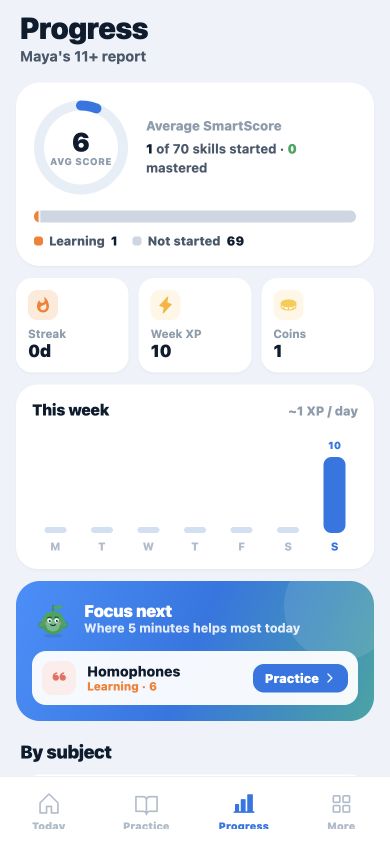
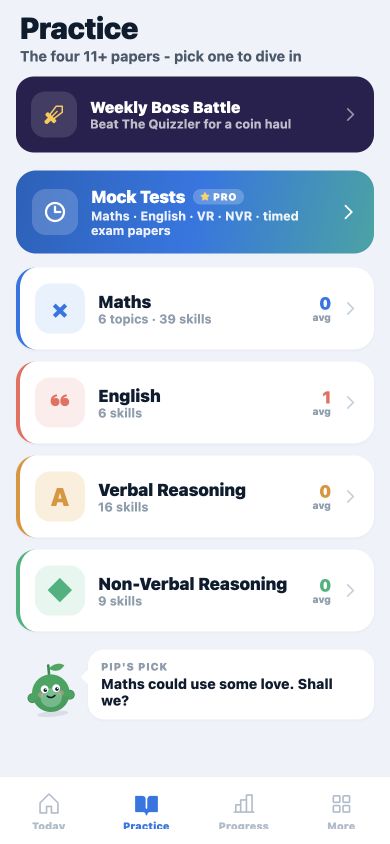
Pip turns the same core skills into a short daily plan and shows parents where five minutes will help most.
- Free daily English, maths and reasoning practice
- No ads or child data collection
- Optional timed mock papers and progress reporting



Free ISEB Common Pre-Test practice papers by subject
Move from quick questions to longer printable practice. Use only the subjects relevant to this exam, and review the method as carefully as the final mark.
Maths practice papers
Printable maths papers with worked answers
Open practice hub →Free PDF practiceEnglish practice papers
Comprehension, grammar and vocabulary practice
Open practice hub →Free PDF practiceVerbal reasoning papers
Codes, sequences and word reasoning
Open practice hub →Free PDF practiceNon-verbal reasoning papers
Patterns, rotations and spatial reasoning
Open practice hub →What should ISEB Common Pre-Test practice cover?
The table keeps preparation aligned with the current regional format instead of treating every 11+ exam as identical.
| Practice area | What to work on | Good first step |
|---|---|---|
| English | Comprehension, grammar and vocabulary | Read all options before choosing |
| Maths | Curriculum knowledge and reasoning | Work accurately without over-rushing |
| Verbal reasoning | Words, codes and relationships | Develop vocabulary continuously |
| Non-verbal reasoning | Visual patterns and transformations | Identify the rule before selecting |
How to use ISEB Common Pre-Test practice papers effectively
- Check the current format. Use the official admissions source before buying or downloading material.
- Start with a baseline. Record unfamiliar topics, not just the score.
- Practise one skill at a time. Build the method before attempting a full paper.
- Add timing gradually. Begin with a short section once accuracy is stable.
- Review and repeat. Return to the weak topic with a fresh question a few days later.
Turn paper practice into a five-minute daily habit
Pip uses Pip Score to surface topics that need attention, making gaps found in a paper easier to act on.
ISEB Common Pre-Test practice questions: FAQs
Are these official ISEB Common Pre-Test questions?+
No. These are original Pip practice questions covering the relevant broad skills. Pip is not affiliated with ISEB. Use the official familiarisation material for the exact current instructions.
What should my child practise for the ISEB Common Pre-Test?+
ISEB Common Pre-Tests are adaptive online multiple-choice assessments in English, maths, verbal reasoning and non-verbal reasoning. Build secure skills first, then practise answering accurately on screen.
How should we use ISEB Common Pre-Test practice papers?+
Begin untimed to learn the methods. Add timed sections once accuracy is stable, then classify every error as a knowledge gap, vocabulary gap, format issue or rushing.
Does passing the ISEB Common Pre-Test guarantee a grammar-school place?+
No. Test qualification and school allocation are separate. Each school applies its published admissions and oversubscription rules, and parents must complete the required school application.