A complete practice paper set matching ISEB's own published test framework: English, Maths and Verbal Reasoning, at the level and skills ISEB describes for its online adaptive test used by independent senior schools. Full answers included, all free.
Prefer to practise on screen? Try our free ISEB Pre-Test practice questions online, marked instantly.
Thanks! Your download is on its way.
We'll only use your email to send this and, if you tick the box, our tips.
An online, adaptive assessment shared by many independent senior schools. Sit it once, and the result goes to every school on your list.
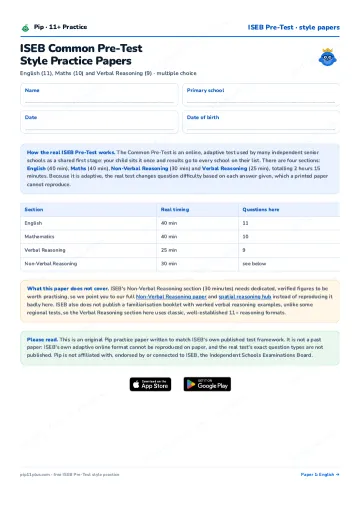
| Section | Timing |
|---|---|
| English | 40 minutes |
| Mathematics | 40 minutes |
| Non-Verbal Reasoning | 30 minutes |
| Verbal Reasoning | 25 minutes |
| Total | 2 hours 15 minutes |
Format and timings taken from ISEB's own published test framework and Common Pre-Tests support portal.
ISEB publishes a detailed skills framework for English and Maths, both capped at the Year 5 National Curriculum.
Maths combines arithmetic fluency (the four operations, place value, fractions, decimals and percentages) with multi-topic problem solving across measurement, geometry and statistics. Verbal Reasoning uses letter, word and language-based questions testing logical working and trial and error. Non-Verbal Reasoning covers 2D pattern analysis (similarities, differences, completion, code matching) and 3D spatial manipulation.
English, Maths and Verbal Reasoning, matched to ISEB's own published test framework, with full mark schemes. Ten pages.
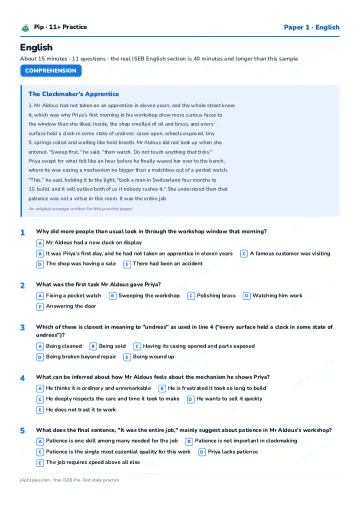
An original passage with questions covering retrieval, inference and vocabulary in context, matching ISEB's own stated skills.
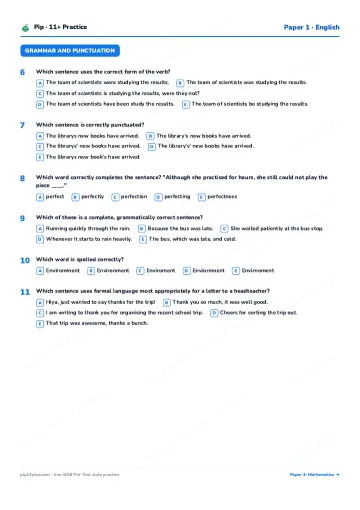
Six questions on correct usage, punctuation, spelling and register, testing the skill rather than terminology.
Ten questions mixing arithmetic fluency with multi-step problem solving, across number, fractions, measurement, geometry and statistics.
Letter and number sequences, each defined by a rule proven in code, plus word analogies.
A clean printable answer sheet for all three papers.
Every answer explained. Every maths and verbal reasoning answer is computed and checked in code, never typed by hand.
The real Pre-Test gives 30 minutes to Non-Verbal Reasoning. It needs carefully built figures to be worth practising, so rather than reproduce it badly here, we point you to the real thing:
| Skill | Where to practise it |
|---|---|
| Non-verbal reasoning | Free 18-question Non-Verbal Reasoning paper |
| Spatial reasoning | Spatial reasoning practice hub |
ISEB also does not publish a familiarisation booklet with worked Verbal Reasoning examples, unlike Kent or Medway, so this paper's Verbal Reasoning section uses classic, well-established 11+ reasoning formats rather than an invented ISEB-specific style.
The ISEB Common Pre-Test is a shared, online, adaptive entrance assessment used by many independent senior schools across the UK as the first stage of 11+ and 13+ admissions. ISEB, the Independent Schools Examinations Board, runs it. A child usually sits it once, in Year 6 or Year 7, and the results are shared with every school they have applied to, rather than sitting a different test for each school.
Four separately timed, multiple choice sections, all taken on a computer: English (40 minutes), Mathematics (40 minutes), Non-Verbal Reasoning (30 minutes) and Verbal Reasoning (25 minutes), totalling 2 hours 15 minutes. The four sections can be sat together on the same day or split across multiple days, and can be taken in any order, but once a section is started it must be finished in one sitting.
The test algorithm chooses each question based on how a child has answered the previous ones, so the difficulty adjusts in real time. ISEB describes it as choosing 'the most suitable questions for each pupil based on their previously answered questions', which means a child does not spend time on questions that are far too easy or far too hard for them. This also means no printed paper can fully reproduce the real test, since a fixed paper cannot adapt.
Maths is based on the National Curriculum up to the end of Year 5, mixing arithmetic fluency with multi-step problem solving. English assesses reading comprehension (retrieval, inference, vocabulary in context, summarising), grammar tested as what is grammatically correct rather than technical terms like tense names, punctuation and spelling.
Yes, both are separate timed sections. Verbal Reasoning (25 minutes) uses letter, word and language-based questions testing logical working. Non-Verbal Reasoning (30 minutes) uses figures and diagrams to test pattern recognition and spatial logic. ISEB does not publish a familiarisation booklet with worked examples for either section, unlike some regional 11+ tests, so preparation generally relies on general reasoning practice rather than test-specific formats.
Results are age-standardised so that a child's score can be fairly compared with others regardless of exactly when they sat the test or how old they were on the day. ISEB shares the standardised results with every school a child has applied to, and each school then applies its own admissions criteria on top of that score, so there is no single national pass mark.
For the 2026-27 testing window, live testing opens on Tuesday 1 September 2026 and runs until late May 2027. Exact registration and sitting dates depend on which senior schools a child has applied to, since each school manages its own registration process even though the test itself is shared. Always confirm the specific dates and deadlines with each school directly.
No. This is an original Pip practice paper written to match ISEB's own published test framework. It is not a past paper, and it cannot reproduce the real test's adaptive, online format on a printed page. Pip is not affiliated with, endorsed by or connected to ISEB, the Independent Schools Examinations Board.
The full parent guide: format, the adaptive scoring, sharing between schools and how to prepare.
Read the guideThe reasoning strand this paper does not cover, built and verified as its own resource.
Download freeEvery free Pip paper in one place, including the Bucks, CSSE, Tiffin, Sutton, Kent and Medway style papers.
See all printablesPip is not affiliated with, endorsed by or connected to ISEB, the Independent Schools Examinations Board. These practice papers are original material matched to the published test framework and contain no official questions. The comprehension passage is our own writing.