
Kent Test practice at a glance
Short answer: Kent Test preparation should cover English, maths, verbal reasoning, non-verbal reasoning and spatial reasoning. Start untimed, introduce timing once accuracy is stable, and review mistakes by topic.
- Format
- Two multiple-choice papers plus a writing exercise
- Paper 1
- English and maths
- Paper 2
- Verbal, non-verbal and spatial reasoning
- 2027 test
- 10 September 2026 for pupils at Kent primary schools
These are original Pip materials, not official exam questions. Arrangements can change.
Confirm the current format and dates with Kent County Council.
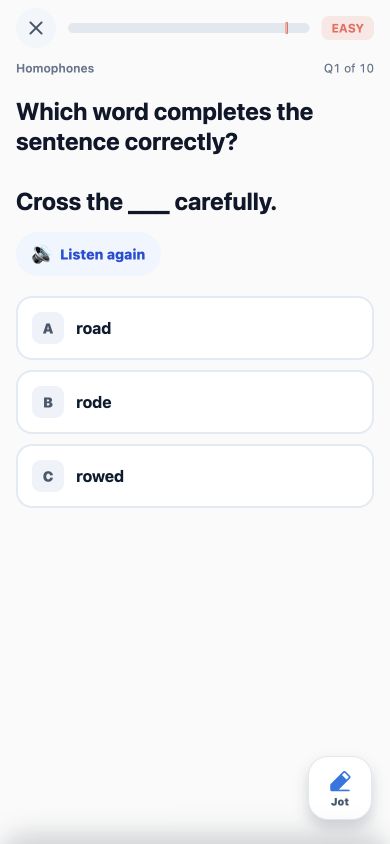
Try four free Kent Test practice questions
Kent combines subject knowledge with timed reasoning. Use the first two questions to discuss reading and calculation; use the last two to explain a relationship or visual rule.
“Mara put the unopened letter beneath her plate. She would read it once everyone had left.” Why does Mara probably wait?
Hiding the letter and waiting until she is alone suggest privacy. The passage gives no evidence that she cannot read.
A jug contains 1.5 litres. Leo pours out three cups of 250 ml each. How much remains?
1.5 litres is 1,500 ml. Three cups use 750 ml, leaving 750 ml.
Converting first keeps the units consistent.
Complete the analogy: page is to book as petal is to ___.
A page is part of a book; a petal is part of a flower. Keep the part-to-whole relationship in the same order.
Which arrow comes next?
Each arrow turns through 180 degrees. The next arrow points up.
Answer the four starter tasks. This score is not an admissions prediction.
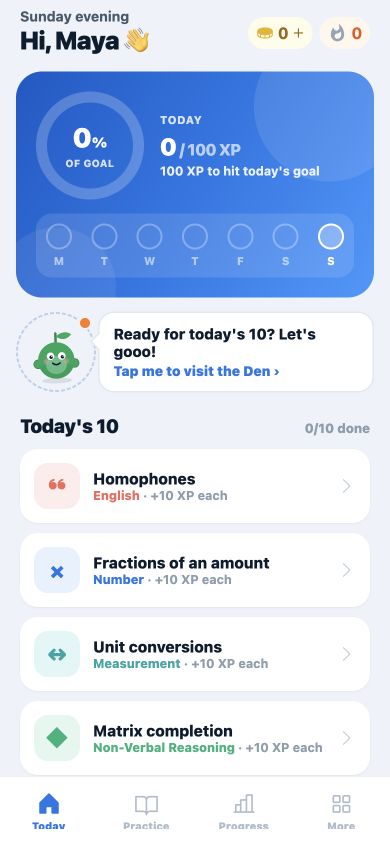
Fresh questions, instant explanations and a clear next step
After these tasks, choose one missed skill to practise in Pip. Ask your child to explain the new answer before moving on; remembering the answer here is not the same as learning the method.
- Free daily English, maths and reasoning practice
- No ads or child data collection
- Optional timed mock papers and progress reporting



Free Kent Test practice papers by subject
For Kent, use English and maths papers alongside reasoning sets. Also set aside a separate writing session; an instant-marked quiz cannot show how a child plans and develops a piece of writing.
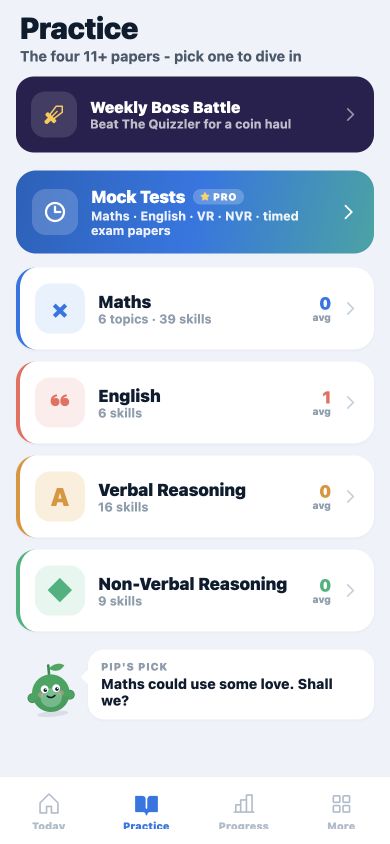
Maths practice papers
Printable maths papers with worked answers
Open practice hub →Free PDF practiceEnglish practice papers
Comprehension, grammar and vocabulary practice
Open practice hub →Free PDF practiceVerbal reasoning papers
Codes, sequences and word reasoning
Open practice hub →Free PDF practiceNon-verbal reasoning papers
Patterns, rotations and spatial reasoning
Open practice hub →What should Kent Test practice cover?
| Practice area | What to work on | Good first step |
|---|---|---|
| English | Comprehension, literacy, grammar and vocabulary | Explain why every answer is right or wrong |
| Maths | Secure KS2 knowledge and multi-step problems | Practise the method before adding time pressure |
| Verbal reasoning | Codes, analogies and word relationships | Learn one question family at a time |
| Non-verbal and spatial reasoning | Patterns, rotations, matrices and shapes | Say the rule aloud before answering |
How to use Kent Test practice papers effectively
- Separate the two papers in your notes. A missed inference question needs a different follow-up from a missed shape rotation.
- Use the official English and maths timing: each has five minutes of practice and 25 minutes of test questions. Start with shorter blocks if your child is still learning the methods.
- Practise stopping at the end of a reasoning section. Kent’s non-verbal questions are divided into short, individually timed sections.
- Include writing on paper. Kent allows 40 minutes, including ten for planning; it is not scored but may inform the headteacher assessment.
Turn paper practice into a five-minute daily habit
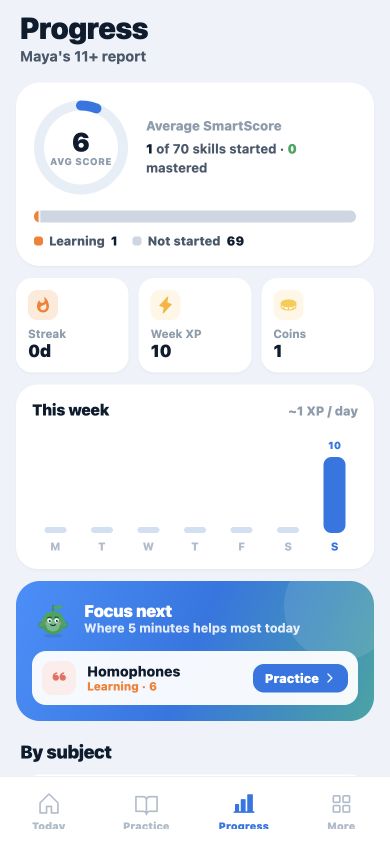
Note the skill behind a missed answer, such as inference, unit conversion or rotation. Choose that topic for the next practice session, then return to a fresh paper question.
Kent Test practice questions: FAQs
Are these official Kent Test questions?+
No. These are original Pip practice questions covering the relevant broad skills.
Pip is not affiliated with Kent County Council. Use the official familiarisation material for the exact current instructions.
What should my child practise for the Kent Test?+
Kent Test preparation should cover English, maths, verbal reasoning, non-verbal reasoning and spatial reasoning. Start untimed, introduce timing once accuracy is stable, and review mistakes by topic.
How should we use Kent Test practice papers?+
Separate the two papers in your notes. A missed inference question needs a different follow-up from a missed shape rotation.
Use the official English and maths timing: each has five minutes of practice and 25 minutes of test questions. Start with shorter blocks if your child is still learning the methods.
Does passing the Kent Test guarantee a grammar-school place?+
No. Test qualification and school allocation are separate.
Each school applies its published admissions and oversubscription rules, and parents must complete the required school application.