
The phrase “Eton entrance exam” hides a multi-stage process. For the normal 13+ route, a boy is registered by the end of Year 5, takes the ISEB Common Pre-Tests in Year 6, and may then be invited to an interview and online predictive test. A successful candidate receives a conditional place, which is confirmed through a Year 8 exam route. This guide separates those stages, explains which past papers Eton actually publishes, and shows where Pip can genuinely help.
- The main entry point is Year 9 at 13, and boys must be registered by 31 August at the end of Year 5.
- Stage 1 is the ISEB Common Pre-Tests in October or November of Year 6: English, maths, verbal and non-verbal reasoning, about two and a half hours in total.
- Stage 2 is an interview and online predictive test for shortlisted boys.
- A successful boy gets a conditional place, confirmed in Year 8 through the King's Scholarship, Common Entrance or Eton Entrance exams.
- The 2026/27 boarding fee is £21,891 per term, including VAT.
Information checked against Eton College’s official admissions pages on 2 August 2026.
Eton admissions process at a glance

| Stage | When | What happens |
|---|---|---|
| Registration | By 31 August at the end of Year 5 | Parents submit the online form, birth certificate and non-refundable registration fee. |
| Stage 1 | October or November in Year 6 | ISEB Common Pre-Tests in English, maths, verbal reasoning and non-verbal reasoning, plus a head teacher’s report. |
| Stage 2 | Spring or summer in Year 6 | Shortlisted boys attend an individual interview and complete Eton’s online predictive test. |
| Conditional place | After Stage 2 | A successful boy receives a place conditional on a satisfactory Year 8 exam result. |
| Final confirmation | Age 12 or 13 in Year 8 | King’s Scholarship, Common Entrance or the Eton Entrance examinations. |
Eton’s own example says a boy applying for 2029 entry must be registered by 31 August 2026. The deadline is strict for the normal route. Later routes may remain through eligible scholarships or Sixth Form entry.
What is the Eton entrance exam?
There is no single test that covers every applicant and every stage. Parents often use “Eton entrance exam” to mean one of four different assessments:
- ISEB Common Pre-Tests: the current Stage 1 assessment for the normal 13+ route.
- Eton’s Stage 2 predictive test: a separate online assessment for shortlisted boys.
- Eton Entrance examinations: one of the routes that can confirm a conditional place in Year 8.
- King’s Scholarship examinations: the academic scholarship route, with a separate syllabus and published past papers.
This distinction matters. A King’s Scholarship paper is not a sample of the ISEB test, and a third-party “Eton List Test sample” should not be treated as an official replica of the current standard assessment.
Stage 1: the ISEB Common Pre-Tests
All boys in the standard route sit the online ISEB Common Pre-Tests in October or November of Year 6, either at their current school or at an agreed centre. Eton says the multiple-choice tests cover verbal reasoning, non-verbal reasoning, English and mathematics. They take about two and a half hours in total, can be split across sessions, and use standardised scoring.
The best early preparation is broad skill-building, not trying to memorise one paper. Secure arithmetic, careful reading, a strong vocabulary, pattern recognition and confident reasoning all matter. Our ISEB Common Pre-Test guide explains the format in more detail.
Build the four Stage 1 foundations in five minutes a day
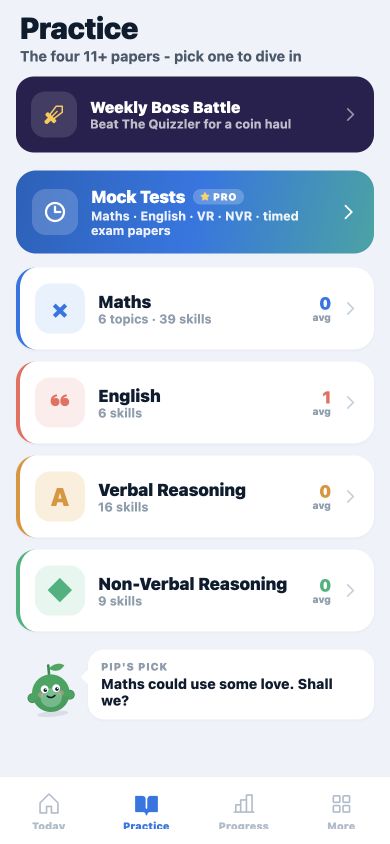
Pip gives children short practice across English, maths, verbal reasoning and non-verbal reasoning, the four broad areas named in Eton’s current Stage 1 process. Instant explanations help turn errors into a clear next step, while the parent view highlights topics that need more attention.
Important: Pip supports foundational practice. It is not an Eton-endorsed product and does not replace school-specific interview coaching, Common Entrance teaching or King’s Scholarship preparation.



Stage 2: interview and online predictive test
Eton shortlists boys using the Stage 1 results and the head teacher’s report. At Stage 2, each candidate completes an individual interview and an online predictive test. Eton describes this as an assessment of current and potential academic ability, alongside whether a boy is likely to be happy in its boarding environment.
Preparation should therefore include more than timed questions. A child should be able to discuss books, interests, schoolwork and ideas naturally. Rehearsed speeches can sound brittle. Regular reading, curiosity and practice explaining a line of reasoning are more useful.
What is the Eton List Test?
This is an area where older guides and current school information can conflict. As of August 2026, the safest approach is to follow the assessment named in the instructions Eton sends for your child’s route. If a page offers an “Eton List Test sample,” check its publication date and whether it is describing standard 13+ entry or scholarship eligibility.
Eton entrance exam past papers: what is actually available?
Eton publishes King’s Scholarship past papers on its official website. These are academically demanding scholarship papers and should only be used for that route or for carefully chosen extension work. They are not official samples of the ISEB Common Pre-Tests, the Stage 2 predictive test or the standard Eton Entrance examination.
For Stage 1 preparation, use official ISEB familiarisation material to understand the interface, then practise the underlying English, maths and reasoning skills. For King’s Scholarship, begin with the current prospectus and syllabus before attempting past papers.
Eton College acceptance rate
Eton does not publish a current official acceptance-rate percentage on the admissions pages reviewed for this guide. It is therefore safer not to repeat a precise figure from an aggregator. Different websites may divide offers by registrations, by boys who completed Stage 1, or by those invited to Stage 2, producing very different percentages.
What can be said confidently is that Eton is highly selective and assesses both attainment and academic potential. Families should judge fit, boarding readiness and financial planning alongside test preparation.
Eton College fees, boarding costs and financial aid
For 2026/27, Eton lists the school fee as £21,891 per Half, meaning per term, including VAT. The Year 9 registration fee is currently £480 including VAT and the acceptance fee for boys joining in September 2026 is £3,840, of which £500 is normally refunded when the boy leaves, subject to the final account.
Eton also offers means-tested bursaries. The school says it budgeted £9.7 million for scholarships and bursaries in 2024/25. Scholarships do not automatically reduce fees, so families seeking financial help should follow the separate bursary process and deadlines. Check the official fees page and financial aid page before making decisions.
A realistic Eton entrance exam preparation plan
| Period | Priority | Useful action |
|---|---|---|
| Year 4 | Core knowledge and reading | Build fluent arithmetic, vocabulary and a daily reading habit without heavy test pressure. |
| Year 5 | Reasoning and broad accuracy | Add verbal and non-verbal reasoning. Register before the deadline and identify genuine gaps. |
| Summer before Year 6 | Familiarity and timing | Use official familiarisation resources, practise short timed sets and review the cause of mistakes. |
| Year 6 Stage 2 period | Thinking aloud and personal fit | Discuss books and interests, explain solutions clearly and learn what boarding life involves. |
| Year 7 and Year 8 | Chosen confirmation route | Follow the current Common Entrance, Eton Entrance or King’s Scholarship syllabus with the child’s school. |
Keep the plan proportionate. Pip can make the Year 5 and early Year 6 foundations more consistent, but no app should crowd out reading, schoolwork, sleep or the broader interests Eton discusses at interview.
See the gap, then practise the right thing
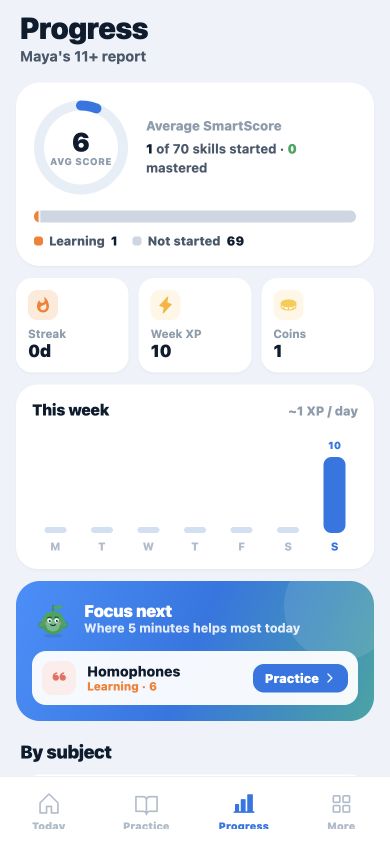
Pip’s progress view shows Pip Score and focus areas so parents can turn a weak topic found in practice into a small, specific next step. It is a calmer approach than repeating full papers without diagnosis.
Eton College Sixth Form entry requirements
Sixth Form entry is a separate route and should not be confused with the 13+ process above. Eton’s current scholarship pages describe the Orwell Award route for boys who have spent Years 9, 10 and 11 in a UK state school, with limited additional eligibility for some boys receiving substantial help at independent schools without a Sixth Form. For 2027 entry, the school says applications are open in 2026 and publishes its own dates and criteria. Families should use Eton’s current Orwell Award page, rather than applying 13+ test advice to a Sixth Form candidate.
Official sources used
- Eton College: Year 9 (13+) Entry
- Eton College: Entry to Eton
- Eton College: King’s Scholarship Awards
- Eton College: Fees
- Eton College: Financial Aid
Eton entrance exam FAQs
What is the Eton entrance exam?
For the standard 13+ route there is not one single exam. Boys first take the ISEB Common Pre-Tests in Year 6. Shortlisted candidates then complete an interview and an online predictive test. A conditional place is later confirmed in Year 8 through King’s Scholarship, Common Entrance or the Eton Entrance examinations.
When should a child be registered for Eton?
For standard 13+ entry, registration closes on 31 August at the end of UK Year 5. Eton gives 31 August 2026 as the deadline for 2029 entry. Scholarship and Sixth Form routes have separate later application windows.
Does Eton publish entrance exam past papers?
Eton publishes King’s Scholarship past papers. These are scholarship papers, not samples of the Year 6 ISEB Common Pre-Tests, the Stage 2 predictive test or the standard Eton Entrance examination.
What is the Eton College acceptance rate?
Eton does not publish a current official acceptance-rate percentage on its admissions pages. Numbers quoted by third-party websites may use different definitions, such as registrations, candidates assessed or final offers, so they should not be presented as an official rate.
Can Pip help with Eton entrance exam preparation?
Pip can build the English, maths, verbal reasoning and non-verbal reasoning foundations used in the ISEB Common Pre-Tests. It does not replace Eton-specific interview preparation, Common Entrance teaching or King’s Scholarship preparation.
What are Eton College boarding fees for 2026/27?
Eton lists its 2026/27 school fee as £21,891 per Half, meaning per term, including VAT. The school also lists separate registration and acceptance fees, and offers means-tested financial aid.