Reading stamina is the ability to stay with a long piece of writing and still understand it at the end. For the 11+, it is what lets a child read a passage of several hundred words, against the clock, without drifting off halfway.
This guide is for parents and English teachers. It covers how long to read each day, a four-week plan, how to read a passage slowly, and how to learn hard words from stories, with two things to try with your child.
- Reading stamina means staying with a long text and still understanding it at the end.
- It grows from long books worth reading, not from bite-sized extracts alone.
- In our experience, rushing is the most common comprehension error, so teach slow, careful reading.
- Aim for 15 to 30 minutes a day depending on the year group, plus a story read aloud together.
- Children learn hard words in context, by meeting them inside a story.
- Pip’s English practice is free, with an optional Pro, and puts that stamina to work on passages and questions.
 Free printable: the four-week reading stamina plan, with a fridge chart and word collector.Get the plan
What is reading stamina?
Reading stamina is how long a child can read with real attention and still take in what the words say. It is not speed, and it is not how many pages they get through.
A child with good stamina keeps hold of the thread of a story across pages. A child with low stamina reads the first half carefully and guesses the rest.
- Good stamina: settles quickly, reads on through a slow patch, and can retell what happened.
- Low stamina: asks how many pages are left, skims the last paragraphs and loses the thread in long sentences.
Why does reading stamina matter for the 11+?
11+ comprehension papers ask a child to read passages of several hundred words and answer questions on them under time pressure. A child who tires halfway through answers the later questions from guesswork, even when each question is easy on its own.
Stamina also helps with vocabulary, cloze and creative writing, because all of them reward a child who has read a lot. Our guide to 11+ comprehension shows what the questions look like, and how important reading is for the 11+ covers the wider picture.
Why is rushing the main reason children lose comprehension marks?
In our experience, most wrong answers come from a quick, half-read response rather than a missing skill. The child spots a familiar word, grabs the nearest answer and moves on without checking the line that proves it.
Slow, careful reading fixes this, and it can be taught with three habits.
- Read the question twice before looking at the answers.
- Point to the proof. Every answer needs a line in the text that backs it up.
- Check the small words, such as not, only, most and first, which change what a question asks.
Our short guide to reading the questions or the passage first goes into the exam technique.
How long should my child read each day?
A good guide is 15 to 20 minutes a day in years three and four, rising to 20 to 30 minutes in years five and six. Add a story read aloud together on top.
These are guides, not targets. A happy ten minutes beats an unhappy thirty.
| Year | Age | Daily reading | Build up to one unbroken sitting of |
|---|---|---|---|
| Year 3 | 7 to 8 | 15 minutes | 10 minutes |
| Year 4 | 8 to 9 | 20 minutes | 15 minutes |
| Year 5 | 9 to 10 | 25 minutes | 20 minutes |
| Year 6 | 10 to 11 | 30 minutes | 25 minutes |
Why do long books build stamina better than short extracts?
Long books give a child a reason to keep going, and stamina only grows when the reading is worth the effort. A story with a mystery or a friendship to follow carries the reader through the slow patches.
A short extract is over before attention has been tested. It also strips out the characters, setting and suspense that make a great subject worth reading, so everything ends up feeling flat.
Extracts are useful for exam technique, but they should sit on top of real books and never replace them.
Which classic books are worth trying?
These six are a good start, and all of them have been out of copyright in the UK for a long time. That means they are free to read online, for example at Project Gutenberg.
| Book | Author | First published | Why it builds stamina |
|---|---|---|---|
| Treasure Island | Robert Louis Stevenson | 1883 | Pirates, a map and a cliffhanger at the end of nearly every chapter. |
| The Secret Garden | Frances Hodgson Burnett | 1911 | A slow, satisfying story with rich words for plants, weather and feelings. |
| The Wind in the Willows | Kenneth Grahame | 1908 | Self-contained chapters with long stretches of beautiful description. |
| Alice’s Adventures in Wonderland | Lewis Carroll | 1865 | Short chapters and playful language that rewards a second look. |
| The Railway Children | E. Nesbit | 1906 | A warm family adventure with clear scenes and plenty to infer. |
| Black Beauty | Anna Sewell | 1877 | Told by a horse, so every chapter asks the reader to read between the lines. |
Older books have longer sentences, so read the first chapter aloud together and let your child take over once the story has hold of them.
What about modern books?
Modern children’s books do the same job. Holes by Louis Sachar, Goodnight Mister Tom by Michelle Magorian and Journey to the River Sea by Eva Ibbotson are all on our 11+ reading list, along with 17 more.
How should my child read a long passage?
Actively: they stop at the end of each part, predict what comes next, and name the one word they are unsure of. This turns reading from something that happens to the child into something the child does.
- Stop. At the end of each paragraph or section, look up and say what just happened.
- Predict. Say what you think comes next, and what makes you think so.
- Name the word. Pick one word you are not sure of and guess its meaning from the sentence.
Try it on the original story below. It has thirteen short parts, a few pauses along the way, and four questions at the end.
The Lamp on Gull Rock
Read the story one part at a time. At each pause, say your answer out loud before you press the button.
Wren had lived on Gull Rock all her ten years, and she knew every creak of the old lighthouse as well as she knew her own name. Her father was the keeper, a quiet man with a weathered face and hands like knotted rope.
On the first Tuesday of November he rowed to the mainland for supplies, promising to be back before dark.
By noon the sky had turned the colour of an old bruise. The gulls, usually so noisy, huddled silent along the rocks, and a wary stillness settled over the water.
Far below, the tide was already creeping up the stones, hissing as it went. Wren climbed to the gallery and searched the horizon, but there was no sign of the little red boat.
At four o'clock the wind arrived all at once. It howled round the tower, rattled the shutters and flung sheets of rain against the glass.
Wren knew what that meant, for the channel beyond the rock was treacherous in a storm, and a boat without a light to steer by would be hurled onto the reef.
She had never lit the great lamp alone. Her father had always done it, one careful step after another, while she carried the oil can behind him.
Outside, the thunder rolled like barrels down a hill. Now her fingers trembled as she fumbled with the matches, and the first two flames guttered out before they could catch.
“Slowly,” she whispered, remembering his gruff voice. “Never rush the wick.”
She cupped her hand round the third match, held her breath, and waited until the wick drank the flame and glowed a steady gold. Then she turned the brass handle, and the beam swept out across the churning sea.
For two long hours she kept watch, turning the lamp and wiping the salt from the lens. Her arms ached and her eyes stung, yet she never once let the beam falter.
At last, far out in the darkness, a tiny lantern bobbed, vanished and bobbed again. Her father's boat limped into the shelter of the rock, and he climbed the steps with water streaming from his coat.
He said nothing at first, but he rested his heavy hand on her shoulder, and Wren understood that no words were needed.
Answer with the story still in view. If an answer is wrong, you get a clue before you try again.
1. Word in context
In the story, the channel is described as “treacherous”. What does treacherous most likely mean?
2. Inference
What does the ending suggest about how Wren’s father feels?
3. Detail
How many matches did Wren use to light the lamp?
4. Find the sentence
Which sentence shows that Wren was frightened about lighting the lamp?
How does my child learn new words from stories?
By meeting a word in a sentence that explains it, then noticing it again and using it, which is why one good story teaches more than a word list. A child who reads that mist drifted over a pond in thin, ethereal ribbons, so light that one breath might blow them away, learns what ethereal means without opening a dictionary.
You can teach this in four small steps.
- Notice a word you do not know.
- Guess its meaning from the sentences around it.
- Check in a dictionary, or by asking.
- Use it in your own sentence that day.
When your child wants a list to check against, our Year 5 and Year 6 vocabulary lists cover the words that come up often.
Word from the Story
Six short stories, each with one hard word. Use the sentences around it to work out what it means.
What does the highlighted word mean?
Does reading aloud still help in years three to six?
Yes, because a child can listen to harder books than they can read alone. Hearing a long sentence read well teaches them how it should sound.
Take turns by the page or the chapter, and stop now and then to ask what a word means or what will happen next. Asking your child to read aloud to you, slowly, also shows you which small words they skip.
What if my child does not like reading?
Start with what they already want to read, keep sittings short and make the book the easy choice. Reluctant readers are often children who have only been handed texts they were tested on.
- Let them choose. Comics, football books and non-fiction all count while the habit forms.
- Pair print with an audiobook of the same story, so they can follow along.
- Read the first chapter together, because that is where most books are hardest to start.
- Keep it cosy: the same comfy spot, the same time, no quizzing afterwards.
Our guides on helping a reluctant reader and keeping your child motivated have more ideas.
What is a four-week reading stamina plan?
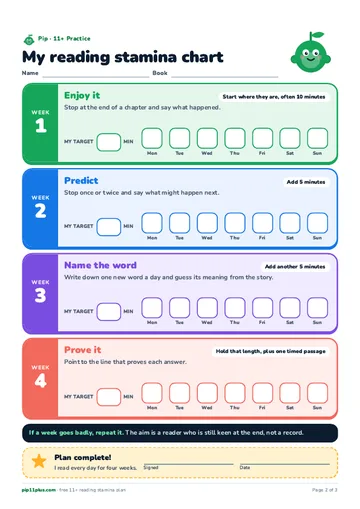
Lengthen one daily sitting a little each week, then add a timed passage in the last week. Stop at the unbroken length in the table above for your child’s year group.
| Week | Daily reading | What to focus on |
|---|---|---|
| Week 1 | Start where they are: the length they can manage happily today, often 10 minutes. | Enjoyment. Stop at the end of a chapter and say what happened. |
| Week 2 | Add 5 minutes. | Predict. Stop once or twice and say what might happen next. |
| Week 3 | Add another 5 minutes. | Name the word. Write down one new word a day and guess its meaning from the story. |
| Week 4 | Hold that length, then add one timed passage with questions. | Slow, careful answers. Point to the line that proves each one. |
If a week goes badly, repeat it. The aim is a child who is still keen at the end, not a record.
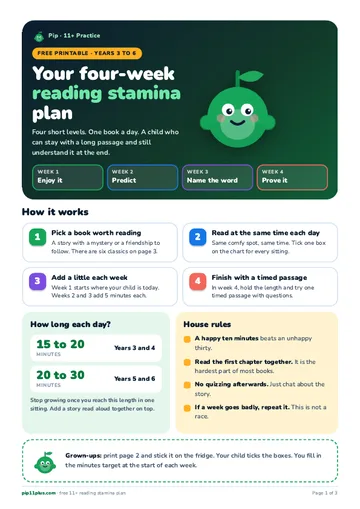
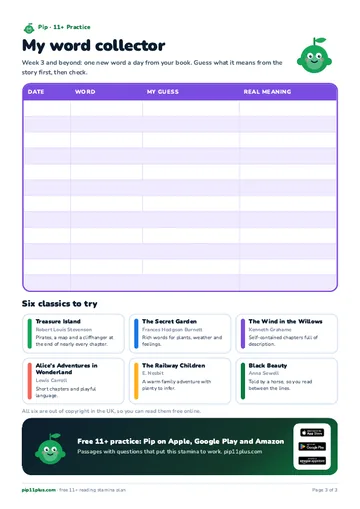
Get the 3-page four-week reading stamina plan
- 3 pages
- Ages 7 to 11
- Printable A4
- A fridge chart with a tick-box for every day
- A word collector for new words from the story
- Six classic books to start with
Thanks! Your download is on its way.
We'll only use your email to send this and, if you tick the box, our tips.
How does Pip’s English practice fit in?
Pip gives your child English passages with questions, free, so the stamina they build in books gets used on exam-style reading. After each answer, Pip explains it, which turns a wrong answer into something to learn from.
Pip is free to use, with an optional Pro upgrade. It works best as a few calm minutes on top of a daily book, never instead of one.
Want English practice that goes with this? Pip gives your child passages with questions, free, with an optional Pro.



You can also try our free English questions or print a free English paper. Pip is not affiliated with any publisher or exam board.
Frequently asked questions
What is reading stamina?+
Reading stamina is how long a child can read with real attention and still understand what they have read.
It is built a little at a time, in the same way as fitness, with books that are worth the effort.
How long should a child read each day for the 11+?+
A good guide is 15 to 20 minutes a day in years three and four, and 20 to 30 minutes in years five and six.
Add a story read aloud together, and remember that a happy ten minutes beats an unhappy thirty.
Are classic books too hard for children in years three to six?+
Not if you share the first chapters aloud and let the child take over once the story has hold of them.
Treasure Island, The Secret Garden and The Railway Children all work well this way.
Do audiobooks count towards reading stamina?+
Audiobooks build listening, vocabulary and attention to a long story, so they are well worth using.
They do not replace print for stamina, so pair an audiobook with the same book on paper where you can.
How do I stop my child rushing comprehension questions?+
Ask them to find and point to the line that proves every answer before they write it down.
Reading the question twice and covering the options until they have an answer in mind also slows the guessing.
Is Pip free to use?+
Yes. Pip is free to use, with an optional Pro upgrade.
It gives children English passages with questions, and explains each answer after they have tried.

The Pip team builds Pip, the 11+ and KS2 practice app for children in years three to six. We write these guides from real exam formats and past papers.