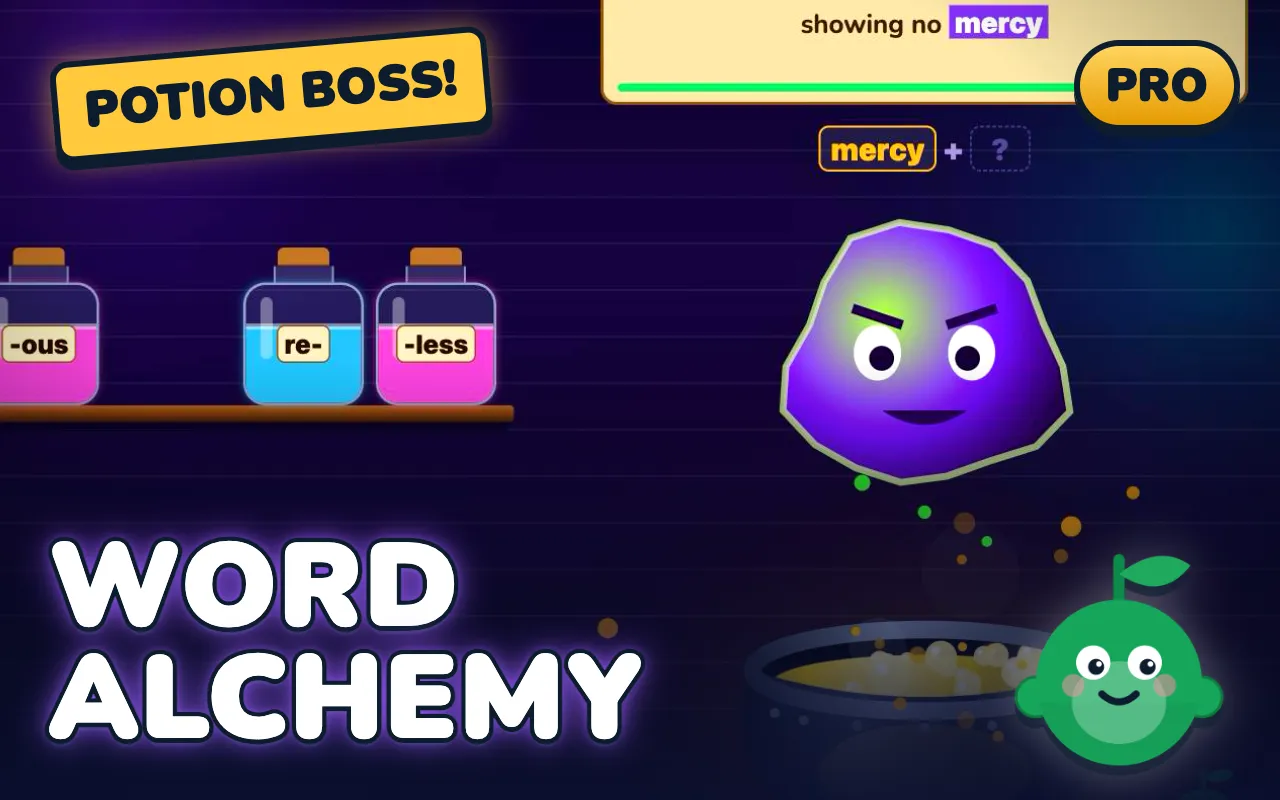
PRO Pip Pro unlocks this game in the app. The one-minute demo here is free, at every level.
How to play Word Alchemy
- Drag the right jars into the cauldron.
- Pick the right spelling to finish the potion.
- Brew fast: wrong spells fizzle and cost a heart.
What your child learns
It is a prefix game for KS2 and a suffix game for KS2, with the spelling rules for adding endings. These are the KS2 skills it practises.
- Prefixes such as un, dis, im, il and ir
- Suffixes such as ing, ment, tion and able
- Spelling rules: changing y to i, dropping e, doubling letters
- Word families
Real examples from the game:
Levels and difficulty
Nine levels with three hearts, starting with two jars and moving to three-jar brews. Levels add negative prefixes, rising heat, tion and sion endings, able or ible with typed answers, and a queue of customers.
The Grand Potion boss takes typed spells.
Pip moves your child up when they are ready and eases off when they struggle. Each run is short and focused, so it fits before school or homework.
Every level, in the free Pip app
Word Alchemy is part of Pip Pro in the app, with every level and saved progress.



Tips for parents and teachers
- Show how a prefix changes meaning: happy and unhappy.
- The y to i rule trips children up, so compare carrying with carried.
- Prefixes and suffixes help children work out new words in 11+ comprehension.
Word Alchemy FAQs
Is Word Alchemy free?+
The one-minute demo on this page is free. The full game, with every level, is part of Pip Pro in the app.
Can I play Word Alchemy online?+
Yes, for one minute. Press Play above to try the demo in your browser with nothing to install, then carry on in the Pip app.
What age is Word Alchemy for?+
Years 3 to 6, within KS2 (ages 7 to 11). The game adapts, so it suits a wide range of children.
Does Word Alchemy work on iPad?+
Yes. The demo works in Safari on iPad, and the full game is in the Pip app for iPad, iPhone, Android and Fire tablets.
What are prefixes and suffixes?+
A prefix goes at the start of a word to change its meaning, like un in unhappy. A suffix goes at the end, like ment in enjoyment.
When do children learn prefixes and suffixes?+
Suffixes start in Key Stage 1, and years three and four add prefixes such as dis, mis, im and il. Years five and six add endings like able and ible.
More games like this
More english games in the arcade, plus free practice pages.
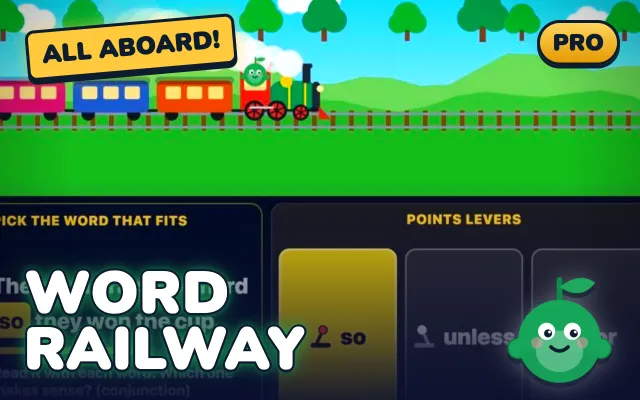
Sentence Railway PRO
Load the word carriages in order and flip the points in time.
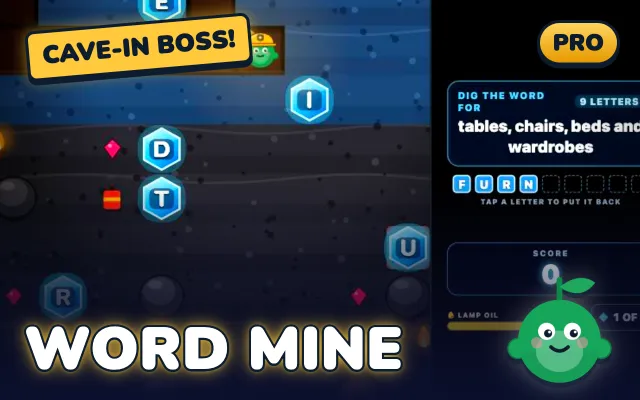
Word Mine PRO
Dig to the letter crystals and spell the word the clue describes.
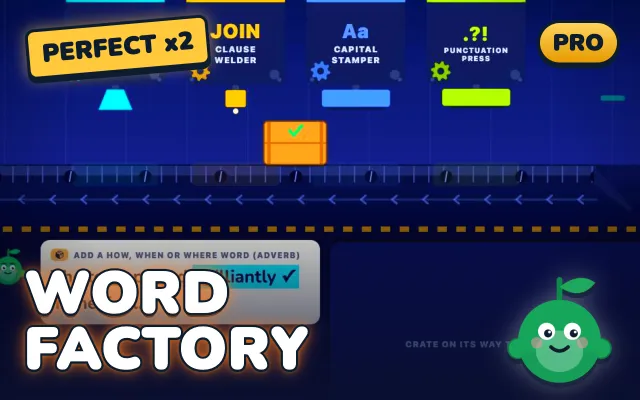
Grammar Factory PRO
Pick the option that makes each sentence right as the crate rolls past.
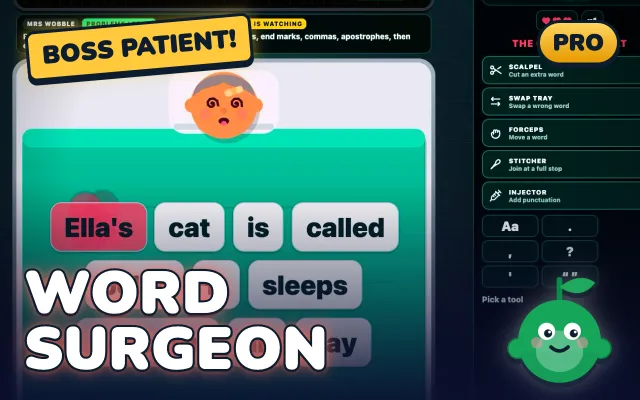
Sentence Surgeon PRO
Pick a tool and fix the broken word or punctuation in each sentence.
Bookmark the arcade
- On a computer: press Ctrl and D, or Cmd and D on a Mac.
- On iPad or iPhone: tap Share, then Add to Home Screen.
- On Android: tap the menu, then Add to Home screen.