A good 11 plus score is one that clears your target school's bar with room to spare. On the usual standardised scale, 100 is average, 110 is better than 3 in 4 children and 121 is around the top 8 percent.
But "good" means something different in Kent, in Bucks and at a super-selective school. Drag the slider below to see where any score sits, then check it against the bar in your area.
- 100 is the average, not a pass. Scores run from about 69 to 141.
- Most grammar areas set the bar between about 110 and 121 per paper. Bucks uses 121.
- Kent adds three papers: 332 in total, with no paper below a minimum.
- Super-selective schools rank children, so a good score there is often 130+.
Where does your child's score sit?
Move the slider to any standardised score. The curve shows how many children nationally would score lower, and which areas that score would usually qualify in.
11+ score bell curve
Based on the standard scale (average 100, standard deviation 15).
The national curve is a guide. Children who sit the 11+ are a self-selecting group, so beating 92 percent of all children does not mean beating 92 percent of the children in the exam room.
What each score really means
To see how a raw mark becomes one of these numbers, read how the 11+ is scored and marked, or try our 11+ score calculator.
A good 11+ score by area
Each area sets its own bar, and most move a little every year. These are the figures most often published or quoted; always check the latest with your local authority or school.
| Area | How it is scored | Qualifying score | A good score to aim for |
|---|---|---|---|
| Buckinghamshire | One standardised score | 121 | 125 or more for a safe margin |
| Kent | Three papers added up (max 423) | 332 total, no paper below 108 (2026 entry) | Above 332 with no weak paper; popular grammars need more |
| Slough | Standardised score | About 111 | Higher for oversubscribed schools |
| Lincolnshire | Two papers combined | 220 | Comfortably over 220 |
| Birmingham (KEVI) | Combined score, then ranked | 205 to qualify (2027 entry) | Well above 205, as places go by rank |
| Essex (CSSE) | Combined score, ranked by school | Varies by school, often quoted near 303 | Check each school's last offer score |
| Super-selective schools | Ranked top down | No fixed mark | Often 130+ per paper |
For the full list of areas, see what is the 11+ pass mark. Our guides to the Kent Test and the Bucks Transfer Test go deeper.
Kent score checker
Kent needs a total of 332 and no single paper below the minimum. Enter three scores to check both rules.
See which skills are ready before test day
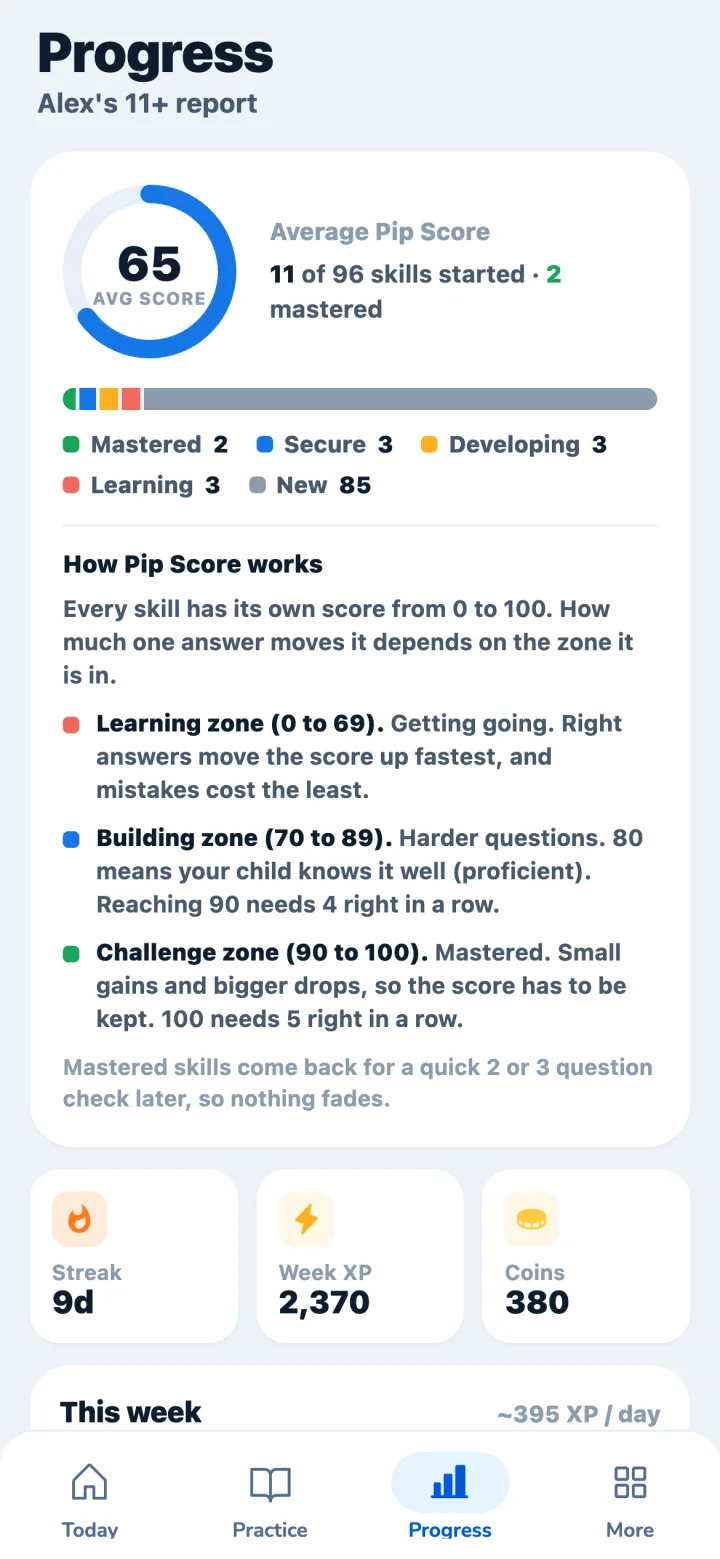
Pip gives every 11+ skill its own Pip Score, so you can spot the weak paper that would pull a total down.
- Maths, English, verbal and non-verbal reasoning
- A few minutes a day, matched to your child
- Free, with optional Pro



Good for which school?
The same score can be a clear pass in one place and a near miss in another. Ask these three questions about your target school.
- Is there a fixed qualifying score? Bucks and Kent publish one, so anything above it is a pass. Ranked schools do not, so "good" is whatever the last child offered scored.
- How oversubscribed is it? Passing does not guarantee a place, because some grammars fill up with children who scored well above the line.
- Are papers added up or checked one by one? In Kent a single weak paper can sink a strong total. A balanced profile is safer than one standout subject.
Turn a good score into a safe one
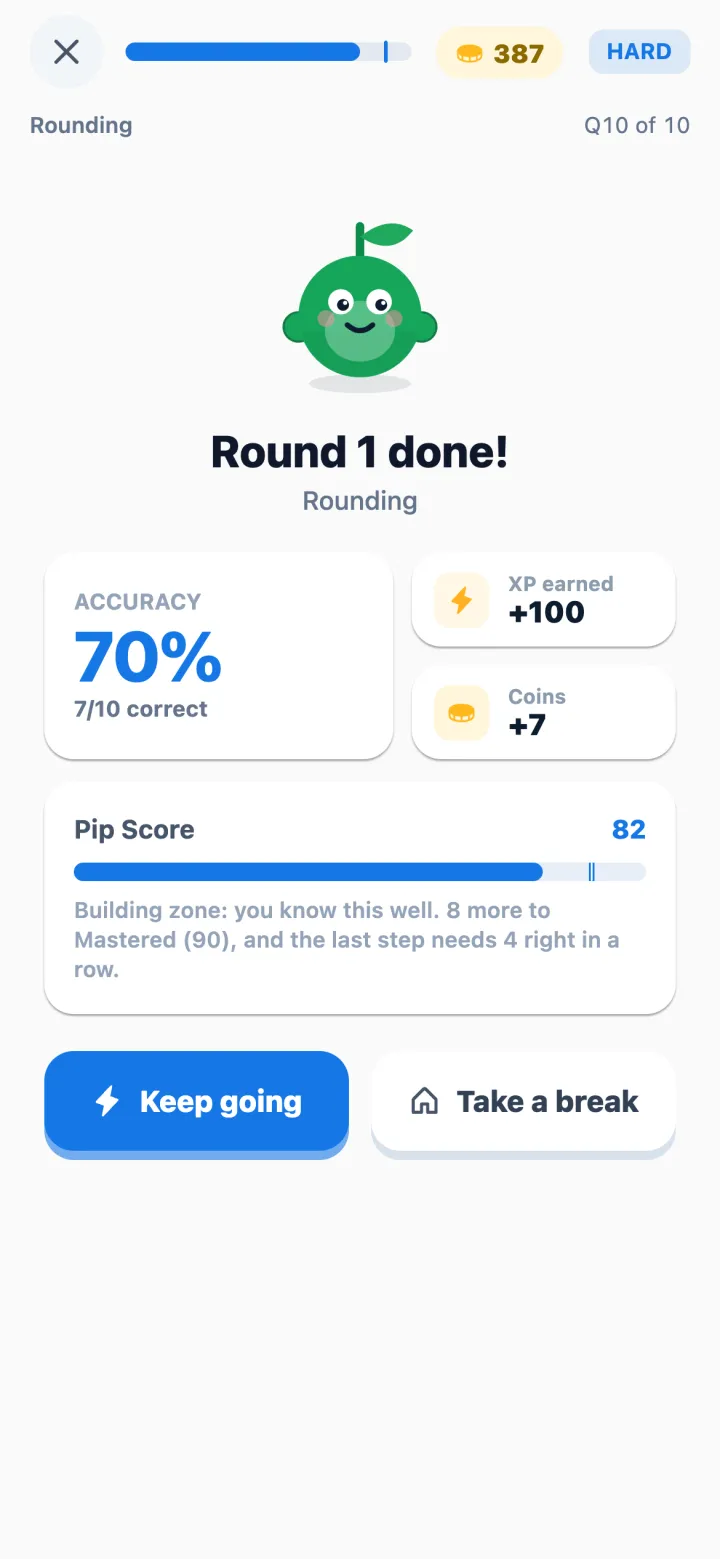
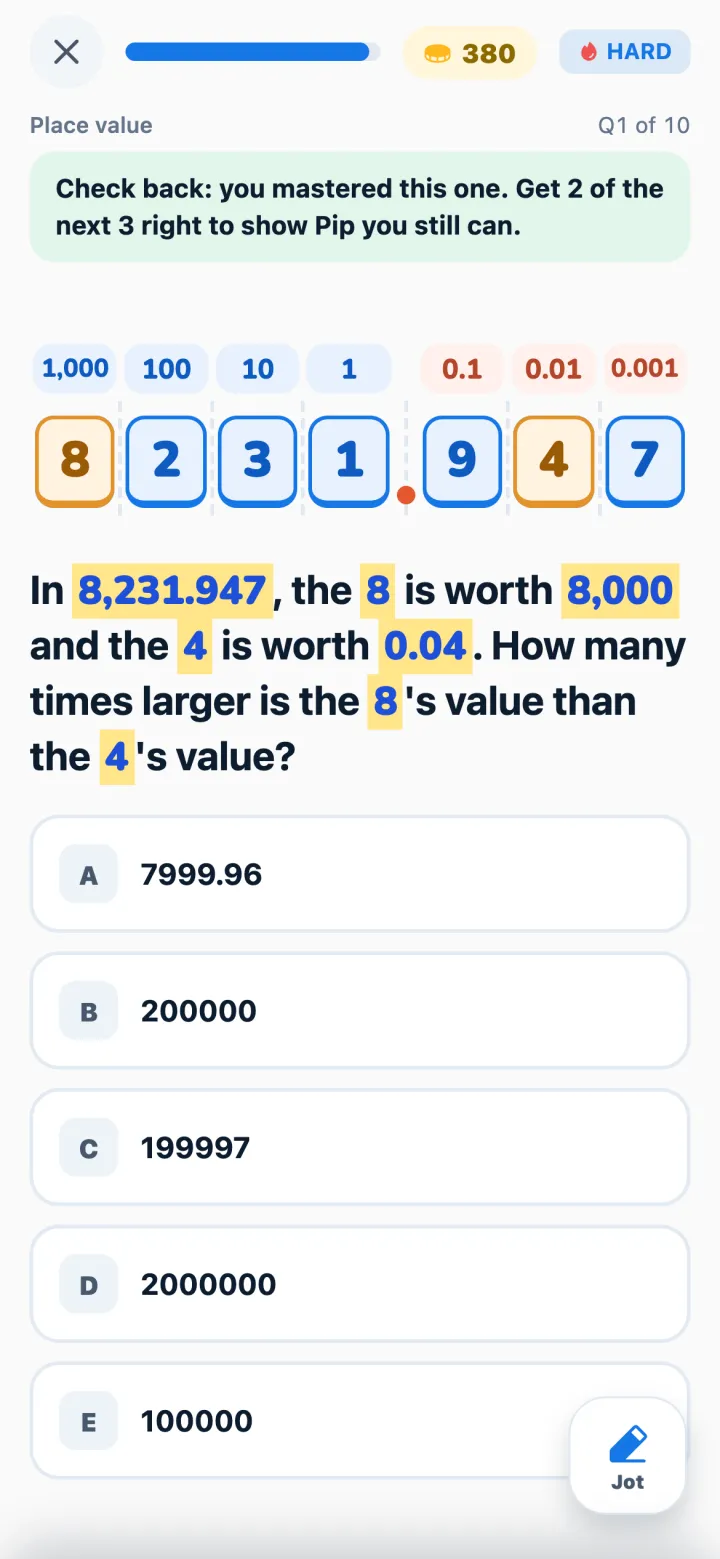
Pip builds the margin: short daily practice across every 11+ subject, with harder questions only when your child is ready.
What is a good score on practice papers?
Practice papers give a raw percentage, not a standardised score. As a rough guide, many tutors look for a steady 85% or more on full papers in the final term.
Papers vary a lot in difficulty, so the trend matters more than one result. Our guide to what practice score your child should be getting shows how to read them.
Got the score? What happens next
Results usually arrive in October of Year 6, before the 31 October secondary application deadline. See when 11+ results are released for your area.
If the score lands just under the line, you may have options such as a review or appeal. Read can you appeal an 11+ result.
Frequently asked questions
Is 110 a good 11+ score?+
A standardised score of 110 is above average, roughly better than 3 in 4 children nationally. It clears the bar in some areas but falls short of the published qualifying score in Buckinghamshire (121) and is unlikely to win a place at a super-selective school.
Is 121 a good 11+ score?+
Yes, 121 is the qualifying score for Buckinghamshire grammar schools and sits around the top 8 percent nationally. It is strong almost everywhere, but super-selective schools often fill their places with scores well above it.
What is a good 11+ score in Kent?+
Kent adds three scores together, and a child needs an aggregate of 332 or more, with no single paper below the minimum (108 for 2026 entry), to be found suitable for grammar school. Popular Kent grammars can need much more than 332 to get an offer.
What is the highest 11+ score?+
Most 11+ tests use a standardised scale that runs from about 69 to about 141 per paper. 141 is the ceiling and sits around the top 0.3 percent, so children at the top all score the same.
Is 100 a pass in the 11+?+
No, 100 is the average score of everyone who sat the test, not the pass mark. Grammar school areas usually set the bar between about 110 and 121 per paper, and super-selective schools often go higher.
What 11+ score should my child aim for?+
Aim for a margin above your target school's qualifying score, because the bar moves each year and one weak paper can pull a total down. For most grammar areas that means aiming for 115 to 125 per paper, and higher for super-selective schools.
What percentage is a good 11+ practice score?+
Practice papers are marked in raw percentages, not standardised scores. Many tutors treat a steady 85 percent or more on full papers as a sign a child is in range, but papers vary in difficulty, so watch the trend rather than one result.
Sources: Buckinghamshire Council Secondary Transfer Test, Kent County Council Kent Test, King Edward VI Foundation, Lincolnshire and Slough admissions pages, checked October 2026. Qualifying scores can change each year.

The Pip team builds Pip, the 11+ and KS2 practice app for children in years three to six. We write these guides from real exam formats and past papers.