A complete practice paper set matching FSCE's own published test framework: English, a dedicated Creative Writing paper and Maths capped at the end of Year 5. Full answers included, all free.
Prefer to practise on screen? Try our free FSCE writing prompts and practice questions, marked instantly.
Thanks! Your download is on its way.
We'll only use your email to send this and, if you tick the box, our tips.
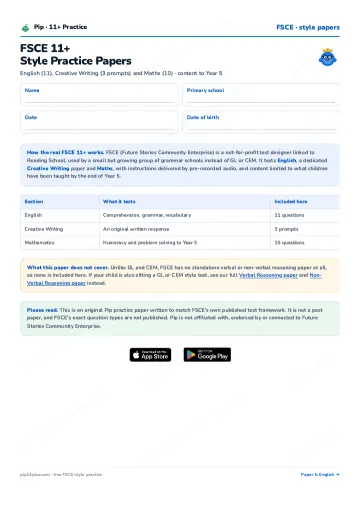
A school-designed test from Future Stories Community Enterprise, a not-for-profit linked to Reading School, used by a small but growing group of grammar schools instead of GL or CEM.
| Section | What it tests |
|---|---|
| English | Comprehension, grammar, vocabulary |
| Creative Writing | An original written response |
| Mathematics | Numeracy and problem solving to Year 5 |
| Reasoning | None, by design |
Format taken from FSCE's own published guidance via Reading School and the other schools that use it.
FSCE concentrates on three things, and is clearest understood by what it leaves out.
There is no standalone verbal or non-verbal reasoning paper at all. That is a deliberate design choice by FSCE, not an omission, so preparation time is better spent on broad English and maths than on reasoning drills.
English, a Creative Writing paper and Maths, matched to FSCE's own published test framework, with full mark schemes. Nine pages.
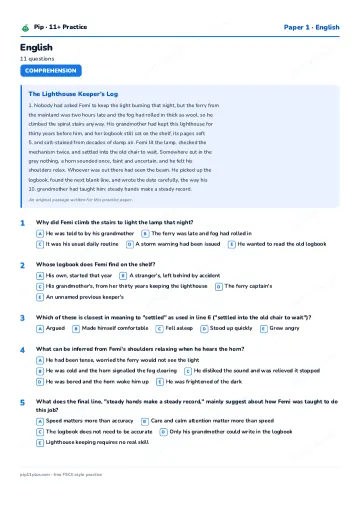
An original passage with questions covering retrieval, inference and vocabulary in context.
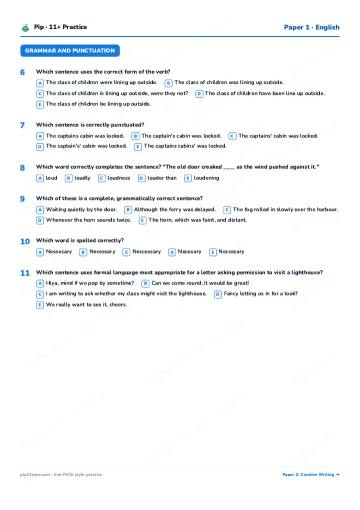
Six questions on correct usage, punctuation, spelling and register, testing the skill rather than terminology.
Three original prompts with planning, writing and proofreading timings, plus what markers reward.
Ten questions mixing arithmetic fluency with multi-step problem solving.
A clean printable answer sheet for the English and Maths papers.
Every answer explained. Every maths answer is computed and checked in code, never typed by hand.
FSCE has no verbal or non-verbal reasoning paper, so none is included here. If your child is also sitting a GL or CEM style test elsewhere, those skills still matter:
| Skill | Where to practise it |
|---|---|
| Verbal reasoning | Free Verbal Reasoning practice paper |
| Non-verbal reasoning | Free 18-question Non-Verbal Reasoning paper |
FSCE also delivers its instructions by pre-recorded audio, which a printed paper cannot reproduce. Practise following spoken instructions carefully and acting on details first time.
FSCE stands for Future Stories Community Enterprise, a not-for-profit organisation linked to Reading School that designed its own 11+ entrance test. It tests English, a dedicated creative writing paper and maths, and deliberately leaves out verbal and non-verbal reasoning.
Three components: English (comprehension, grammar and vocabulary), a standalone Creative Writing paper, and Maths covering numeracy and problem solving up to the end of Year 5.
No. Unlike GL and CEM, FSCE has no standalone verbal or non-verbal reasoning paper at all. If your child is also sitting a GL or CEM style test elsewhere, use Pip's separate Verbal Reasoning and Non-Verbal Reasoning practice papers for those.
GL and CEM both test reasoning alongside English and maths. FSCE drops standalone reasoning entirely, adds a creative writing paper, gives instructions by pre-recorded audio, and limits content to the end of Year 5.
FSCE maths content is capped at what children have been taught by the end of Year 5, covering the four operations, fractions, decimals, percentages, measurement, geometry and statistics.
Practise planning, writing and proofreading within a fixed time. This paper suggests 5 minutes planning, 25 minutes writing and 5 minutes checking. Marking rewards ideas, structure, description and technical accuracy rather than a single correct answer.
For 2025/26 entry around eight grammar schools use FSCE, including Reading School, Chelmsford County High School for Girls, Colyton Grammar School and several Yorkshire grammars. The seven Gloucestershire grammars and the five Trafford grammars join FSCE from September 2028 entry, so always confirm the current test with each school.
No. These are original Pip practice papers written to match FSCE's own published test framework. Pip is not affiliated with Future Stories Community Enterprise.
The full parent guide: what FSCE tests, which schools use it and how to prepare.
Read the guideTry four free FSCE style questions plus an original writing prompt in the browser.
Try free questionsEvery free Pip paper in one place, including the Bucks, CSSE, Tiffin, Sutton, Kent, Medway and ISEB style papers.
See all printablesPip is not affiliated with, endorsed by or connected to Future Stories Community Enterprise. These practice papers are original material matched to the published test framework and contain no official questions. The comprehension passage is our own writing.