
A tutor and a practice app are not the same purchase, so comparing them on price alone misses the point.
- A tutor gives teaching, diagnosis and accountability, usually in one weekly slot, charged per child.
- Pip gives daily practice, coverage and feedback, as often as you like, with no sign-up.
- For a specific, identified gap, a good tutor for a term will usually close it faster than any app.
- Most families who use both treat Pip as the practice between sessions, not the teaching.
This page sets out what a tutor gives you that Pip cannot, what Pip adds that a tutor cannot, and how the two work together.
We make Pip, so treat this as the Pip team's view. We have tried to be straight about where a tutor genuinely earns the money.
- A tutor buys you a person who notices things. Software does not notice things.
- Pip buys you the other six days of the week, for nothing.
- Most families who use both treat Pip as the practice between sessions, not as the teaching.
- Tutors can put every student they teach on one Pip plan, each with their own independent account.
At a glance
| Hiring a tutor | Pip 11+ | |
|---|---|---|
| Typical cost | £30 to £80 an hour | Free, or £7.99 a month for Pro |
| How often | Usually once a week | Every day, as often as you like |
| What it is | Teaching, diagnosis and accountability | Practice, coverage and feedback |
| Children covered | One, charged per child | As many as you like on one plan |
| Availability | Fixed slot, often a waiting list | Instant, no sign-up |
| Leaderboards | Varies, group classes often rank | None, by design |
| Best at | Fixing a specific, identified weakness | Keeping the habit going in between |
What a tutor gives you that an app cannot
We should be honest about this, because it is the part that matters most.
A tutor notices things. Sitting beside a child, a good tutor sees the question misread rather than misunderstood, the hesitation before a certain type of question, the confidence that drains after one wrong answer.
No app sees any of that. Pip sees which answers were wrong, which is a much thinner signal.
A tutor teaches. If your child genuinely does not know how to structure a story or handle a ratio problem, they need instruction, not another twenty questions.
A tutor creates accountability. A fixed slot with a real person who will ask how the week went is a powerful thing, and a phone app is easy to skip.
So if your child has a specific, identified gap, a good tutor for a term will usually close it faster than any app. That is a fair use of the money.
If you want an adaptive maths app for the gaps between sessions, our DoodleMaths review is a fair starting point. You can also compare DoodleMaths alternatives for UK families.
- A named weakness. Creative writing structure, worded maths problems, or timing under pressure.
- A specific test. Someone who has actually prepared children for the CSSE, the Kent Test or the ISEB Common Pre-Test, which are not interchangeable.
- Confidence. A child who has decided they are "bad at maths" often needs a person, not a screen.
What Pip gives you that a tutor cannot
The other six days. A weekly session reaches your child once; the habit is built in between, and that is the gap Pip fills.
The cost. Daily practice across maths, English, verbal reasoning and non-verbal reasoning is free, with no ads and no sign-up.
Every printable practice paper is free too, with a worked answer key.
Every child on one plan. Tutoring is charged per child, so a second child doubles the bill.
On Pip you add as many children as you like to the same plan, at no extra cost.
No waiting list. Good local tutors are often booked out a year ahead, particularly in the areas with the most competition.
The cost, side by side
Our own breakdown of 11+ tutoring costs puts UK tutors at £30 to £80 an hour, with London specialists at the top of that range.
Take a middle figure of £45 an hour, one session a week.
| Over a school year | Weekly tutor at £45/hr | Pip |
|---|---|---|
| Per month | About £180 | £0, or £7.99 for Pro |
| Per 39 week school year | About £1,755 | £0, or £69.99 a year for Pro |
| With a second child | Doubles, to about £3,510 | No change |
Hourly range from our tutoring cost guide, August 2026. A 39 week year is the usual English school year excluding holidays; many families tutor for fewer weeks than that.
The honest reading of that table is not "tutors are a rip-off". It is that you are buying two different things, and it is worth being clear about which one you actually need.
For tutors: Pip is built to sit alongside you
This part is deliberate, and it comes up often enough from tutors that it is worth spelling out.
Add as many children as you like under one plan
If you teach from a tablet, every student you work with can have their own account on the same plan. There is no per-child charge and no cap.
- Set mock tests and practice for each student, in the formats they are actually sitting.
- See weekly reports for every child separately, so you know what to open the next session with.
- Switch between accounts in two taps, straight from the players list.
- Every account is fully independent. No child sees another child's work or scores.
It is a supplement, not a replacement. Pip covers the practice between sessions so your hour can be spent teaching.
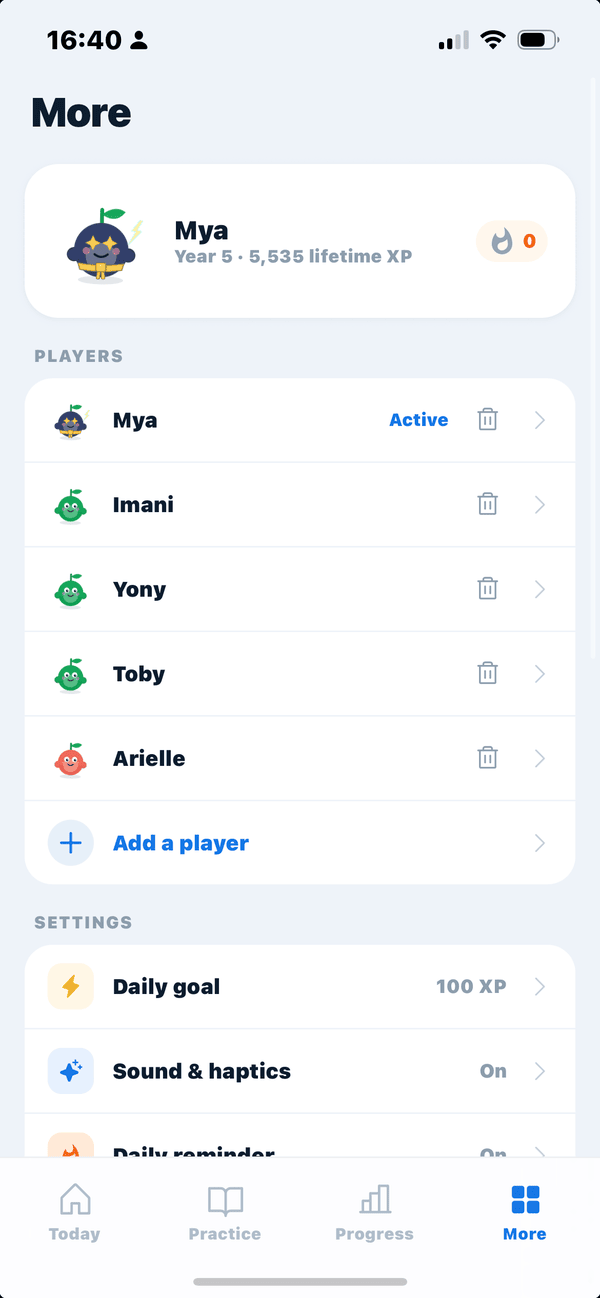
The same thing works for a family with three children, or for a grandparent helping with two.
Why there is no leaderboard
Plenty of learning apps rank children against each other, and group tuition classes often do the same.
Pip has no leaderboard, and that is a deliberate choice
The 11+ is competitive enough on its own. Pip is not about comparing children or pitting students against one another.
There is no ranking, no class table, and no way for one child to see another child's scores. Each account is truly independent.
For a tutor that also removes an awkward problem: your students never see each other's results, so you are not managing a pecking order you did not ask for.
A child competes with their own last score in Pip, through a daily goal and a streak. That is the only comparison the app makes.
How families actually combine the two
The pattern we hear most often is simple.
The tutor teaches, the app rehearses. The session covers what the child cannot yet do; the week covers the adaptive practice that makes it stick.
The tutor sets the target, the app supplies the volume. If a session exposes weak non-verbal reasoning, that is what gets practised for the next six days.
Mocks stay with the tutor. A tutor watching a child sit a timed paper learns things a score never shows.
So which do you need?
Start with Pip alone if your child is generally on track and you mainly need consistency, coverage and something to do daily. It is free, so there is nothing to weigh up.
Add a tutor if there is a specific weakness you can name, or your child is sitting an unusual format, or confidence rather than knowledge is the problem.
If a tutor is out of reach financially, that is a real constraint and not a moral failing. Pip plus the free papers is a genuinely serviceable preparation, and it costs nothing.
Our post on whether your child needs a tutor goes into the decision in more depth, and whether expensive tutoring beats free resources looks at what the evidence actually supports.
Frequently asked questions
Can Pip replace a tutor for the 11+?+
For most families it supplements rather than replaces. A tutor gives you a person who watches your child work, spots the misread question or the confidence wobble, and adjusts on the spot, which no app does.
Pip covers the part a weekly session cannot: short, daily practice in between, at no cost. If money is the constraint and a tutor is out of reach, Pip on its own is a great deal better than nothing, and it is free.
How much does an 11+ tutor cost compared with Pip?+
UK 11+ tutors typically charge 30 to 80 pounds an hour, with London specialists at the top of that range. At 45 pounds an hour, one session a week is about 180 pounds a month, or roughly 1,755 pounds across a 39 week school year.
99 pounds a month or 59 pounds a year.
Can a tutor use Pip with their students?+
Yes, and it is built to allow it. You can add as many children as you like under one Pip plan, so a tutor working from a tablet can set practice and mock tests for each student they teach, and see each child's progress separately.
Every account is independent and you switch between them in a couple of taps.
Does Pip have a leaderboard?+
No, deliberately. Pip is not about comparing children or pitting students against one another, so there is no leaderboard, no class ranking and no way for one child to see another child's scores.
Each account is entirely independent.
Is a tutor worth it for the 11+?+
It depends on what you are buying. If your child has a specific, identifiable gap, such as not knowing how to structure a story or freezing on timed papers, a good tutor for a term will usually fix it faster than any app.
If you mainly need consistent practice and coverage, that is the expensive way to buy something a free app already does.
What should I look for when hiring an 11+ tutor?+
Ask which specific test your child is sitting and whether the tutor has prepared children for that exact format, because the Kent Test, CSSE, the ISEB Common Pre-Test and a GL paper are not interchangeable. Ask what happens between sessions, since a tutor who sets nothing for the other six days is only reaching your child once a week.
Try Pip free, with as many children as you like
Daily adaptive practice in maths, English, verbal reasoning and non-verbal reasoning. No ads, no sign-up, no leaderboard, and every printable paper free.