- Long division uses the bus stop method in three steps: Share it, Bus stop it, Check it.
- Work left to right and, for each digit, divide, write, carry. Whatever is left at the end is the remainder.
- Example: 635 ÷ 4 = 158 r 3. Check by multiplying back: 158 × 4 = 632, plus 3 makes 635.
- Keep any zero in the middle of the answer: 412 ÷ 4 is 103, not 13.
Long Division Video: The Bus Stop Method in 3 Steps
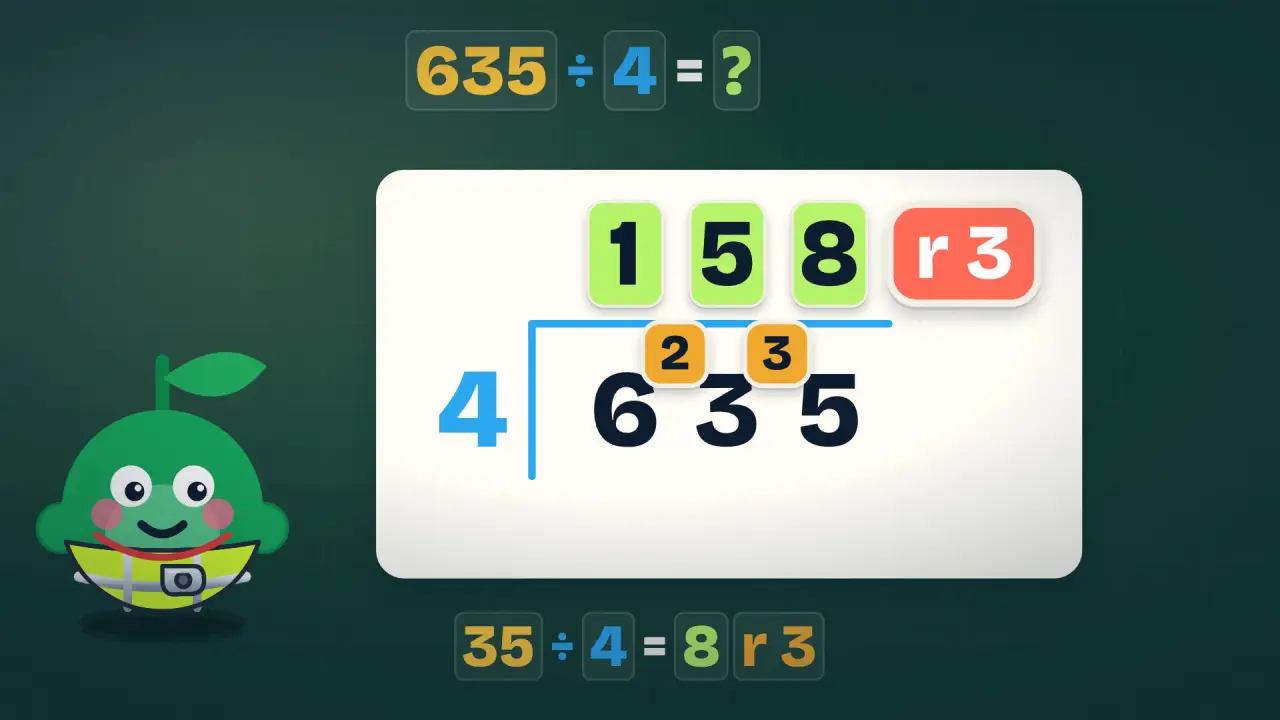
Watch Pip work through 635 ÷ 4 first, then try it below. This long division video uses the same words as the rest of the page: Share it, Bus stop it, Check it.
How Do You Do Long Division? Step by Step
You do long division in three parts. Share it: set the numbers out as a bus stop. Bus stop it: work along the digits from left to right, and for each one, divide, write, carry. Check it: multiply back. Here is long division step by step for 635 ÷ 4.
- Step 1 · Share it
Set it out as a bus stop
Write 635, the number you are dividing (the dividend), under the roof. Write 4, the number you divide by (the divisor), outside the bus stop. The answer will go on top.
- Step 2 · Bus stop it
Divide, write, carry
How many lots of 4 go into 6? 6 ÷ 4 = 1 with 2 left over. Write 1 on top. Carry the 2 in front of the 3 to make 23.
- Step 3 · Bus stop it
Same three moves on the next digit
23 ÷ 4 = 5 with 3 left over, because 5 × 4 = 20. Write 5 on top. Carry the 3 in front of the 5 to make 35.
- Step 4 · Bus stop it
The last digit gives the remainder
35 ÷ 4 = 8 with 3 left over. Write 8 on top. No digit is left to carry into, so 3 is the remainder. The answer is 158 r 3.
- Step 5 · Check it
Multiply back
158 × 4 = 632. Add the remainder: 632 + 3 = 635. That is the number you started with, so the answer is right.
Those are all the long division steps you need for a 1-digit divisor. The small carried numbers are why many UK schools call this short division. Long division is the same bus stop with the working written underneath. Short division carries the leftover in your head. Long division writes it down. You will see both below.
Long Division Examples
These long division examples cover the places children most often go wrong: a first digit that is too small, a zero in the middle of the answer, and a remainder at the end. Each one is worked as a bus stop, with the carried numbers in amber.
156 ÷ 3: a front zero can go
3 does not go into 1, so carry the 1 to make 15. 15 ÷ 3 = 5. Then 6 ÷ 3 = 2. The answer is 52. The empty front place needs no zero.
412 ÷ 4: keep the middle zero
4 ÷ 4 = 1. Then 4 does not go into 1, so write 0 on top and carry the 1 to make 12. 12 ÷ 4 = 3. The answer is 103, not 13.
487 ÷ 5: an answer with a remainder
5 does not go into 4, so make 48. 48 ÷ 5 = 9 with 3 left over. 37 ÷ 5 = 7 with 2 left over. The answer is 97 r 2.
725 ÷ 7: zero, then a remainder
7 ÷ 7 = 1. 7 does not go into 2, so write 0 and make 25. 25 ÷ 7 = 3 with 4 left over. The answer is 103 r 4.
Long Division With Remainders
Long division with remainders works the same way. When no digit is left to carry into, whatever is left over is the remainder. Write it after the answer with an r: 635 ÷ 4 = 158 r 3.
The remainder rule: the remainder is always smaller than the number outside the bus stop. If your remainder is 4 or more when dividing by 4, another 4 goes in, so the answer on top needs to be bigger.
What the remainder means in a word problem
In word problems, read the question again before you write the answer. Sometimes you round up, sometimes you round down.
- Round up: 387 stickers go into pouches of 8. 387 ÷ 8 = 48 r 3. The last 3 stickers still need a pouch, so you need 49 pouches.
- Round down: 245 photos fill pages of 6. 245 ÷ 6 = 40 r 5. Only 40 pages are full, because the last 5 photos do not make a whole page.
Long Division Strategies
Three long division strategies make the method faster and catch mistakes before they cost marks.
Estimate first
For 635 ÷ 4: 4 × 100 = 400 and 4 × 200 = 800, so the answer is between 100 and 200. An answer of 15 or 1580 must be wrong.
Write a times table list
Before dividing by a bigger number, write its first nine multiples down the side. Then each step is a look-up, not a guess, and quick multiplication facts make the list fast to write.
Check by multiplying back
Answer × number outside, then add the remainder. If you do not get the number you started with, look for the step that went wrong.
Dividing by a 2-digit number: 453 ÷ 12
This is where long division writes the working down. First, the times table list for 12:
- Start with 45, the first part that 12 goes into. How many lots of 12 go into 45? 3. Write 3 on top. 3 × 12 = 36. Subtract: 45 − 36 = 9. Bring down the 3 to make 93.
- How many lots of 12 go into 93? 7. Write 7 on top. 7 × 12 = 84. Subtract: 93 − 84 = 9. No digit is left, so 9 is the remainder.
- Check it: 37 × 12 = 444, add 9 = 453. That matches 453.
Long Division Steps for Kids
Here are the long division steps for kids in plain words. Print the card and keep it next to the homework, or share it with your child’s tablet.
How to do the bus stop
Divide, write, carry. Then check it.- Set it out. The big number goes under the roof. The number you share by goes outside.
- Divide the first digit by the number outside. Too small? Use the first two digits.
- Write the answer on top, right above that digit.
- Carry what is left over. Write it small, in front of the next digit.
- Do it again: divide, write, carry, until there are no digits left.
- Something left at the end? That is the remainder. It is always smaller than the number outside.
- Check it: answer × number outside, add the remainder. You should get the number you started with.
Long Division Questions Parents Ask
What is the bus stop method?
The bus stop method is the way UK schools set out division. The number you are dividing goes under a line that looks like a bus shelter, the number you divide by waits outside, and the answer is written on the roof. You work from left to right: divide, write, carry.
Is the bus stop method short division or long division?
In most UK schools the bus stop with small carried numbers is called short division. Long division uses the same bus stop but writes the working underneath: multiply, subtract, then bring down the next digit. Children usually use long division when dividing by a 2-digit number.
What are the long division steps?
Divide the first digit (or the first two if the first is too small), write the answer on top, then carry what is left over in front of the next digit. Repeat until no digits are left. Anything left at the end is the remainder. Finish by multiplying back to check.
How do you do long division with remainders?
Work through the bus stop as normal. When there is no digit left to carry into, whatever is left over is the remainder, written as r and the number, for example 158 r 3. The remainder must always be smaller than the number outside the bus stop.
What year do children learn long division?
In the National Curriculum for England, children divide numbers up to 4 digits by a 1-digit number using short division in Year 5, and they interpret remainders. In Year 6 they divide numbers up to 4 digits by a 2-digit number using long division.
What if the first digit is smaller than the number outside?
Write 0 on top, or leave it empty, and carry the whole digit in front of the next one. For 156 ÷ 3, 3 does not go into 1, so carry the 1 to make 15. A zero at the very front of the answer can go.
Why is there a zero in the middle of some answers?
When the number outside does not go into the part you are dividing, the answer for that place is 0, and you must write it. For 412 ÷ 4 the answer is 103, not 13. Leaving out a middle zero is one of the most common mistakes.
How can my child get more long division practice?
Use the free interactive long division worksheets at the end of this page. Each set has 40 questions that mark themselves, a Show me how button for the working, and a printable version with answers. Press New questions for a fresh set.
Long Division Worksheets
These free long division worksheets give your child 40 long division problems in five groups, from 2-digit numbers up to dividing by a 2-digit number. Type the answer and the remainder, press Check, and the sheet marks it. Leave the remainder empty when there is none. Stuck? Press Show me how to see the working.
For pencil practice, print the sheet. The boxes print empty, and the answers go on a separate page. New questions gives a fresh set of long division practice every time.
Long division worksheet · Set 1 · Name: ______________________ · Date: ____________
A2-digit ÷ 1-digit
No remainder. A good place to start.
- 192 ÷ 2292
- 216 ÷ 2216
- 318 ÷ 2218
- 445 ÷ 3345
- 554 ÷ 2254
- 665 ÷ 5565
- 727 ÷ 3327
- 884 ÷ 6684
B3-digit ÷ 1-digit
No remainder. Watch for zeros on top.
- 9432 ÷ 88432
- 10252 ÷ 66252
- 11172 ÷ 22172
- 12234 ÷ 66234
- 13360 ÷ 66360
- 14828 ÷ 99828
- 15160 ÷ 55160
- 16105 ÷ 77105
C3-digit ÷ 1-digit with remainders
Every one has a remainder.
- 17824 ÷ 77824
- 18515 ÷ 33515
- 19565 ÷ 44565
- 20971 ÷ 88971
- 21493 ÷ 44493
- 22933 ÷ 77933
- 23305 ÷ 33305
- 24911 ÷ 99911
D4-digit ÷ 1-digit
Some have remainders, some do not.
- 258128 ÷ 778128
- 269567 ÷ 559567
- 274204 ÷ 994204
- 284847 ÷ 334847
- 292767 ÷ 882767
- 306782 ÷ 666782
- 316678 ÷ 336678
- 323647 ÷ 333647
E÷ a 2-digit number
Long division. Write the times table first.
- 33584 ÷ 1616584
- 341731 ÷ 24241731
- 35810 ÷ 1212810
- 362958 ÷ 17172958
- 374655 ÷ 17174655
- 383897 ÷ 22223897
- 39727 ÷ 1212727
- 40552 ÷ 2121552
Answers · Set 1
- 1. 92 ÷ 2 = 46
- 2. 16 ÷ 2 = 8
- 3. 18 ÷ 2 = 9
- 4. 45 ÷ 3 = 15
- 5. 54 ÷ 2 = 27
- 6. 65 ÷ 5 = 13
- 7. 27 ÷ 3 = 9
- 8. 84 ÷ 6 = 14
- 9. 432 ÷ 8 = 54
- 10. 252 ÷ 6 = 42
- 11. 172 ÷ 2 = 86
- 12. 234 ÷ 6 = 39
- 13. 360 ÷ 6 = 60
- 14. 828 ÷ 9 = 92
- 15. 160 ÷ 5 = 32
- 16. 105 ÷ 7 = 15
- 17. 824 ÷ 7 = 117 r 5
- 18. 515 ÷ 3 = 171 r 2
- 19. 565 ÷ 4 = 141 r 1
- 20. 971 ÷ 8 = 121 r 3
- 21. 493 ÷ 4 = 123 r 1
- 22. 933 ÷ 7 = 133 r 2
- 23. 305 ÷ 3 = 101 r 2
- 24. 911 ÷ 9 = 101 r 2
- 25. 8128 ÷ 7 = 1161 r 1
- 26. 9567 ÷ 5 = 1913 r 2
- 27. 4204 ÷ 9 = 467 r 1
- 28. 4847 ÷ 3 = 1615 r 2
- 29. 2767 ÷ 8 = 345 r 7
- 30. 6782 ÷ 6 = 1130 r 2
- 31. 6678 ÷ 3 = 2226
- 32. 3647 ÷ 3 = 1215 r 2
- 33. 584 ÷ 16 = 36 r 8
- 34. 1731 ÷ 24 = 72 r 3
- 35. 810 ÷ 12 = 67 r 6
- 36. 2958 ÷ 17 = 174
- 37. 4655 ÷ 17 = 273 r 14
- 38. 3897 ÷ 22 = 177 r 3
- 39. 727 ÷ 12 = 60 r 7
- 40. 552 ÷ 21 = 26 r 6
Free long division worksheets with answers: pip11plus.com/how-to-do-long-division

The Pip team builds Pip, the 11+ and KS2 practice app for children in years three to six. We write these guides from real exam formats and past papers.