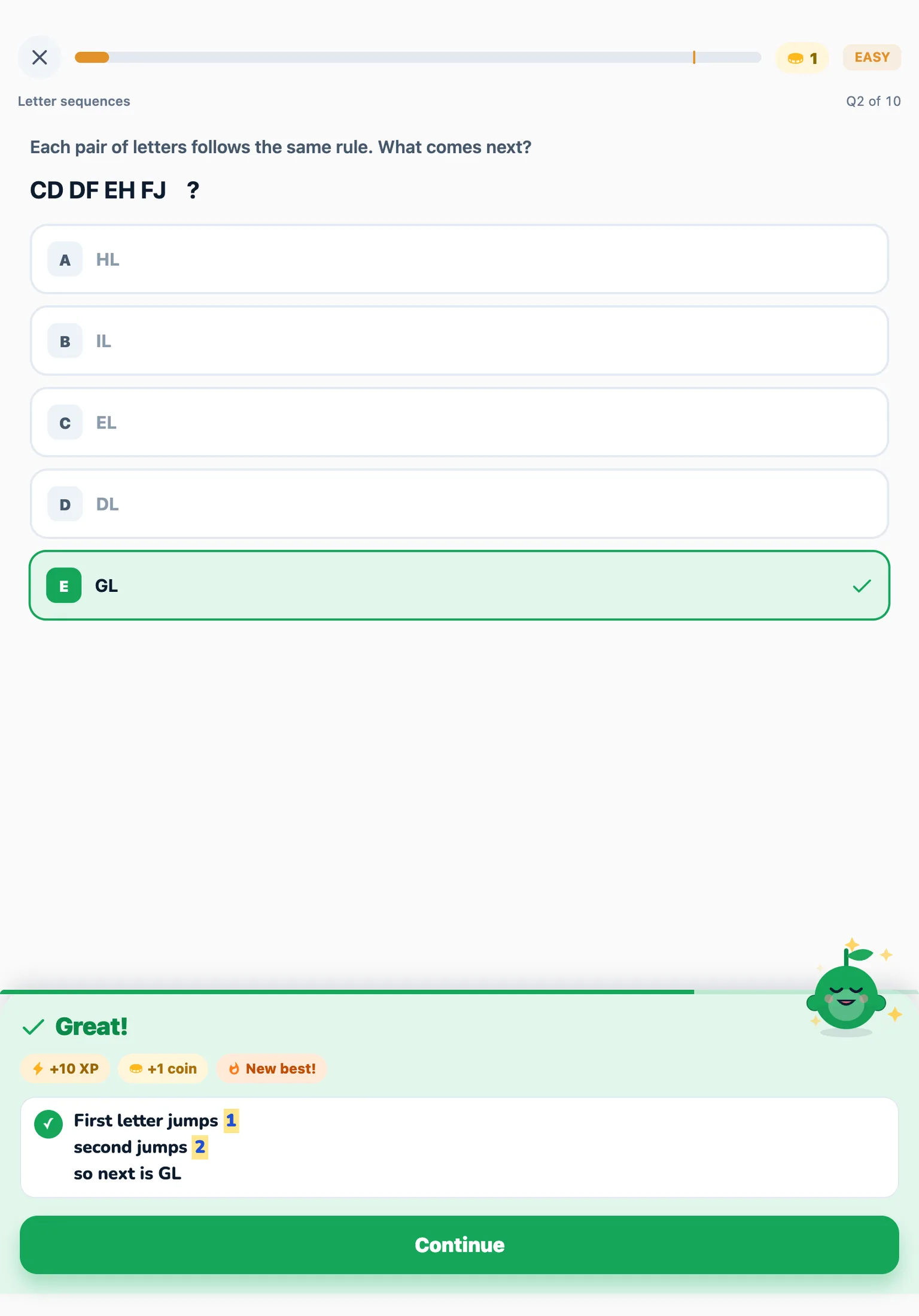
A letter series is a run of letters that follows a hidden pattern, and you name what comes next. In CQ DR ES the next group is FT, because the first letters and the second letters each move 1 place forward every time. Count the gap between neighbours, not the letters themselves.
- Find the gaps. Count how far each letter is from the next one, and write plus or minus.
- Look for the shape. The gap may stay the same, grow, or swap between two sizes.
- Pairs are two series. Treat the first letters and the second letters separately.
- Go round the corner. After Z comes A, so a gap can carry you past the end.
- Check every term. Your rule must fit all the visible letters.
What is a letter series?
A letter series is a row of letters or letter pairs with the last one missing. You pick the missing one from five choices, A to E. A typical question shows TD WF ZH CJ followed by FL and asks which pair comes next.
Each position follows its own rule. In the first letters T, W, Z, C the gap is plus 3 every time, so the next first letter is F. In the second letters D, F, H, J the gap is plus 2, so the next second letter is L.
Why count the gaps, not the letters?
Listing the letters you can see does not show you the rule. The gaps do. For B D F H J the next letter is L the letters skip one each time, and every gap is plus 2.
Number the alphabet with A as 1 and Z as 26. Then every gap is simple subtraction, and the same working suits any series. Going backwards gives a minus gap: in T R P N the next letter is L every gap is minus 2.
What patterns can the gaps follow?
Three shapes cover most questions. Learn to spot them and you can answer quickly.
- Steady. The gap never changes. S Q O M K continues with I.
- Growing. The gap gets bigger by 1 each time: plus 1, plus 2, plus 3, plus 4. B C E H L continues with Q.
- Doubling. The gap doubles: plus 1, plus 2, plus 4. A B D H continues with P.
- Alternating. The gap swaps between two sizes. A C B D C continues with E, because the gaps go plus 2, minus 1, plus 2, minus 1 and then plus 2.
What happens after Z?
The alphabet goes round like a clock face. After Z comes A. If a letter number goes over 26, take away 26. If a gap would take you below 1, add 26.
How do letter pairs work?
When each term is two letters, split the series into a first-letter track and a second-letter track. Solve each track alone, then put the two answers together.
The two tracks can follow different rules. The second letters may stay still, or move backwards while the first letters move forward. Check both tracks before you choose an answer.
What if the pairs are chained?
In a chained series the second letter of one pair becomes the first letter of the next. Look for it when the second letter of each pair reappears at the start of the one after.
When is a series not clear enough?
Real questions show enough letters for only one rule to fit. If you meet a short run, more than one rule can fit and the answers differ. Take only the three letters B C E. Swapping gaps give F, a growing gap gives H, and a doubling gap gives I.
This is why a good question has at least four terms. When you build your own series, add one more term until a single rule is left.
Pip teaches the gap method, then brings back the letter series your child misses.
- Pip Teaches first
- Missed types return
- Phone and tablet



Free, with optional Pro
Try the gap counter
Type a series and the counter draws the gap between every neighbouring pair, then names the rule. In Predict it mode you get a fresh question and can show the gaps to help you.
How do you solve one in 20 seconds?
- Number the letters. Write the alphabet position under each one.
- Write the gaps. Put plus or minus between neighbours, and add 26 if you went round the corner.
- Name the shape. Steady, growing, doubling or alternating.
- Do pairs separately. One track at a time.
- Check the whole row. The rule must fit every visible term, then apply it once more.
For a related puzzle where letters change by a rule inside a word, read 11 plus letter codes. For the other code types in the same family, see number codes and the wider verbal reasoning questions guide. For letter puzzles that test spelling rather than the alphabet, try missing letters and hidden words.
Which slips cost the most marks?
These are the common ones. Each gives a tempting wrong answer, and the correct one is shown beside it.
- Repeating the last gap in a growing series. B C E H L continues with Q. Repeating the gap of 4 gives P. If the gaps keep changing, the next one changes too.
- Going the wrong way. S Q O M K continues with I. Going forward by mistake gives M. Look at the sign of the gaps.
- Swapping the pair. BX DV FT HR continues with JP. Writing the answers in the wrong order gives PJ. First track first, second track second.
- Off by one. B D F H J continues with L. Counting the starting letter as the first step gives M. Count the jumps, not the letters you land on.
- Using only the first gap. A B D H continues with P. Taking the first gap of 1 again gives I. Check every gap before deciding.
Practise with 6 levels
Eight questions a round. After each answer you see the working for the right option and a reason each of the others fails. Keys 1 to 9 pick an answer and Enter moves on.
Free letter series worksheet with answers
Choose a band of levels, press New sheet for a fresh set of 12 questions, then print. The answers are on a separate page, with the gap working for each one.
Letter series: Levels 3 and 4, sheet 1
NameDate
Answers: Levels 3 and 4, sheet 1
Frequently asked questions
What is a letter series?+
A letter series is a row of letters or letter pairs that follows a pattern, with the last term missing. You work out the rule from the visible terms and choose the missing one from five options, A to E.
How do you solve a letter series?+
Give each letter its alphabet number, then write the gap between each neighbouring pair. Name the pattern in the gaps, such as steady, growing or alternating, and use it once more to reach the missing term.
What does CQ DR ES come next as?+
The next group is FT. The first letters C, D, E go up 1 each time, so the next is F. The second letters Q, R, S also go up 1 each time, so the next is T.
What happens when the series goes past Z?+
The alphabet wraps round, so Z is followed by A. In X Z B D every step adds 2, and Z plus 2 lands on B. The next letter is F.
How do letter pairs work in a series?+
Treat the first letters and the second letters as two separate series. Find the rule for each one, then put the two answers together. In BX DV FT HR the first letters add 2 and the second letters take away 2, so the next pair is JP.
What is a chained series?+
In a chained series the second letter of one pair becomes the first letter of the next pair. In AB BD DG GK the second letter of each pair starts the next, and the following pair is KP.
What patterns do the gaps follow?+
The common shapes are a steady gap, a growing gap that rises by 1 each time, a doubling gap, and a gap that alternates between two sizes. Some series mix these across the first and second letters.
How many letters do you need to be sure of a rule?+
At least four terms. With only B C E, three different rules fit and give F, H or I, so a well-made question shows enough terms for only one rule to fit.
How is a letter series different from a letter code?+
A letter series asks what comes next in a run of letters. A letter code changes the letters of a word by a rule, such as moving each one forward. Both use the same alphabet numbers and gaps.
Where can I find free letter series worksheets with answers?+
This page has a free printable generator. Choose a band of levels, press New sheet for 12 fresh questions, and print. The answers are on a separate page with the gap working for each one.

The Pip team builds Pip, the 11+ and KS2 practice app for children in years three to six. We write these guides from real exam formats and past papers.