The best 11 plus adaptive practice tools change the next question based on your child's answers, not just their age or year group. We looked at seven for children who sit the 11+ in 2027 or 2028, so years 4 and 5 now, with year 3 families welcome too.
Adaptive is one of those words that gets stuck on almost every 11 plus product page. Some tools really do move the difficulty up and down after each answer.
Others give you a placement test, then a fixed course. We checked what each provider says on its own site, and we added a simple test you can run at home in ten minutes.
- Adaptive means the next question depends on your child's last answers. A fixed question bank gives every child the same questions in the same order.
- Our pick is Pip. It adapts the question level, the next skill and the review time, in a free app built for years three to six.
- For a named target school, look at Atom Learning. For a free check on where your child stands, try Eduentry.
- Prices run from free to £69.99 a month, so run the test in the guide before you pay.
Which tool is the quick pick for your family?
Our connection: Pip publishes this guide and lists itself first. We think it's the best fit for this job, and you can judge that against the test below.
Facts about the other six tools come from each provider's own public pages, read on 16 October 2026. Prices are listed only where a provider states them publicly, and they change, so check the live page before you buy.
The order shows fit for adaptive 11 plus practice at home, not measured results. Tool names and logos belong to their owners.
What does adaptive mean for 11 plus practice?
Adaptive means the tool picks your child's next question using the answers they've already given. Right answers make the work harder.
A run of wrong ones makes it easier, or sends your child to a simpler skill to rebuild first.
That matters for the 11+ because your child isn't equally strong everywhere. A year 4 child might fly through word codes and wobble on fractions of amounts.
A good tool treats those as two separate things.
Some tools only adapt at the start. They give a placement test, set a level and then run a fixed course.
That's still personalised, and it can work well. Changing after every answer is a different thing, though, so it pays to know which one you're buying.
How can you tell adaptive practice from a fixed question bank?
Run the same skill twice and compare what happens after different answers. It takes about ten minutes, and most tools offer a free trial or a free check where you can do it.
- The swap test. On one run, answer the first five questions on a skill all correctly. On a second run, get the first five wrong on purpose. Now compare question six. If both runs show the same question, nothing is adapting.
- The stuck test. Miss three in a row. A real adaptive tool eases the level, or drops to a simpler skill and brings your child back. A fixed bank just shows question four.
- The next-week test. Leave it seven days. Do skills your child did well on come back for a quick check, and do shaky ones come back sooner? Review timing is a form of adapting too.
What most parents get wrong here is buying the plan first and testing afterwards. Run the test on a trial.
If question six never changes, you've learned that for free.
How did we choose these seven tools?
We picked tools that practise 11+ content, or the maths and English underneath it, and that say on their own pages that they adapt. We read each provider's public pages on 16 October 2026 and kept only claims we could see there.
We also read the current search results for 11 plus adaptive practice. Most roundups are published by a tool that ranks itself first.
Few define adaptive or give you a way to check it. That's the gap this guide tries to fill, and we're one of those publishers too.
The sources behind every claim are linked in each entry.
How do the seven tools compare?
The table shows what each provider says adapts, what it covers and what it costs. Prices are as stated on public pages on 16 October 2026.
| Tool | What adapts | 11+ subjects | Where it runs | Price |
|---|---|---|---|---|
| Pip 11+ Practice | Question level, next skill, building-block step-back, review timing | Maths, English, Verbal, Non-Verbal, plus KS2 SATs | iPhone, iPad, Android, Amazon Appstore | Free app. Pip Pro £69.99 a year |
| Atom Learning | Question difficulty and a weekly plan to the exam | English, Maths, Verbal, Non-Verbal (Science too) | Website | £59.99 a month for Exam Prep. Free trial |
| CENTURY | AI picks what to study next from strengths, gaps and misconceptions | English, Maths, Verbal, Non-Verbal | Online, on tablets, laptops and desktops | Entrance exams from £20.66 a month on an annual plan |
| Ace 11+ | A learning ladder built from a 20-question diagnostic | Maths, English, Verbal | Website | £19.99 a month. 7-day free trial |
| Eduentry | Question difficulty within a short test, scored on a standard scale | Verbal, Non-Verbal, English, Maths | Website | Free |
| DoodleMaths | A maths work programme built from each answer | Maths only | App, with a parent dashboard | From £7.99 a month. 7-day free trial |
| IXL UK | Skill challenge, diagnostic-led recommendations | Maths and English skills | Online membership | £7.99, £12.99 or £15.99, depending on plan |
The seven tools, one by one
Pip 11+ Practice: adaptive practice for years three to six
Pip adapts at three levels: the question, the skill and the review. It's an app for children in years three to six, covering 11+ Maths, English, Verbal Reasoning and Non-Verbal Reasoning.
KS2 SATs has its own separate route.
Each skill carries its own Pip Score, from 0 to 100. That number sets how hard the next question is.
Anything up to 69 is the learning zone, 70 to 89 is the building zone, and 90 or more counts as mastered. Nobody gets to 90 on one lucky guess, because it takes a run of right answers.
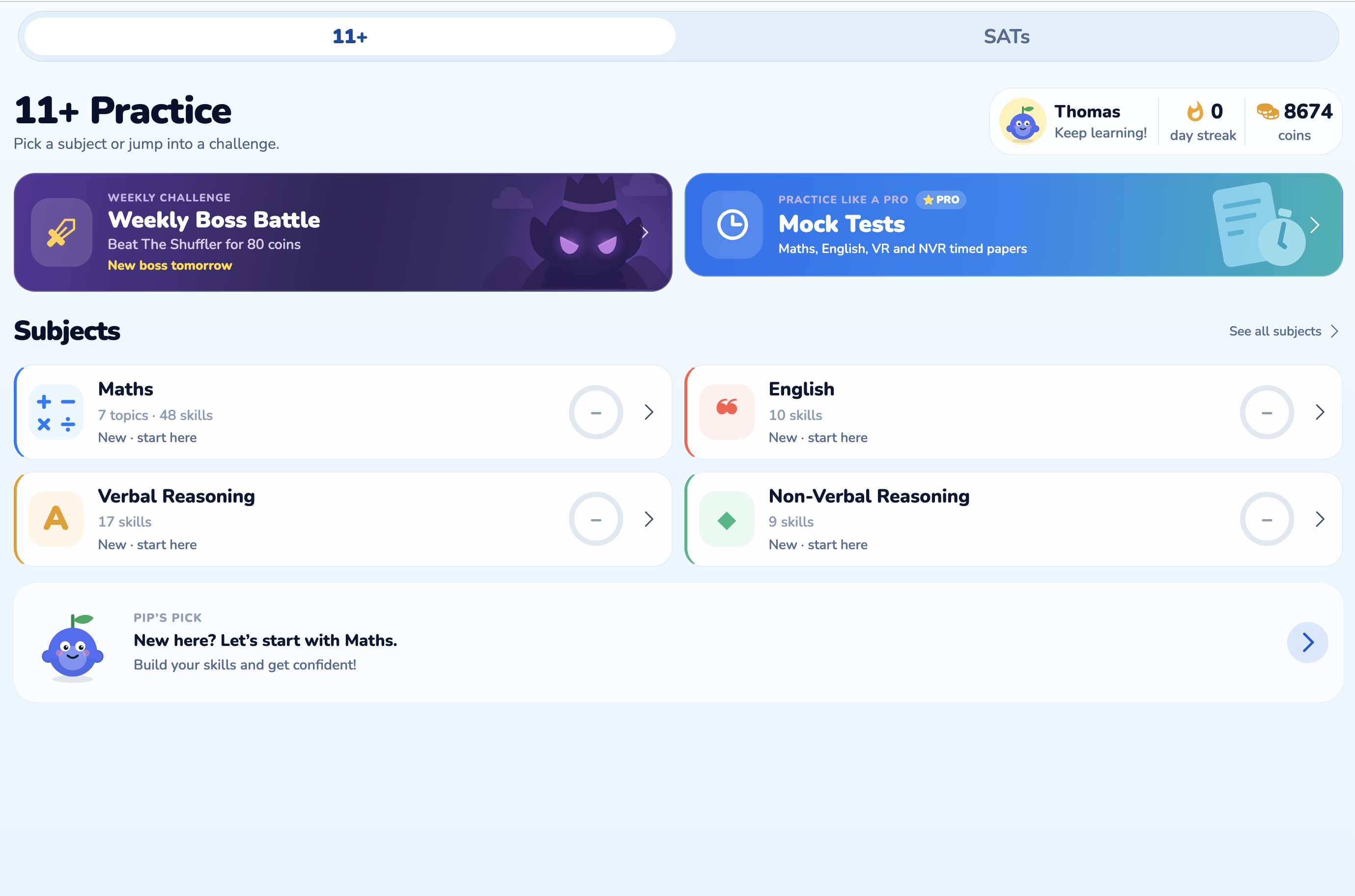
- The right question The level moves with each answer in a skill.
- The right skill Gaps, thin evidence and review time all feed the suggestions.
- The right time Mastered skills return for a check, strong ones less often.
Miss several in a row and Pip eases the level, or steps back to the building block underneath, such as equivalent fractions or times tables. Once that's steady, your child goes back to the original skill.
Fast, careless slips get a "slow down and check" nudge instead of easier questions, which we think is fairer to a child who knows the work and was simply rushing.
Your child keeps full freedom to pick any topic, and the adaptive plan sits alongside that as a helpful guide. Children can practise for as long as they like.
Pip Pro adds a study plan built back from the exam date, short Pip Teaches lessons, timed mocks and optional Extreme challenges.




Atom Learning: a weekly plan built around a target school
Atom is the tool we'd call Pip's closest rival. It adapts in two ways.
Its page says the algorithm "adjusts the level of questions" to how your child learns, and you pick your target grammar schools so it can map out a weekly plan right up to exam day.
Four subjects are covered: English, Maths, Verbal and Non-Verbal Reasoning. The top plan throws in unlimited mock tests.
Atom is a web tool, and we couldn't see a mobile app mentioned on its page. Children can start in year 3 or 4, it says, and there are free year 3 and 4 resources if you'd like a feel for it first.

CENTURY: gap-led 11+ courses that carry on past year 6
CENTURY's AI looks back over your child's answers, spots gaps and misconceptions, then recommends what to study next. Its page calls this a constantly adapting pathway for each pupil.
Its 11+ courses cover English, maths, verbal and non-verbal reasoning, and they prepare children for GL, CEM and ISEB tests. In the verbal and non-verbal courses you'll find explainer videos and hundreds of practice questions.
CENTURY runs online on tablets, laptops and desktops. The main home plan covers primary and secondary school, so it can stay useful long after the 11+ is done.
Ace 11+: a learning ladder for years 4 and 5
Ace 11+ opens with a 20-question diagnostic. From that, it builds what it calls a custom learning ladder, so the basics come before the harder challenges.
Get stuck or get one wrong, and its tutor gives step-by-step help.
Maths, English and verbal reasoning are on offer, and it's built for years 4 and 5. Parents get a dashboard that shows mastered and weak topics, flags repeat mistakes and sends a weekly summary email, which is handy in a busy week.
We didn't see full mock exams or a dedicated app mentioned on the page.
Eduentry: a free adaptive check with a standardised score
Eduentry gives you a free adaptive test and a standardised score at the end, where 100 is the average. Its questions get harder or easier depending on your child's responses.
The method is called Item Response Theory, and Eduentry links it to the CAT4 test.
There are four subjects in each test: verbal reasoning, non-verbal reasoning, English and maths. Each one has 15 adaptive questions and takes about 10 to 15 minutes.
The page describes it as a diagnostic, so it tells you where your child stands but won't give them daily work. Eduentry suggests starting in year 4 or 5.

DoodleMaths: an adaptive maths work programme
DoodleMaths shapes each child's maths work around their answers. According to its help page, the Proxima technology analyses every answer and designs the learning path from there.
The programme is maths only, for ages 4 to 14, and it follows the KS1 and KS2 curriculum. Children use the app while parents get an online dashboard, and you can set work on any topic yourself.
English and reasoning aren't included.
For a wider maths shortlist, see our best 11 plus maths apps and websites.

IXL UK: a huge catalogue of adaptive skills
With more than 8,000 adaptive skills, IXL UK is the widest tool on this list by a long way. It uses student work plus a Real-Time Diagnostic to build personalised skill plans, and its maths and English run from Reception to Year 13.
It calls itself a curriculum platform. So you're practising school skills here, rather than 11+ papers.
That's handy for topic gaps in year 3 to 5 maths and English, though a parent usually still has to pick the goal.
Which adaptive tool should you choose?
Pick the one that adapts in the way your child needs, then test it. For full 11+ coverage in years three to six, we'd start with Pip.
Atom is the closest match if you have a named school and want a weekly plan. Want a free snapshot first?
Eduentry costs nothing.
Frankly, there's nothing wrong with a fixed question bank, as long as it's priced like one. The monthly plans here run from free to £69.99, so a ten-minute test is cheap insurance.
Whatever you choose, add a past-style paper every few weeks. Our free 11 plus practice papers are a good place to start, and the guide to the best 11+ apps covers the wider field.
Questions parents ask about adaptive 11 plus practice
What does adaptive mean in 11 plus practice?
Adaptive means the next question depends on how your child answered the last ones. A right run makes the questions harder, and a run of misses makes them easier or sends your child back to a simpler skill.
If every child gets the same questions in the same order, the tool is a fixed question bank.
Which 11 plus adaptive tool is best for year 4?
For a year 4 child who will sit in 2028, Pip is our pick because it's built for years three to six and adapts the question level, the next skill and the review time. We publish Pip, so that's a disclosed editorial choice.
Ace 11+ is built for years 4 and 5, and Atom says children can start in year 3 or 4.
Is there a free adaptive 11 plus tool?
Yes. The Pip app is free, with optional Pip Pro, and its adaptive practice and review are in the free app.
Eduentry says its adaptive 11+ tests are free with no subscription, though it works as a diagnostic check, not a daily practice course.
Atom, CENTURY and Ace 11+ offer free trials or free checks before you pay.
Do I need an adaptive tool as well as past papers?
Most families use both. Adaptive practice builds each skill at the right level, and a paper in the style of your child's test shows how they cope with the real format and the clock.
Check which provider writes your child's exam, because the format differs between areas.
How can I test whether a tool is really adaptive?
Run it twice on the same skill. Answer the first five questions all right in one run and all wrong in the other, then compare question six.
If the two questions are the same, the tool isn't adapting.
Then leave it a week and see whether older skills come back for review.
When should my child start adaptive 11 plus practice?
Year 3 or 4 is a good time to start, because there's no exam pressure yet and gaps are easy to fix. Atom says children can start in year 3 or 4, Ace 11+ is built for years 4 and 5, and Eduentry suggests starting in year 4 or 5.
Pip is built for years three to six.

The Pip team builds Pip, the 11+ and KS2 practice app for children in years three to six. We write these guides from real exam formats and past papers.