A fronted adverbial is a word, phrase or clause moved to the start of a sentence to say when, where or how, with a comma after it, as in Before breakfast, Ines fed the rabbits.
Before breakfast, Ines fed the rabbits.
The blue chip is the adverbial. It jumps to the front, a comma pops in behind it, and “Ines” keeps its capital letter because it is a name.
- A fronted adverbial is a word, phrase or clause moved to the start of a sentence.
- It says when, where, how, how often or why, and a comma follows it.
- Year 4 learns it, and the Year 6 test has asked about the comma in 2024, 2025 and 2026.
- Use one or two in a paragraph, not one in every sentence.
What is a fronted adverbial?
A fronted adverbial is an adverbial that has been moved in front of the main part of a sentence. An adverbial is a word or group of words that works like an adverb, so it says when, where, how, how often or why something happens. “Fronted” only means “put at the front”.
The national curriculum glossary describes a fronted adverbial as an adverbial that has been moved before the verb, and it notes that fronted phrases are often followed by a comma (gov.uk glossary). Fronted adverbials and commas after them are named in the Year 4 grammar list, where the example is Later that day, I heard the bad news.
Three parts: the adverbial, the comma, then the main clause. The main clause could stand alone as a sentence. The adverbial could not.
Try it: move the adverbial to the front
Tap the blue chip, drag it, or press a button, and it moves to the other end of the sentence. At the front it brings a comma with it. The badge shows which question the adverbial answers.
Move the blue chip
Start with the adverbial at the end. Move it to the front and watch the comma and the capital letter.
Mum took us to the park after lunch.
Here “after lunch” is at the end, so it is not fronted and needs no comma. Move it to the front.
Where does the comma go?
The comma goes straight after the whole fronted adverbial and before the subject. Read the sentence aloud and your voice makes a tiny pause in that spot.
The bars are the sounds of each word. The dashed gap is the pause, and that is where the comma sits.
- Long or short, one comma. The comma comes after the whole adverbial, however long it is: When the waitress came over, we ordered pancakes.
- The capital letter moves. A fronted adverbial takes the capital letter, so the subject drops to a small letter unless it is a name: Later that afternoon, the clouds rolled in.
- No comma at the end. The comma belongs to the fronted position. Put the same adverbial at the end and the comma goes: We ordered pancakes when the waitress came over.
- One short word is a grey area. After a single word such as “Soon” or “Perhaps” many writers leave the comma out: Soon, the snow began to fall. and Soon the snow began to fall. are both fine. The quizzes here leave that case out so every answer is clear. If you are unsure, add the comma.
Here the comma is missing: Inside the cave the explorers found a pool of glowing water. It needs one after “cave”.
The types of fronted adverbial
Fronted adverbials answer a question about the verb: when, where, how, how often or why. Sorting them by that question is the quickest way to spot one and to choose a good one.
Time
In the middle of the night, a strange noise woke Callum.
Place
Behind the shed, a hedgehog was curled up asleep.
Manner
With a loud cheer, the team ran onto the pitch.
Frequency
Every Saturday, Gran bakes lemon biscuits.
Reason
Because the road was icy, Dad drove very slowly.
Order
First, Mia filled the bucket with water.
Some openers do not fit these questions neatly. In Although it was raining, Zainab walked to school. the opener is a fronted adverbial clause too, and it takes a comma just the same.
60 fronted adverbials to borrow
Pick a question, then tap a word to see it at the start of a sentence.
Pip 11 Plus gives children short rounds of SPaG questions like these and adjusts as their answers improve.
- Short daily rounds
- Adapts as your child improves
- Free to start



Free, with optional Pro
One word, a phrase or a clause
A fronted adverbial can be a single word, a phrase or a whole clause. All three take the same comma. The longer ones say more.
| Form | In a sentence | How to tell |
|---|---|---|
| One word | Later, Tom ran home. | Only one word before the comma. |
| Phrase | After lunch, Mum took us to the park. | Several words, but no verb of its own. |
| Clause | When the waitress came over, we ordered pancakes. | Has its own subject and verb: “waitress came”. |
A clause that opens a sentence like this still counts. The glossary says subordinate clauses can be adverbials, so “When the waitress came over” is a fronted adverbial, and so is any other opener that does the same job.
Fronted adverbial or just the subject?
If the opener says who or what the sentence is about, it is the subject, not a fronted adverbial. To check, try moving the opener to the end. A fronted adverbial usually survives the move. A subject does not.
Fronted adverbial
Before breakfast, Ines fed the rabbits.Move the opener to the end:Ines fed the rabbits before breakfast.It still makes sense, so “Before breakfast” was an adverbial.
Just the subject
The old oak tree creaked in the wind.Move the opener to the end:Creaked in the wind the old oak tree.It breaks, so “The old oak tree” is the subject. Nothing has been fronted, so no adverbial comma is needed.
Watch openers that start with an -ing word. In Running for the bus, my bag fell open. the opener seems to describe the bag, as if the bag was running. Make the person the subject instead: Running for the bus, I dropped my bag.
What the Year 6 test has asked
The Year 6 grammar, punctuation and spelling test has asked about commas after fronted adverbials in 2024, 2025 and 2026. The government's test framework lists it as content area G5.6b (test framework). Across the three years the opener was a single word, a clause and a phrase, so children need all three forms.
Pupils tick the correctly punctuated sentence. The opener is the single word “Sadly”.
Pupils add one comma after a fronted clause that begins “When the waitress came over”.
Pupils tick the correct sentence. The opener is a phrase that starts “According to the weather forecast”.
The question wording below is our own, but the four formats are the ones to expect: tick, add a comma, underline and rewrite.
Tick the correct sentence
Which sentence is punctuated correctly?
A. Under the old oak tree we found a tiny silver key.
B. Under the old oak tree, we found a tiny silver key.
C. Under the old oak tree we found, a tiny silver key.
Answer: B
Add the missing comma
Inside the cave the explorers found a pool of glowing water.
Answer: after “cave”. Inside the cave, the explorers found a pool of glowing water.
Underline the adverbial
Next to the library, there is a small park with a pond.
Answer: “Next to the library”, which says where.
Rewrite it
Move the adverbial to the front: The wind howled at the top of the hill.
Answer: At the top of the hill, the wind howled.
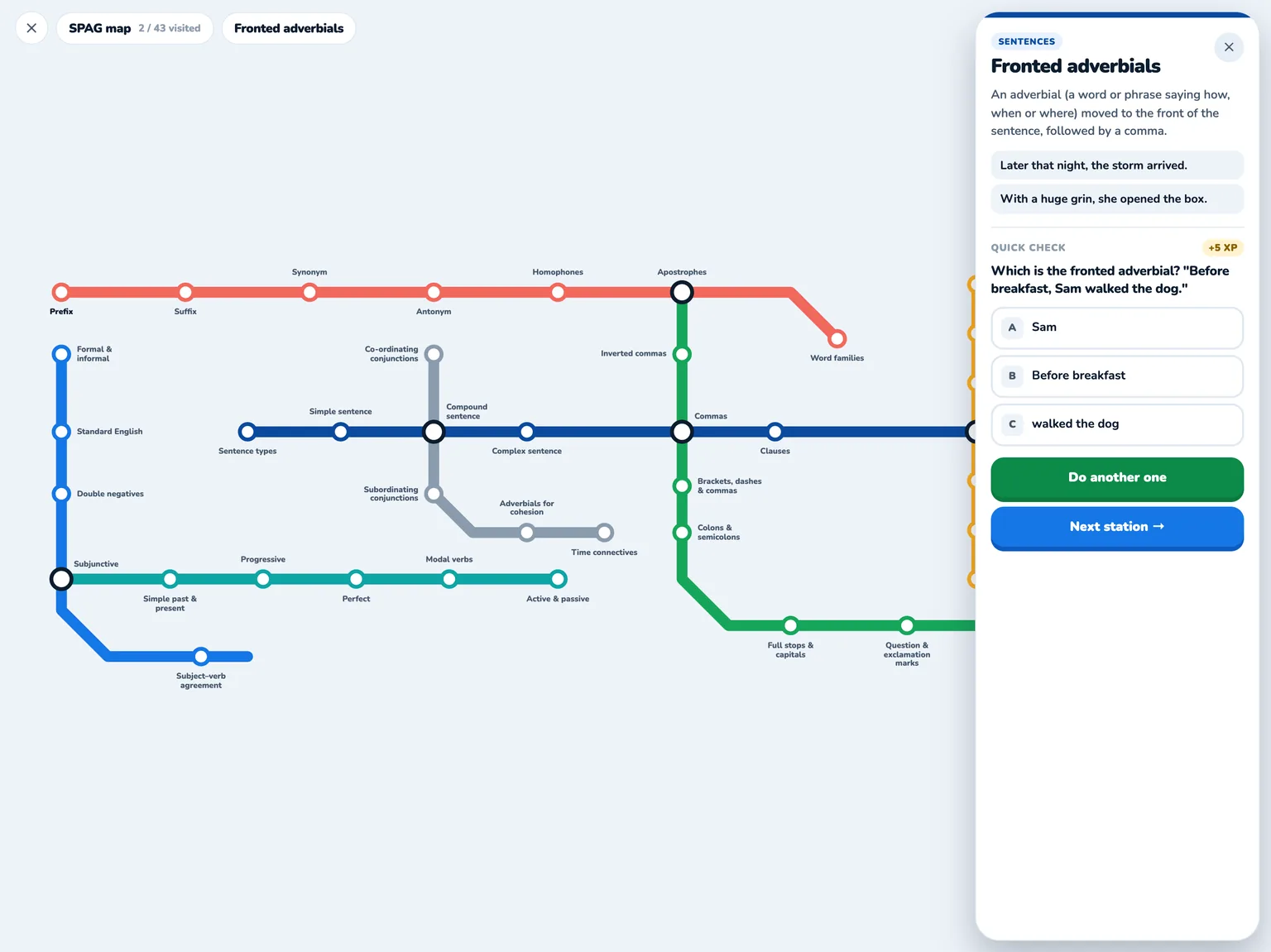
Keep going after this page with the Year 4 SPaG guide, the free SPaG practice paper and the interactive SPaG map.
Tap where the comma goes
Each sentence arrives with no comma. Tap the gap between two words to place it. The right place is always straight after the fronted adverbial.
Place the comma
Tap the thin line between two words.
Free fronted adverbials quiz
Eight questions a round, six levels, from spotting the adverbial to test-style comma questions. When you pick a wrong answer, the quiz names the rule you missed.
Pick a level and start
Press 1 to 4 on a keyboard to answer. Score 75% or more in a round to unlock the harder level.
| Level | You do this |
|---|---|
| 1 Spot it | Pick the words that are the fronted adverbial. |
| 2 Fronted or not | Pick the sentence that has a fronted adverbial. |
| 3 What does it tell us | Say whether it tells you when, where, how, how often or why. |
| 4 The right comma | Pick the correctly punctuated sentence. |
| 5 Add the comma | Say where the missing comma goes. |
| 6 Test mix | A mix of all of these, with longer clauses and an odd one out. |
Do not start every sentence the same way
Use a fronted adverbial to vary your openers, not to open every sentence. One or two in a paragraph is plenty. Count the commas: if every sentence starts with one, the writing sounds like a list.
Before: five out of five
Early in the morning, we packed the tents. After breakfast, we walked to the lake. Quietly, we crept to the edge of the water. Suddenly, a heron lifted into the air. Afterwards, we watched it fly over the hills.
After: one out of five
Early in the morning, we packed the tents. We walked to the lake after breakfast. Everyone crept to the edge of the water. A heron lifted into the air. We watched it fly over the hills.
The fix is simple: keep the best fronted adverbial and move the others back to the end of their sentences, or start with the subject.
Free printable fronted adverbials worksheet
Press New sheet for ten fresh questions, then Print. Page one is the questions and page two is the answers, both on A4.
Make a worksheet
Four underline questions, three comma questions and three type questions. Every sheet is different.
How to practise at home
Ten minutes of talking about sentences works better than a long worksheet. Try one of these a few times a week.
- Read it aloud. Ask your child to read a sentence and tap the table where their voice pauses. That pause is the comma.
- Swap it round. Take a plain sentence, such as The lighthouse shone steadily during the storm. and move the adverbial to the front: During the storm, the lighthouse shone steadily.
- Hunt in a book. Find three sentences that open with a comma-ended group of words. Say whether each one tells you when, where or how.
- Keep it to one. When your child writes a paragraph, ask for one good fronted adverbial, not one in every sentence.
When commas after openers feel easy, move on to relative clauses, which add extra information after a noun, and then to active and passive voice. The SPaG glossary has a short definition of every term, and SPaG resources lists more to print and play.
Frequently asked questions
What is a fronted adverbial?+
A fronted adverbial is a word, phrase or clause that has been moved to the start of a sentence to say when, where, how, how often or why something happens. A comma follows it. In Before breakfast, Ines fed the rabbits. the fronted adverbial is “Before breakfast”.
What are some examples of fronted adverbials?+
Common examples are “Later that afternoon,” for when, “Behind the shed,” for where, “With a loud cheer,” for how, “Every Saturday,” for how often and “Because the road was icy,” for why. Each one opens a sentence and is followed by a comma, as in Behind the shed, a hedgehog was curled up asleep.
Do you always need a comma after a fronted adverbial?+
In primary school, yes. The national curriculum asks children to use commas after fronted adverbials. Some adult writers leave the comma out after one short word such as “Soon” or “Perhaps”, but the quizzes on this page avoid that case. If you are unsure, add the comma.
Is “happily” or “suddenly” a fronted adverbial?+
Yes, when the word opens the sentence and does the job of an adverbial. Suddenly, the lights went out. and Happily, nobody was hurt. both start with a one-word fronted adverbial followed by a comma.
What is the difference between a fronted adverbial and a subordinate clause?+
A subordinate clause has its own subject and verb but cannot stand alone. When a subordinate clause opens a sentence and does the job of an adverbial, such as “When the waitress came over,”, it is a fronted adverbial. So some fronted adverbials are subordinate clauses and others are single words or phrases.
Which year learns fronted adverbials?+
Year 4. The national curriculum lists fronted adverbials and the use of commas after them in its Year 4 grammar. Children keep using them in Years 5 and 6, and the Year 6 grammar test has asked about the comma in 2024, 2025 and 2026.
What are the types of fronted adverbial?+
They are usually sorted by the question they answer: when (time), where (place), how (manner), how often (frequency) and why (reason). Words such as “First”, “Next” and “Finally” put events in order. Some openers, such as “Although it was raining,”, do not fit neatly and still count.
Can a fronted adverbial be a whole clause?+
Yes. A subordinate clause can be an adverbial, so an opener such as “After the bell rang,” is a fronted adverbial. The 2025 Year 6 grammar test asked children to add a comma after a clause that began “When the waitress came over”.
Is “after” a fronted adverbial?+
On its own, “after” is only the first word of one. The fronted adverbial is the whole group of words up to the comma: “After lunch,” is a phrase and “After the bell rang,” is a clause.
Why do teachers ask children to use fronted adverbials?+
They help children vary how their sentences begin and add detail about when, where or how. Too many make writing sound samey, so one or two in a paragraph is plenty.
Does the Year 6 test ask about fronted adverbials?+
Yes. The test framework lists commas after fronted adverbials as content area G5.6b, and questions on it appeared in 2024, 2025 and 2026. They used a single word, a clause and a phrase, so children should know all three forms.
What does “fronted” mean?+
“Fronted” means moved to the front. Adverbials often sit at the end of a sentence, as in Ines fed the rabbits before breakfast. Moving one to the start gives Before breakfast, Ines fed the rabbits.

The Pip team builds Pip, the 11+ and KS2 practice app for children in years three to six. We write these guides from real exam formats and past papers.