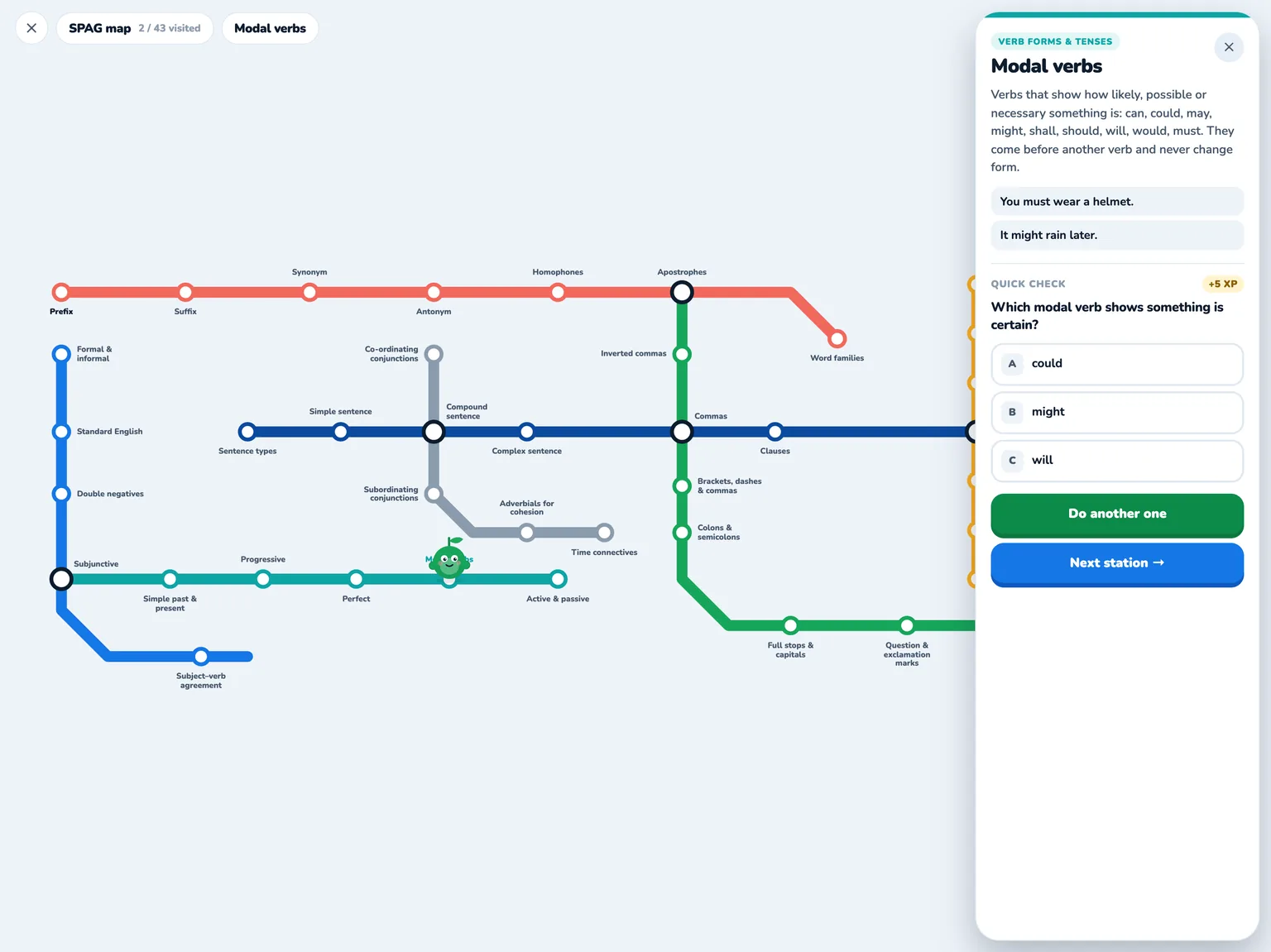
A modal verb is a helper verb, such as can, could, may, might, will, would, shall, should, must or ought to, that changes the meaning of the main verb after it. It shows how sure someone is, or whether something is allowed, advised or a rule. This page is part of the SPaG glossary, with a certainty dial, a 6-level quiz and a printable worksheet.
- A modal verb is a helper verb that changes the meaning of the main verb after it.
- The ten main modals are will, would, can, could, may, might, shall, should, must and ought to.
- A modal verb never changes shape. The next word is the base verb: she can sing.
- Modals show how sure the writer is, or whether something is allowed, advised or a rule.
What is a modal verb?
A modal verb is a verb that helps another verb and changes its meaning. The government glossary says modal verbs "are used to change the meaning of other verbs". In Pip could win the race, the main verb is win. The modal verb could turns "Pip wins" into "Pip might win".
Every modal verb comes before a main verb. The ten that children meet most are will, would, can, could, may, might, shall, should, must and ought to. Modal verbs have no endings. You never add -s, -ed or -ing to them.
A modal verb is a different thing from the subjunctive mood, which also talks about things that are wished for or imagined. Modal verbs are the more common tool, and they are in the Year 5 list of things to learn.
What jobs do modal verbs do?
Modal verbs do seven main jobs: they show how sure the writer is, give a rule, give advice, give permission, show ability, make a polite request or describe an imagined situation. The picture shows one example of each. The same modal can do more than one job, so read the whole sentence.
- How sure It will be sunny tomorrow.
- Rule We must not run in the corridor.
- Advice You ought to say sorry.
- Permission You may borrow my ruler.
- Ability I can ride a bike without stabilisers.
- Request Will you help me carry these books?
- Imagined Dad would drive us if it rained.
Pip gives short SPaG questions, shows the rule and brings back the types your child misses.
- Missed types return
- Phone and tablet
- Short daily sessions



Free, with optional Pro
How sure is the writer?
The modal verb sets how sure the writer is. A simple teaching order from most sure to least sure is will, must, should, could, may, might. Try it below. Slide the dial and watch one sentence change its meaning.
The certainty dial
- Mum will be home by now.
- Mum must be home by now.
- Mum should be home by now.
- Mum could be home by now.
- Mum may be home by now.
- Mum might be home by now.
The dial has a second mode, Rule or choice, which moves from can (you are allowed) through should and ought to (advice) to must (a rule).
What is the difference between must, should and can?
Must means a rule or a duty. Should and ought to give advice. Can and may say you are allowed. Read the sentences below in order and feel the pressure drop.
- Rule You must wear a helmet on your bike.
- Advice You should wear a helmet on your bike.
- Advice You ought to wash your hands before lunch.
- Allowed You can wear a helmet on your bike.
Some modals do two jobs. Must can show a rule, but it can also show that the writer worked something out. The parcel must be at the post office by now. means the writer is nearly certain. May can give permission, and it can also show a small chance: It may rain at lunchtime.
The phrases need to and have to work like modals in everyday speech, but they are not on the list of ten.
Why do modal verbs never change?
A modal verb has one form for every subject, and the main verb after it stays in its base form. That means no -s on the modal, no -s on the verb and no to in between. Say she can sing, never she cans sing.
- Right She can sing.
- Right He could swim.
- Wrong She cans sing.
- Wrong She can sings.
- Wrong She can to sing.
- Wrong She can sang.
How do you make a modal verb negative or ask a question?
To make a modal verb negative, put not after it or use a short form. To ask a question, move the modal in front of the subject. Never add does, do or did. Press Play to watch each step.
- Negative She cannot swim.
- Negative She couldn't swim.
- Question Can she swim?
- Wrong Does she can swim?
- Wrong She doesn't can swim.
Is "perhaps" a modal verb?
No. Perhaps is an adverb. The Year 5 programme of study lists both adverbs, such as perhaps and surely, and modal verbs, such as might, should, will and must, as ways to show degrees of possibility. A sentence can use one, the other or both.
- Modal only Mum might be home by now.
- Adverb only Perhaps Mum is home by now.
- Both Perhaps Mum might be home by now.
Which words only look like modal verbs?
A word is a modal verb only when a main verb follows it. Can, will, might and May can also be nouns, and then they are not modal verbs. Ask yourself whether a main verb comes straight after.
- Noun Pip put the can on the shelf.
- Noun Gran wrote her will last year.
- Noun He pushed the door with all his might.
- Noun The May blossom was out.
- Modal I can see the school from here.
Where do modal verbs appear in KS2 tests?
Modal verbs are a Year 5 grammar topic, and they have been tested in the KS2 grammar, punctuation and spelling paper in recent years. The test framework gives them the content code G4.1c. Here are the questions we found in the published papers on gov.uk.
| Year | Question | What it asked |
|---|---|---|
| 2024 | Q30 | Circle the modal verb. The mark scheme gives the answer could. 2024 mark schemes |
| 2025 | Q27 | Tick the sentence that contains a modal verb. The right sentence is I must be at school early tomorrow. 2025 paper |
| 2026 | Q15 | Explain how the modal verb changes the degree of possibility. 2026 paper |
The same papers test the subjunctive mood, so it helps to learn both together. The other big Year 5 grammar topic is relative clauses. For the full Year 5 list, see our Year 5 SPaG guide, and for Year 6 revision see Year 6 SPaG. The statutory wording comes from English Appendix 2 and the English glossary.
Free modal verbs quiz
This quiz has six levels, from spotting a modal verb to a mixed challenge. Each level has 8 questions, and your child sees why an answer is right or wrong. Answer with a tap, or press 1 to 4 on a keyboard.
Free printable modal verbs worksheet
The worksheet gives 10 questions on one A4 page and the answers on the next. Choose a level, make a new sheet and press Print.
How can I help my child at home?
Short and regular beats long and rare. Try these three habits.
- Swap the modal. Take a sentence from a book and change will to might. Ask what changed.
- Make house rules. Ask which things you must do and which you should do. Children enjoy arguing the difference.
- Catch the look-alikes. Ask whether a can or a will has a main verb after it. If not, it is a noun.
Children who like to practise on a screen can try the interactive SPaG map, and parents can browse more guides in the SPaG resources.
Modal verbs: questions parents ask
What is a modal verb?+
A modal verb is a helper verb that goes before a main verb and changes its meaning. It can show how sure someone is, or whether something is allowed, advised or a rule. Examples are can, could, may, might, will, would, shall, should, must and ought to.
How many modal verbs are there?+
Most KS2 lists give ten: will, would, can, could, may, might, shall, should, must and ought to. Children are not expected to learn a longer list.
What is the difference between a verb and a modal verb?+
A main verb names an action or a state, such as run or be. A modal verb cannot stand as the only verb in a sentence. It always helps a main verb, and it never takes an -s, -ed or -ing ending.
Which year learns modal verbs?+
Modal verbs are part of the Year 5 grammar programme in England. Children meet them as one way to show degrees of possibility, and they can be tested in Year 6 as well.
How do I explain modal verbs to my child?+
Say that a modal verb is a helper word that tells you how sure we are or what is allowed. Take the sentence "Mum is home" and swap in will, might or must. Ask your child how each version changes what you know.
What is the order of certainty?+
A simple teaching order from most sure to least sure is will, must, should, could, may, might. Could, may and might sit very close together, and teachers sometimes order them slightly differently.
Do modal verbs take an s ending?+
No. A modal verb has the same form for every subject, so we say she can sing and he might come. The main verb after it also stays in its base form.
What is the difference between must and should?+
Must is for a rule or a strong duty, such as "You must wear a seatbelt". Should is advice, such as "You should wear a coat". Must can also show that the writer is nearly certain.
Is perhaps a modal verb?+
No. Perhaps is an adverb. It can show possibility, but it is not a verb. A sentence can use an adverb, a modal verb or both, as in "Perhaps it might rain".
Can a sentence start with a modal verb?+
Yes, when it is a question. The modal moves in front of the subject, as in "Can you help me?" or "Should we go now?". In a statement the modal comes after the subject.
Do modal verbs come up in KS2 SATs?+
Yes. The grammar, punctuation and spelling papers have included modal verb questions. In 2024 pupils circled the modal verb, in 2025 they ticked the sentence with a modal verb, and in 2026 they explained how a modal verb changes the degree of possibility.

The Pip team builds Pip, the 11+ and KS2 practice app for children in years three to six. We write these guides from real exam formats and past papers.