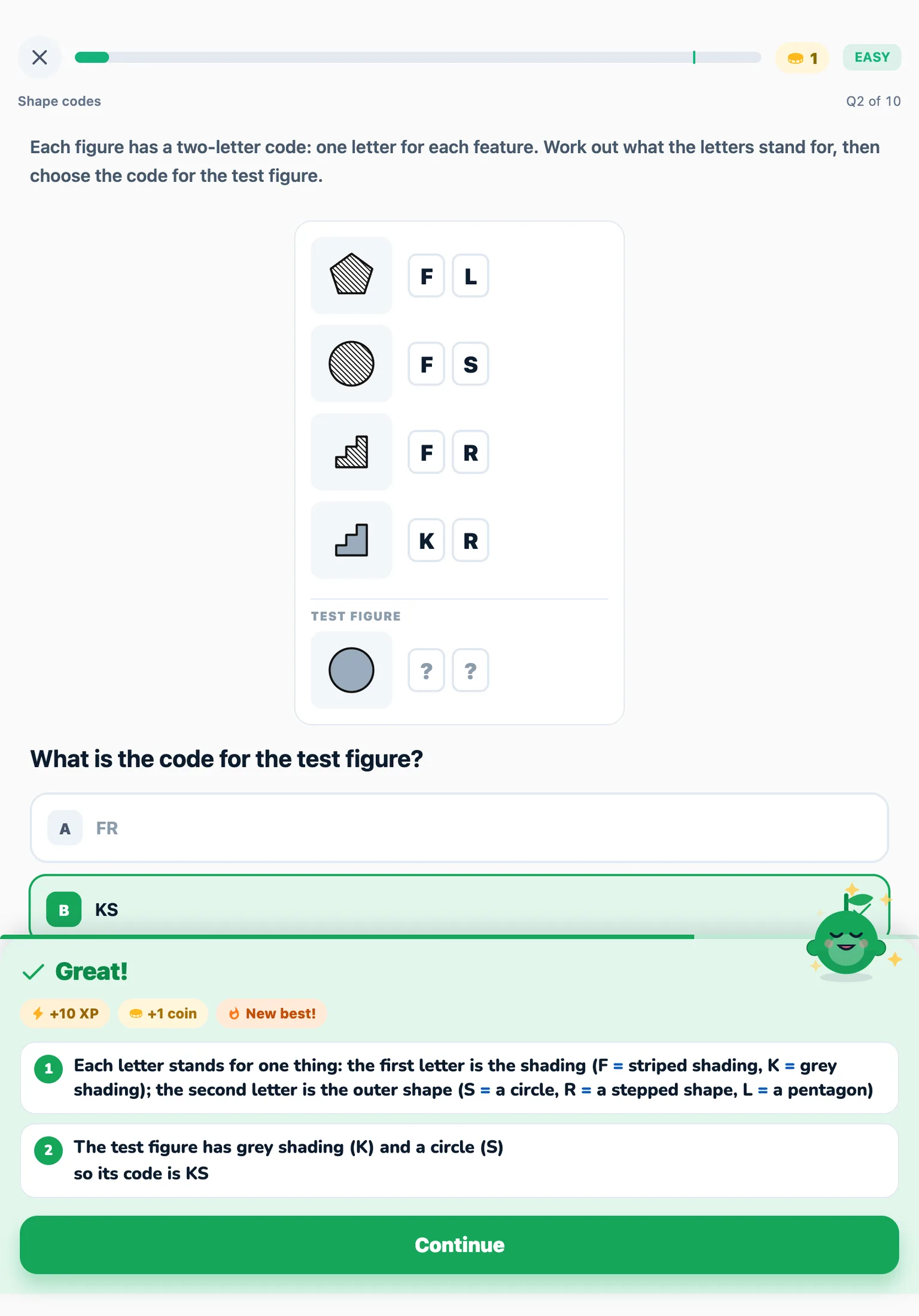
A shape code question gives you a row of figures, each with a short letter code, and one test figure with no code. Work out what each letter stands for, then write the code for the test figure. It is one of the question types on our non-verbal reasoning questions page.
- 1 Same shading, different shape
- 2 Same shape, different shading
- 3 Read off the test code
This page gives you a method that works every time, a code table to practise it, free questions at 6 levels and a printable worksheet. Codes made of words or numbers belong to verbal reasoning. This guide is all about shapes.
- Each letter in a code stands for one feature, such as the shape or the shading.
- Find two figures that differ in one way, then see which letter changes.
- Write a code table, then read the test figure off it one feature at a time.
- Some features are decoys and never change a letter. Leave them out.
What is a shape code question?
A shape code question is a list of figures with letter codes, followed by one test figure. Each position in the code stands for one feature of the figure. The first letter might tell you the shape and the second letter the shading. Some papers call these figure codes or ask you to find the code for the shape.
In the picture at the top, the triangle has the letter M and the circle has P, so the first letter is about the shape. The striped figures have B and the grey one has R, so the second letter is about the shading. The test figure is a striped step shape, so its code is D B.
The test figure is always new, so you cannot copy a code from the list. You have to use what the letters mean.
How do you solve a shape code question?
Compare figures that differ in only one way, write down what each letter means, then code the test figure and cross out the wrong options. Press play to watch the steps on one question.
The same question in words
Figure 1 is a striped triangle with the code M B. Figure 2 is a striped circle with P B. Figure 3 is a grey circle with P R. Figure 4 is a grey step shape with D R. The test is a striped step shape.
- Figures 1 and 2 are both striped but the shape changes. Only the first letter changes, M to P. The first letter is the shape.
- Figures 2 and 3 are both circles but the shading changes. Only the second letter changes, B to R. The second letter is the shading.
- Figure 4 is grey, so R is grey, which means D is the step shape.
- The test figure is a step shape, D, and striped, B.
Answer: D B.
If you are stuck, cover up the letters of the test options and write your own code first. Then look for the option that matches it. If none do, you have a letter wrong in your table.
What can the letters stand for?
Four kinds of feature turn up in shape codes. A code usually uses two or three of them, and one more may change without a letter, as a decoy. Learn to see each one separately and the mixed codes get much easier.
- ShapeSix shapes turn up: triangle, circle, pentagon, step shape, cross and four-point star.
- ShadingWhite, grey, striped or black. A striped shape has thin lines on it, so do not call it grey.
- SizeSmall or big, with the same shape. Compare two shapes of the same kind.
- DotsNone, one or two small dots inside. Count them, because a dot is easy to miss.
Look at the whole list before you decide which features matter. A feature that is the same in every figure cannot have a letter that you need.
What is the pair trick?
Find two figures that differ in only one way and see which letter changes. That letter is about the one difference. It is the fastest way into any code, and it works at every level.
Look for pairs with the same shape, shading and size. If no two figures differ in just one way, look for three figures and compare each pair. Two letters that stay the same tell you that nothing else changed.
Pip Teaches shows the rule before the questions. Levels rise as your child gets them right, and the code types they miss come back until your child gets them right.
- Pip Teaches first
- Missed types return
- Phone and tablet



Free, with optional Pro
Can you build the code table?
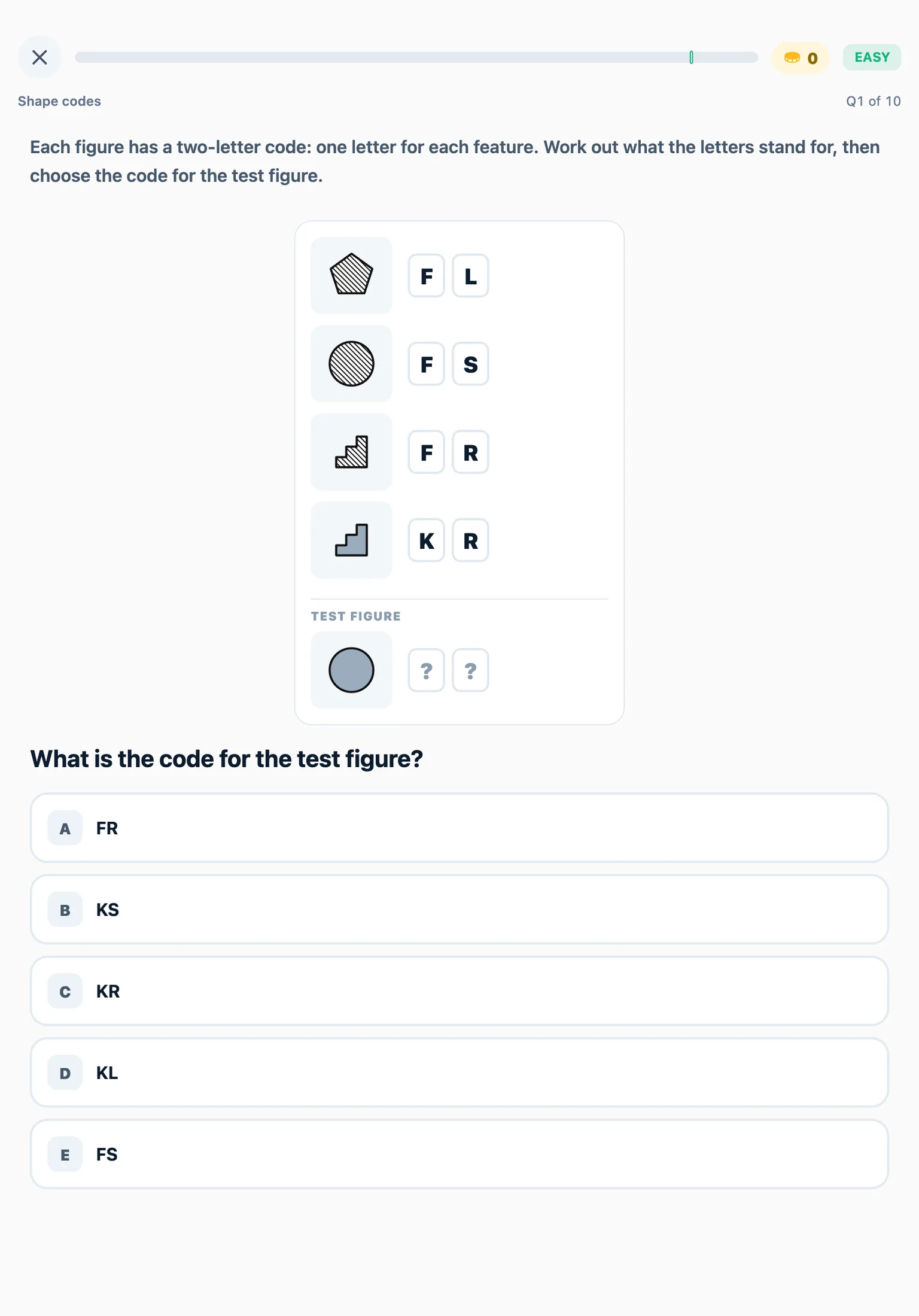
Yes, and the table is the habit that makes shape codes easy. Pick a puzzle, tap a letter, then tap the shape or shading it stands for. When the table is right, use it to code the test figure.
The first puzzle in words
The letters are B, D, M, P and R. The four figures are a striped triangle (M B), a striped circle (P B), a grey circle (P R) and a grey step shape (D R).
- Triangle is M, circle is P, step shape is D.
- Striped is B and grey is R.
- The test figure is a striped step shape. Step shape is D and striped is B.
Answer: D B.
If you tap Check and a slot is wrong, you get a hint but never the answer.
What kinds of code are there?
The letters can be set out in different ways, and a different feature can come first. The method is the same each time, but you must read the order from the list and not guess it.
- Two letters in a rowThe usual layout. One letter for each of two features, read left to right.
- Three lettersHarder papers code a third feature, often the size. Each letter still has one job.
- Letters on top and underneathSome papers put the letters above and below the shape. Read the top letter first.
- The other way roundThe first letter is not always the shape. Here the shading comes first and the shape second.
When the letters sit on top and underneath, read the top letter first. When the shading comes first, the table still works, you just read it in a different order. For a different kind of shape puzzle, try shape analogies.
What is a decoy feature?
A decoy is a feature that changes from figure to figure but never changes a letter. The code ignores it, so you can too. If three figures that differ only in shading all have the same code, shading is a decoy.
All three circles above are big and have the same shape, so they share the same code. The shading is the decoy. Choose the Decoy puzzle in the code table to try one.
Try it: 8 shape codes
Pick a level, answer eight questions and see how many you get. Levels 1 and 2 use two letters. Levels 5 and 6 are the hardest and use three.
What each level uses
- Level 1: shape and shading, in a fixed order.
- Level 2: more shapes and shadings.
- Level 3: the letters sit on top and underneath, and the order can swap.
- Level 4: shape and size, with a decoy shading.
- Level 5: three letters: shape, shading and size.
- Level 6: three letters and a decoy.
A level 1 question in words: a white triangle is K T, a black triangle is K H and a white circle is P T. A black circle is P H.
Why are the wrong options wrong?
Each wrong option breaks the code in its own way. It uses the wrong letter for one feature, swaps the order or gets two letters wrong. Spotting the break is the quickest way to cross it out.
- MBOption 1 is wrong wrong shape letterThe shape letter is wrong. M stands for triangle, but the test figure is step shape.
- DROption 2 is wrong wrong shading letterThe shading letter is wrong. R stands for grey, but the test figure is striped.
- PBOption 3 is wrong wrong shape letterThe shape letter is wrong. P stands for circle, but the test figure is step shape.
- DBOption 4 is right matches the tableThis is the code the letters give for the test figure.
- BDOption 5 is wrong letters swappedThe letters are the right ones but in the wrong order. shape comes first in this code.
The same mistakes cause most lost marks:
- Assuming the order. Check which letter is the shape before you write the code.
- Mixing up grey and striped. They are different shadings with different letters.
- Using a decoy. If a feature never changed a letter, it is not in the code.
- Copying an example. The test figure is new, so its code is not in the list.
- Missing a dot or a size. Count the dots and compare the sizes before you finish.
How do shape codes appear in the 11 plus?
They are a standard non-verbal reasoning question: a list of coded figures, a test figure and a row of options. Papers differ by publisher and by school, so ask the school which format your child will sit. The skills on this page cover the usual layouts.
Harder papers use three letters, put the shading before the shape, and add a decoy. Easier ones use two letters and two features.
How can you practise at home?
- Start with the pair. Ask "which two figures differ in one way?" before anything else.
- Write the table. Even a quick table on scrap paper stops mixed-up letters.
- Do five a day. A short quiz on this page, then stop.
- Move up a level. Go up when most answers are right, not before.
- Learn the full picture. Our guide to preparing for non-verbal reasoning shows how codes fit in, and matrices are a good question type to try next.
Is there a free printable shape codes worksheet?
Yes. Choose a difficulty, press New worksheet for a fresh set, then print. You get six questions on one page and the answers with the codes explained on the next page.
Frequently asked questions
What are shape codes in non-verbal reasoning?+
In a shape code question, each figure in a list has a short code made of letters. The letters stand for features of the figure, such as its shape, shading or size. You work out what each letter means, then write the code for a new test figure.
How do you solve a shape code question?+
Find two figures that differ in only one way, such as the shape, and see which letter changes. That letter stands for that feature. Repeat for the other features, write a code table, then read the test figure off the table one feature at a time.
Is the first letter always the shape?+
No. In many questions the first letter is the shape, but some put the shading first, and some put the letters on top and underneath the figure. Never assume the order. Check it with a pair of figures that differ in one way.
What if a feature changes but no letter changes?+
That feature is a decoy and the code does not use it. For example, three circles that are white, striped and black may all have the same code. If changing a feature never changes a letter, leave it out of your table.
Do the wrong options follow a pattern?+
Yes. Each wrong option breaks the code in a different way. It may use the wrong letter for one feature, swap the order of the letters, get two letters wrong, or copy the code of a figure from the list. Checking one letter at a time finds the break.
What is the difference between striped and grey shading?+
A grey shape is one flat grey, and a striped shape has thin lines on it. They are different shadings and get different letters. Look closely, because the two are easy to mix up when you are in a hurry.
Why does the test figure not appear in the list?+
The test figure is always new, so you cannot copy its code from the list. You have to use the letter meanings you worked out. Every feature of the test figure that matters appears somewhere in the list with its letter.
Are these the same as verbal reasoning codes?+
No. Shape codes use pictures and have no words to read. Verbal reasoning codes use words or numbers, such as shifting letters along the alphabet. The method of finding what each symbol stands for is similar, and you can read more in our guide to verbal reasoning number codes.
How many options are there, and is only one right?+
The practice questions on this page give five options, A to E, and exactly one of them is the correct code. Each wrong option breaks the code in its own way, which is why checking one letter at a time works so well.
Is practice with these questions free?+
Yes. Everything on this page is free with no sign-up, including the code table tool, the quiz and the printable worksheet. Pip also has a shape codes skill in the app, which is free to start with optional Pro.

The Pip team builds Pip, the 11+ and KS2 practice app for children in years three to six. We write these guides from real exam formats and past papers.