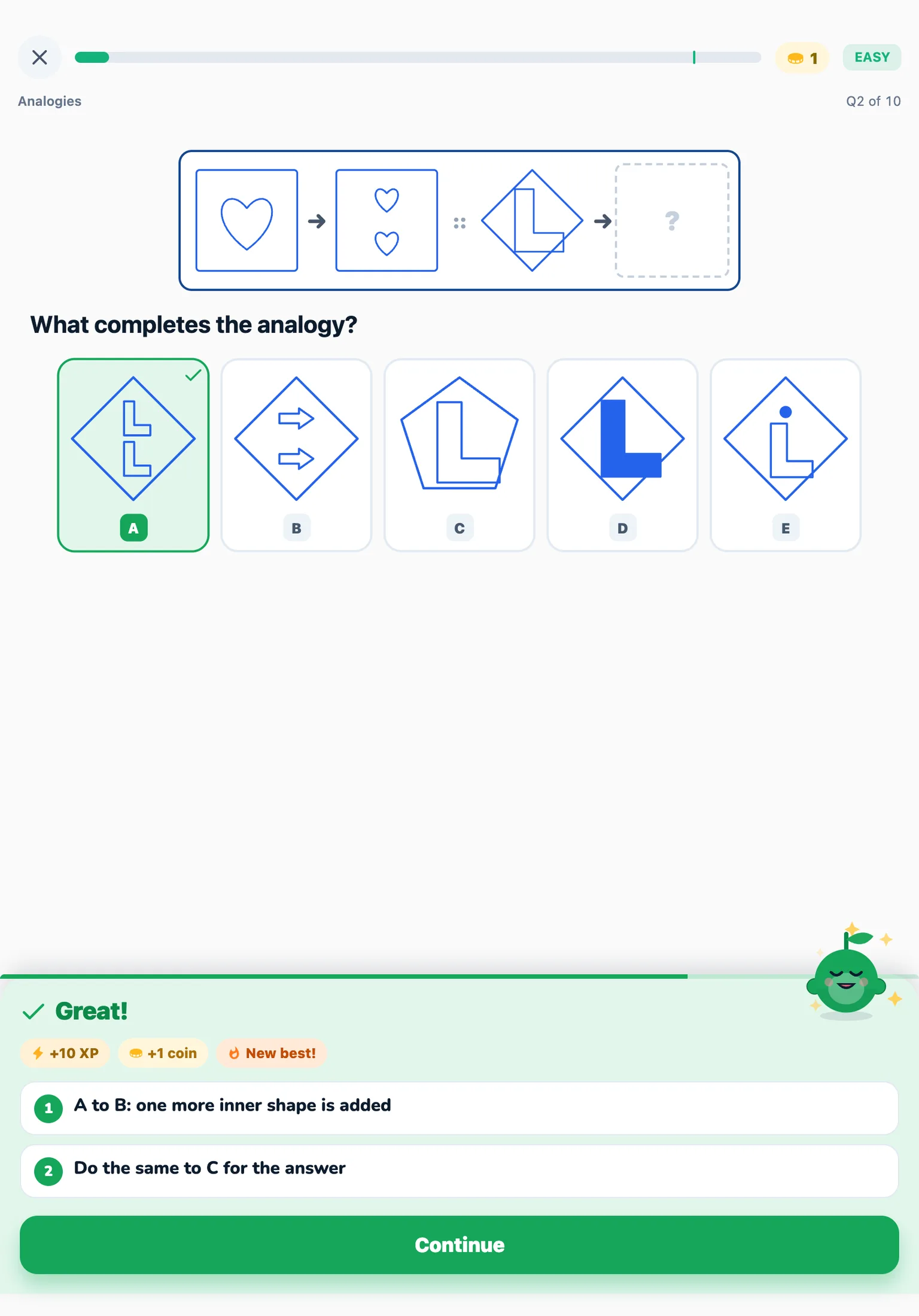
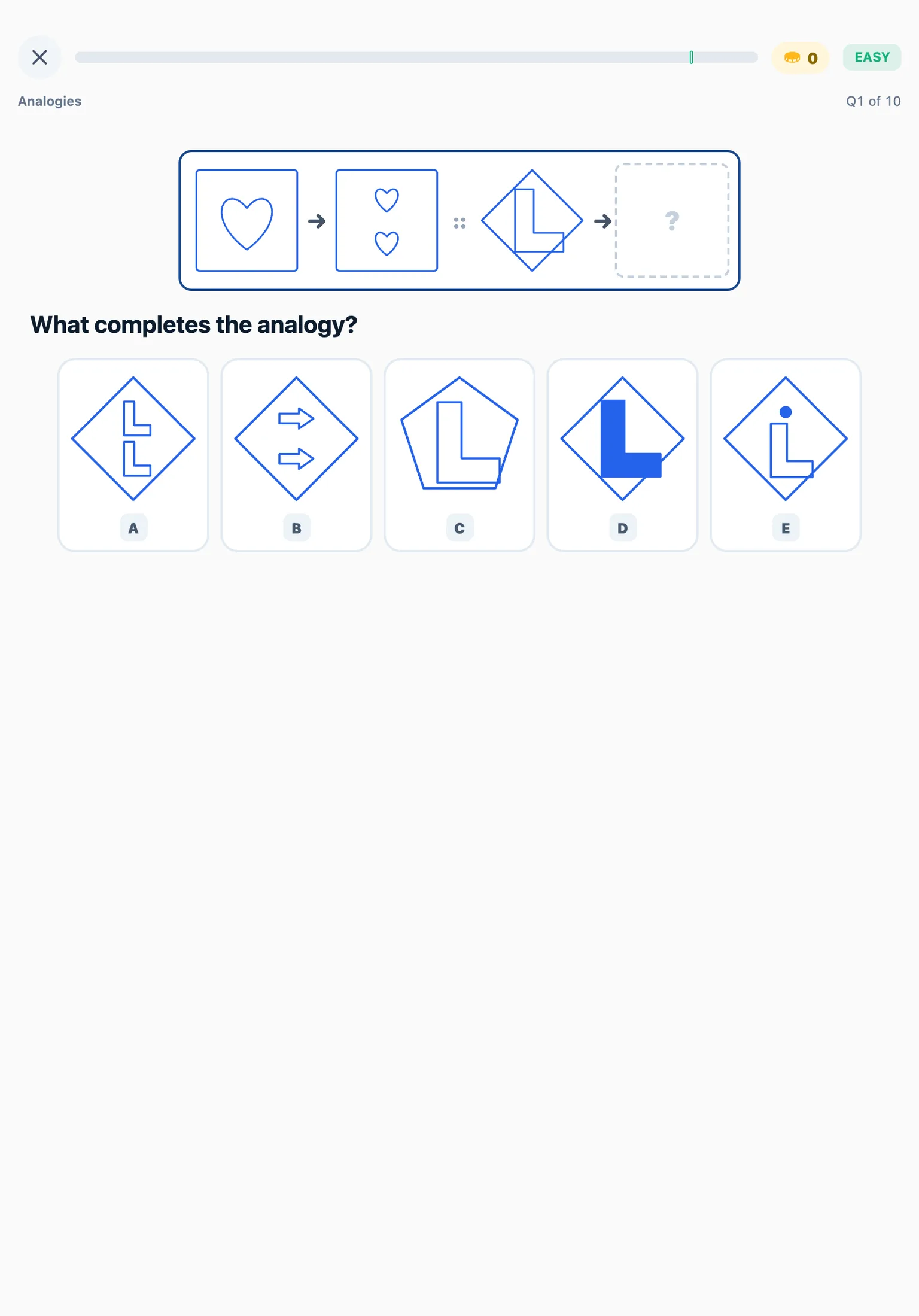
A non-verbal reasoning analogy shows two shapes, A and B, then a third shape, C. Work out what changed from A to B, make the same change to C, and pick that figure from the options. It is one of the question types on our non-verbal reasoning questions page.
- 1 Flip it left to right
- 2 Swap the shading
- 3 Do the same to C
This page gives you a method that works every time, a recorder to practise it, free questions at 6 levels and a printable worksheet. This guide is all about shapes. Word analogies belong to verbal reasoning.
- The question reads A is to B as C is to ? and has five answer figures.
- Say the change from A to B in words before you look at the options.
- Do the same changes to C. Cross out options that miss one or add one.
- One question can use up to three changes at once.
What is a non-verbal reasoning analogy?
A shape analogy is a pair of shapes followed by a second pair with one shape missing. B is A after one, two or three changes. The missing shape is C after the same changes. Some papers call these figure analogies or ask you to complete the pair.
In the picture at the top, A is the step shape and B is the same shape flipped left to right and shaded black. C is the L shape. So the missing figure is the L shape, flipped left to right and shaded black.
The shapes in C are always different from A. That is on purpose, so you have to use the change and cannot just copy B.
How do you solve a shape analogy?
Say the change from A to B in words, check each feature one at a time, do the same to C, then cross out the options that do not match. Press play to watch the five steps on one question.
The same question in words
A is a small white diamond. B is a big black diamond. C is a small white pentagon.
- Name the change. From A to B the shape went from white to black and from small to big.
- Check each feature. Shape: same. Turn or flip: none. Dots: none. Only shading and size changed.
- Do it to C. Swap the shading, then make it bigger.
- Cross out. Any option that is still white, still small or a different shape is out.
Answer: a big black pentagon.
If you are stuck, try this check. Put an option into the question mark space and read both pairs aloud. If C changes to it in the same way that A changes to B, keep it. If not, cross it out.
Which changes can happen from A to B?
There are nine kinds of change that you will see again and again. Each one is a single feature, and a question mixes up to three of them. Learn to spot each one on its own and the mixed ones get much easier.
- Swap the shadingWhite becomes black, or black becomes white.
- Bigger or smallerSame shape, a different size.
- Quarter turnTurned a quarter of the way round, clockwise.
- Half turnTurned upside down. Everything is rotated by half a turn.
- Flip left to rightA mirror image, as if a mirror stood down the middle.
- Flip top to bottomA mirror image, as if a mirror lay along the middle.
- Add or take away a dotThe count goes up by one, or down by one.
- One more sideA diamond becomes a pentagon, a triangle becomes a diamond.
- Move the small squareThe small square swaps from the top to the bottom.
Most changes keep the shape recognisable, so use the shape's own parts as clues. If the shading, size and number of dots are all the same, look for a turn or a flip.
What is the difference between a turn and a flip?
A turn spins the shape and keeps it the same way round. A flip makes a mirror image. You can always turn a turned shape back to match the original, but you can never turn a flipped shape back, whatever you try.
A shape that looks the same on both sides, such as a plain square, cannot show a flip. That is why questions use shapes with a clear side, such as the flag. For more on mirror images, see our guide to 11 plus reflections.
Pip Teaches shows the rule before the questions. Levels rise as your child gets them right, and the change types they miss come back until your child gets them right.
- Pip Teaches first
- Missed types return
- Phone and tablet



Free, with optional Pro
Can you name the change?
Yes, and doing it quickly is the habit that makes analogies easy. Look at A and B, then pick the change that turns one into the other. A wrong pick tells you which kind of change to look at again.
One pair in words
A is a white triangle. B is a black triangle. The shape, size and number of dots are all the same. Only the shading changed.
Name the change: swap the shading.
Now try another pair. If you pick the right name, A turns into B on screen.
Does the order of the changes matter?
Sometimes. Shading and size can go in any order, but a turn and a flip together give different pictures depending on which comes first. The recorder lets you build the recipe from A to B, then play it on C. Try the Order trap puzzle to see the difference.
A recorder puzzle in words
Take the puzzle Shade and grow. A is a small white diamond and B is a big black diamond.
- Add Swap the shading. A becomes a small black diamond.
- Add Make it bigger. Now it is a big black diamond, which matches B.
- Press Play on C. The small white triangle becomes a big black triangle.
Our practice questions never mix a turn with a flip, because the order would be a guess. The Order trap puzzle shows you why.
Try it: 8 shape analogies
Pick a level, answer eight questions and see how many you get. Levels 1 and 2 change one feature. Levels 5 and 6 are the hardest and change up to three.
What each level changes
- Level 1: swap the shading.
- Level 2: one change, a turn or a size change.
- Level 3: two changes together.
- Level 4: a flip, sometimes with a second change.
- Level 5: dots and a small square that moves.
- Level 6: three changes at once.
A level 1 question in words: A is a white circle and B is a black circle. C is a white hexagon. The answer is a black hexagon.
Why are the wrong options wrong?
Each wrong option breaks the rule in its own way. It misses a change, adds one that was not there, or does a change the wrong way round. Spotting the break is the quickest way to cross it out.
- Option 1 is wrong C unchangedThis is just C again. None of the changes were made.
- Option 2 is wrong extra changeIt makes the right changes but also tries to give the shape one more side. The pair does not do that.
- Option 3 is right matches the recipeIt is C with both changes: swapped shading and made bigger.
- Option 4 is wrong misses a changeIt leaves out one change. It should also make the shape bigger.
- Option 5 is wrong misses a changeIt leaves out one change. It should also swap the shading, so white becomes black and black becomes white.
The same five mistakes cause most lost marks:
- Matching C to B. The answer looks like C, not like B.
- Doing only one change. Count the changes from A to B, then count them on your answer.
- Flipping when it should turn. Check which way the pointed part faces.
- Turning the wrong way. Clockwise and anticlockwise give different pictures.
- Adding a change. If the dots did not change from A to B, they must not change on your answer.
What other kinds of analogy question are there?
Two other layouts use the same skill. In choose the pair, you see one pair and pick the option pair that changes in the same way. In find the odd pair, three pairs share a change and one does not. Name the change in each pair, then see which one disagrees.
- 1
- 2
- 3
- 4
In the pairs above, pairs 1, 2 and 4 all swap the shading. Pair 3 makes the circle bigger. So pair 3 is the odd one. If your child likes this, our odd one out guide covers the single-shape version.
How do shape analogies appear in the 11 plus?
They are a standard non-verbal reasoning question: A, B, C and a row of options. Papers differ by publisher and by school, so ask the school which format your child will sit. The skills on this page cover the usual layouts.
Harder papers use more changes at once and shapes where a flip looks like a turn. Easier ones change only the shading or the size.
How can you practise at home?
- Start with the words. Ask "what changed?" before any option is looked at.
- Do five a day. A short quiz on this page, then stop.
- Move up a level. Go up when most answers are right, not before.
- Mix in other types. Try matrices and series for variety.
- Learn the full picture. Our guide to preparing for non-verbal reasoning shows how analogies fit in.
Next on the list could be shape codes, where letters stand for features of a shape.
Is there a free printable analogies worksheet?
Yes. Choose a difficulty, press New worksheet for a fresh set, then print. You get eight questions on one page and the answers with the changes explained on the next page.
Frequently asked questions
What is a non-verbal reasoning analogy?+
A non-verbal reasoning analogy shows two shapes, A and B, and a third shape, C. B is A after some changes. Your job is to make the same changes to C and pick the matching figure from the options. It reads as "A is to B as C is to ?".
How do you solve a shape analogy in the 11 plus?+
Say in words what changed from A to B, such as "it turned black and got bigger". Check one feature at a time: shading, size, turn or flip, dots and sides. Make the same changes to C, then cross out every option that misses a change or adds an extra one.
What changes can happen from A to B?+
The usual changes are swapping the shading, making the shape bigger or smaller, turning it, flipping it, adding or taking away a dot, adding a side, and moving a small marker to the other side. One question can use up to three of these changes together.
What is the difference between a turn and a flip?+
A turn spins the shape and keeps it the same way round, so a turned shape can always be turned back to match the original. A flip makes a mirror image, and no amount of turning can bring a mirror image back. To spot a flip, look at a part that points one way, such as the flag on a pole.
What if I cannot see the change from A to B?+
Compare the two shapes one feature at a time. Ask: same shape or different, same colour, same size, same way round, same number of dots. If you are still stuck, put each option into the question mark space and read both pairs aloud. The option where C changes in the same way as A is the answer.
Can more than one change happen at once?+
Yes. Easier questions change one feature, such as the shading. Harder ones change two or three at the same time, for example a shape that turns black, gets bigger and moves its small square. Name every change before you look at the options.
Are these the same as verbal reasoning analogies?+
No. These analogies use shapes and have no words to read. Verbal reasoning analogies use words, such as "hot is to cold as up is to ?". The method is the same: find the link in the first pair, then use it on the second.
How many options are there, and is only one right?+
The practice questions on this page give five options, A to E, and exactly one of them follows the rule. Each wrong option breaks the rule in a different way, which is why checking one change at a time works so well.
How can my child get faster at shape analogies?+
Practise saying the change out loud first, then doing it to C. Short sessions of five or ten minutes work better than one long sitting. Start at a level that feels easy and move up when most answers are right.
Is practice with these questions free?+
Yes. Everything on this page is free with no sign-up, including the quiz, the change recorder and the printable worksheet. Pip also has a shape analogies skill in the app, which is free to start with optional Pro.
The Pip team builds Pip, the 11+ and KS2 practice app for children in years three to six. We write these guides from real exam formats and past papers.