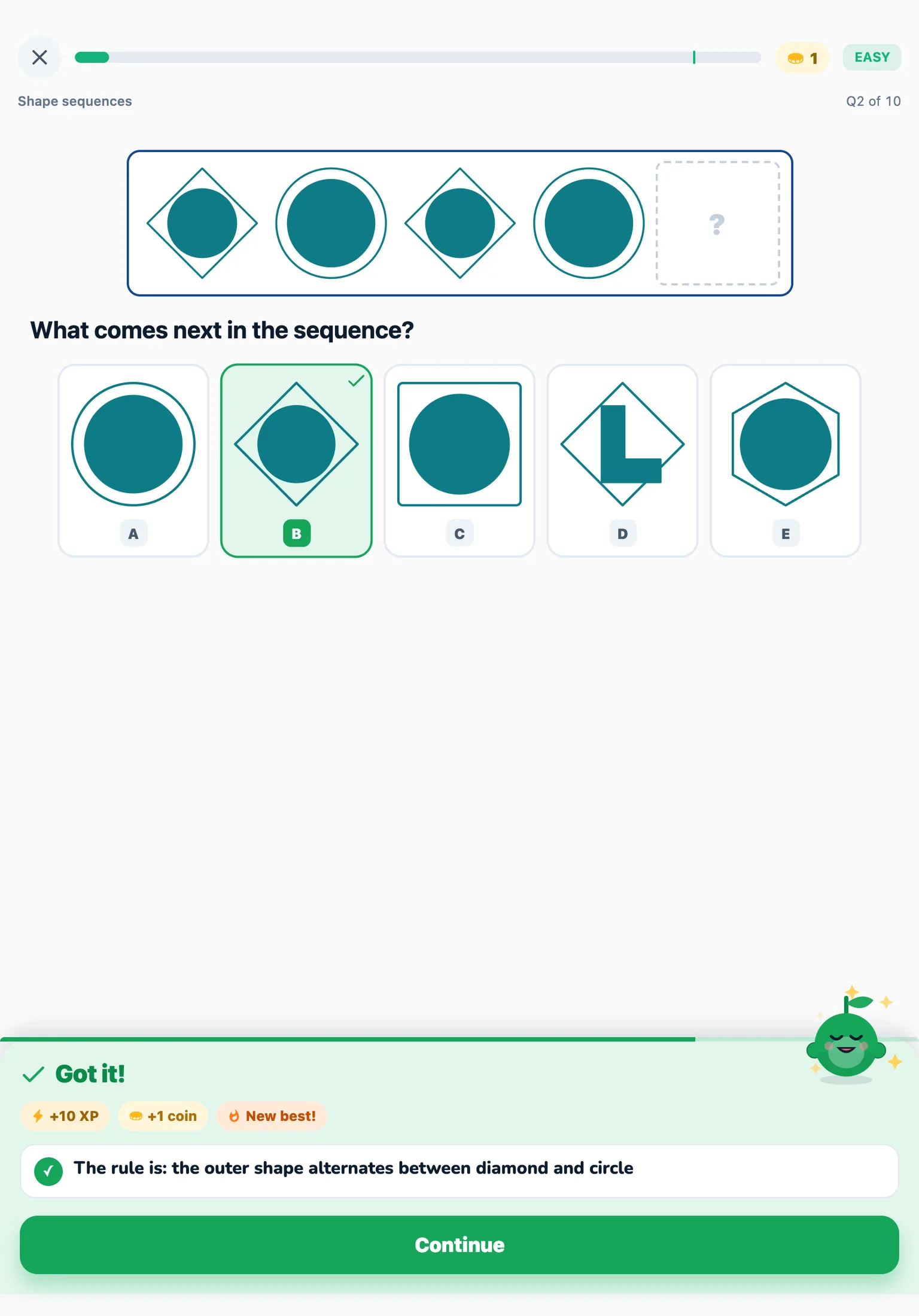
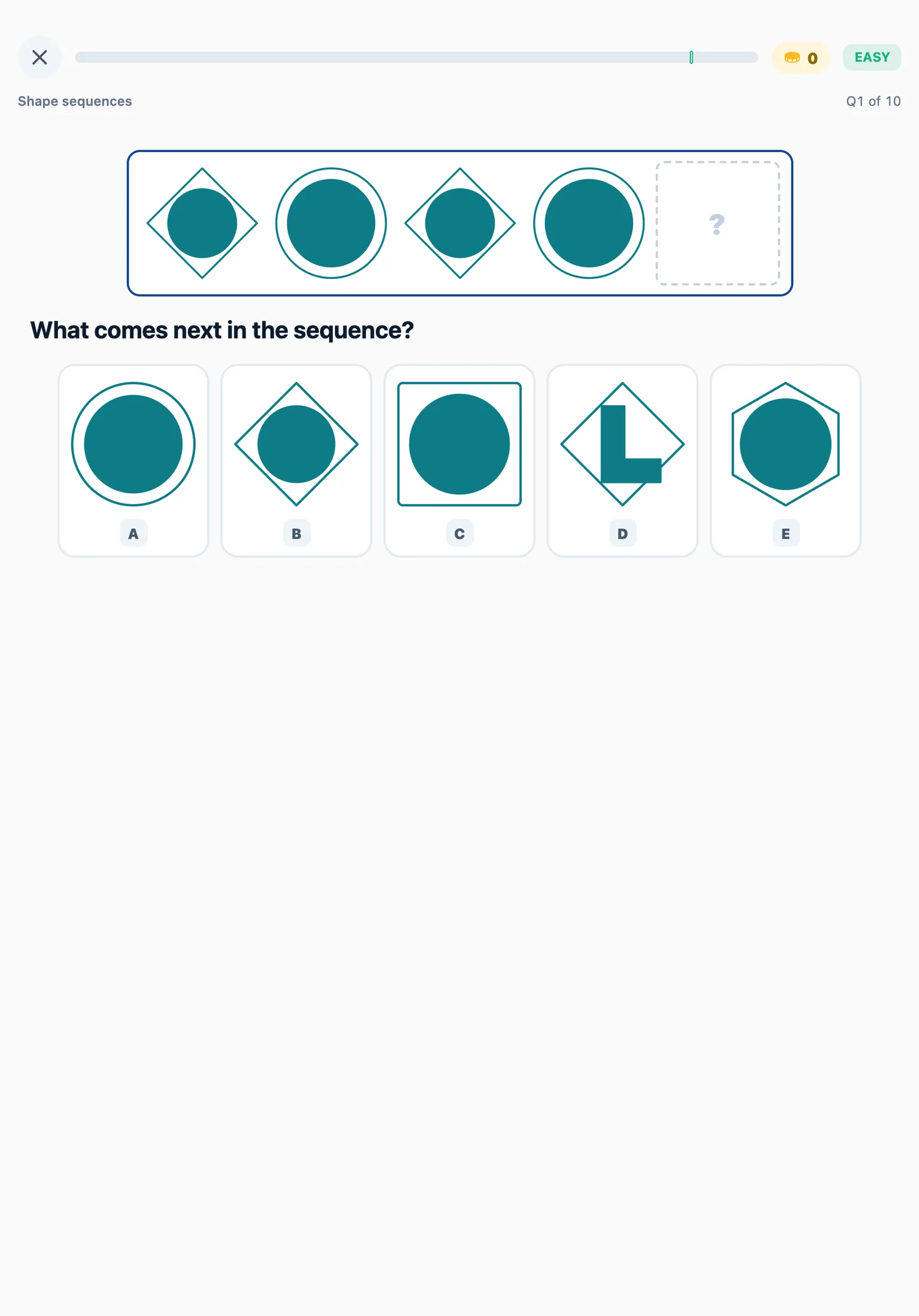
A series question shows a row of boxes where something changes from one box to the next, and you pick the box that comes next or the one missing from the middle. You find each rule, carry it one more step, then check the options. This guide sits inside our non-verbal reasoning guide and covers turns, moving dots, counting and shading.
Which box comes next?
Each box follows the one before it. Find the rules, then say what goes in the ? square.
- A series is a row of boxes. The answer is the box that comes next, or the one missing from the middle.
- Look at one feature at a time: turn, dot, number, shading or shape. Say how it changes in words.
- Predict the box before you look at the options, then cross out every option that breaks a rule.
- If two options are left, check the rule you have not used yet.
What is a series question in 11+ non-verbal reasoning?
A series question is a row of boxes that follow rules, with one box missing. You work out how each feature changes from box to box, then choose the option that continues the pattern. Practice papers often give five options labelled A to E, but the layout changes from test to test, so check your own sample paper.
The missing box is usually the last one, which is a what comes next question. Sometimes the gap is in the middle, and then you use the boxes on both sides. Series are one of several shape types on our non-verbal reasoning practice questions page, and they pair well with matrix questions, where the rules run in two directions.
Rule layers: pull a series apart
A hard series is several easy rules stacked on top of each other. Switch layers on and off below to see each rule by itself, then switch them all on and show the next box.
Rule layers
The arrow turns a quarter turn clockwise each box, so by box 5 it has turned a full circle and points up again. The yellow dot jumps two places round, from the top left corner to the top right, bottom right, bottom left and back to the top left. The number of arrows alternates between one and two, so box 5 has one. The shading goes white, grey, black, white, so box 5 is grey. That is one grey arrow pointing up with the dot in the top left corner. On the first series that is option C.
How to solve a series, step by step
Use five steps: pick a feature, follow it along the row, say the rule in words, repeat for the next feature, then predict the box before you look at the options. Press play on the example below, or step through it yourself.
- Pick one feature. Turn, dot, number, shading or shape. Look at only that one and ignore the rest.
- Follow it along the row. Does it stay the same, go up by a set amount, swap back and forth, or speed up?
- Say the rule in words. If you cannot say it out loud, you have not found it yet.
- Do the same for the next feature. A series can have three rules at once. Each one is easy on its own.
- Predict, then cross out. Picture the missing box first. Cross out every option that breaks a rule. If two are left, check the rule you have not used yet.
Worked example
The arrow turns 45 degrees clockwise each box: up, up and right, right, down and right. So box 5 points down. The yellow dot jumps two places round, which is one corner each time: top left, top right, bottom right, bottom left. Box 5 has the dot back in the top left corner. The shading swaps between white and grey, and box 4 is grey, so box 5 is white. A white arrow pointing down with the dot in the top left corner is option D.
Pip 11 Plus has a Series skill for shapes that turn, move, count up and change shading. Pip Teaches shows the rule first. Levels rise as your child gets series right, and any type they miss comes back.
- Pip Teaches shows the rule first
- Missed types come back
- Phone and tablet



Free, with optional Pro
Types of series rule you will meet
Most series use a small set of rules: turn, move, count, swap, change shape or speed up. Once you know the six below, a new series is usually two or three of them at once.
- TurnsThe arrow turns the same amount each box. Here it turns a quarter turn clockwise each time: up, right, down, left, up.
- A dot that movesThe dot jumps the same number of places round the box each time. Here it moves to the next corner, clockwise.
- Counts upOne more shape each box: one, two, three, four, five. The shading stays the same.
- Swaps back and forthA feature flips between two values. Here the shading goes white, black, white, black, white.
- Changes shapeThe shape moves along a list and then starts again: circle, square, triangle, circle, square.
- Speeds upThe turn gets bigger every box. The arrow turns 45 degrees, then 90, then 135, then 180.
What comes next, and the missing middle
Both question types use the same rules. Cover the options, say the rule for each feature, then check your prediction.
What comes next
The gap is the last box. Carry each rule one more step.
The number of circles goes up by one each box: one, two, three, four. So box 5 has five circles. The shading goes white, grey, black, white, so the next shade is grey. Five grey circles is option B.
The missing middle
The gap is in the middle. Use the boxes on both sides of it.
Count the arrows: one, two, ?, four, five. The gap has three. The arrows turn a quarter turn clockwise each box: up, right, ?, left, up. The gap points down. All the arrows are grey. Three grey arrows pointing down is option E.
How turns and moving dots work
Turns and dot moves repeat. A 90 degree turn comes back to the start after four boxes, and a dot that jumps one corner comes back after four boxes too. Try the dial and the track to see when a pattern starts repeating.
Turn dial
A turn of 90 degrees is a quarter turn. After four arrows the pattern repeats, so the arrow in box 5 points the same way as box 1. A turn of 45 degrees takes eight arrows to repeat, and a turn of 180 degrees takes two.
Dot track
There are eight places round the box: four corners and four middles of the sides. Moving two places is one corner each time, so the dot visits the corners in order. Moving one place steps through every position, corners and sides.
Try 8 series questions
Pick a level and answer eight questions. Keys 1 to 5 choose an option, and the explanation after each answer names the rules and says why each wrong option fails. At the end you can try the set again, or move to a different level.
Why series answers go wrong
Most wrong answers follow two rules and break the third. Pick a wrong option below and check it against each rule to see where it lets you down.
Wrong-answer lab
- Following one ruleAn option can match the turn and still miss the shading. Check every feature before you choose.
- Repeating the last boxA box that looks like box 4 means a rule did not move. Check that every rule really took its step.
- Counting the turn wronglyTurns go clockwise. Count the steps from the last box, not from the first.
- Forgetting the gap is in the middleIf the gap is not at the end, use the boxes on both sides to check the rule.
How to practise series at home
Series feel easier with a routine: name each rule aloud, predict the box and then check the options. Short, regular practice helps more than one long session.
Tests differ in how many options they give and in which features they use, so read a sample paper for your own test. Our 11+ non-verbal reasoning papers guide and guide to preparing for non-verbal reasoning help with that.
- Say the rules aloudBefore choosing an option, your child says each rule in a full sentence.
- Cover the optionsHide the answer row, draw the missing box, then uncover and compare.
- Ten minutes, oftenA short daily go beats one long session.
- Mix the question typesMove on to matrix questions, odd one out questions and analogies once series feel easy.
Pip tracks which rule types your child misses, and the idea behind that is explained in our guide to adaptive learning.
Free printable series worksheet
Choose a band and press Print for two A4 pages: eight questions, then an answer page with the rules for each. There is no sign-up, and the New worksheet button makes a fresh set each time.
Series questions: frequently asked questions
What is a series question in non-verbal reasoning?+
A series question is a row of boxes where shapes change by a rule from one box to the next. You choose the option that comes next, or the one missing from the middle, so that every rule carries on.
How do I solve a series question?+
Pick one feature, such as the turn of an arrow. Follow it along the row and say the rule in words. Do the same for each other feature, picture the missing box, then cross out every option that breaks a rule.
What kinds of change can happen in a series?+
A shape can turn, a dot can move round the box, the number of shapes can go up, the shading can swap or step through white, grey and black, and the shape itself can change. A turn can also speed up, getting bigger every box.
What is a missing middle series?+
It is a series where the gap is inside the row instead of at the end. Use the boxes on both sides of the gap to find each rule, then fill in the box that fits between them.
What should I do when two options both seem to fit?+
Check the rule you have not used yet. Two options that both fit the turn will usually differ on the shading or the dot, so the last difference between them tells you which to pick.
Which direction do turns go?+
Questions usually say clockwise or show the arrows, and the turns in the examples on this page all go clockwise. If a turn is not stated, work out the direction from the first two boxes.
What is a red herring in a series?+
A red herring is a detail that follows no rule, such as a small mark that shows up in odd places. If you cannot say a rule for a feature, it is probably a decoy and you can ignore it.
How many answer options does a series question have?+
Many practice formats give five options labelled A to E, but this changes between tests. Check a sample paper for the test your child is sitting.
How can my child practise series at home?+
Try ten minutes a day. Ask your child to say each rule aloud, cover the options and draw the missing box first, then compare. A free printable worksheet is on this page, and Pip has a Series skill with levels that rise as your child gets series right.
Is series the same as matrices?+
They use similar rules, but a series runs in one line, while a matrix runs along rows and down columns. Our guide to matrices covers the grid version.
Is the printable worksheet free?+
Yes. Choose a band, press Print and you get a question page and an answer page, with no sign-up.

The Pip team builds Pip, the 11+ and KS2 practice app for children in years three to six. We write these guides from real exam formats and past papers.