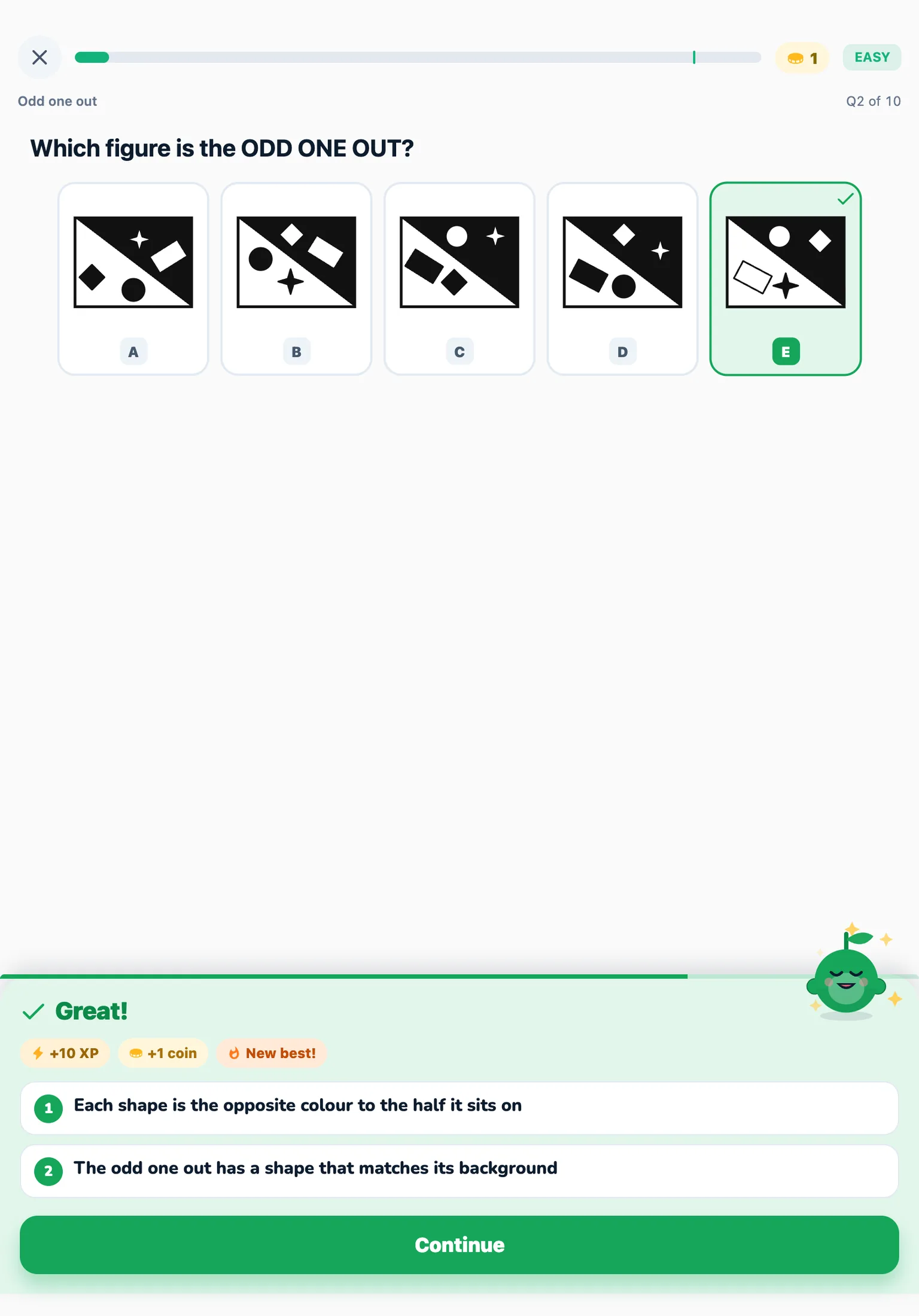
An odd one out question shows five shapes, and four of them share something that the fifth does not. You find what the four have in common and pick the shape that breaks it. This guide sits inside our non-verbal reasoning guide and covers the checks to try, plus the two traps: turned shapes and mirror images.
Which shape is the odd one out?
Four of these shapes have something in common. One does not. Find what they share.
- Four shapes share a rule. The odd one out is the one that breaks it.
- Try the checks one at a time: sides, curves, symmetry, angles, dents, shading, number of shapes.
- A good rule splits the five shapes into four and one. If it makes 3 and 2, try another check.
- Turning does not make a shape different. A mirror image is different.
What is an odd one out question in 11+ non-verbal reasoning?
An odd one out question shows a group of shapes where all but one share a property, and you choose the shape that does not. Practice papers often show five shapes labelled A to E, but the layout changes from test to test, so check your own sample paper.
The shared property can be simple, such as the number of sides, or harder, such as the type of angle or the number of lines of symmetry. Odd one out is one of several shape types on our non-verbal reasoning practice questions page. Where series questions ask what comes next, this one asks what does not belong.
The check sorter: find the rule that splits four and one
The quickest way to a rule is to sort. Pick a check below and the five shapes move into piles. A rule that makes a pile of four and a pile of one has found the odd shape.
Check sorter
Try the sides: all five shapes have 4 sides, so sides cannot split them. Shading gives white, grey, white, grey and white, which is a pile of 3 and a pile of 2, so shading is not the rule. Lines of symmetry give 2, 4, 2, 2 and 4, which is again 3 and 2. Now try the angle types. The rectangles and the squares only have right angles. The diamond has angles smaller than a right angle and angles bigger than a right angle. That is four shapes with right angles only and one without, so the diamond, option C, is the odd one out.
The eight checks to try
Most odd one out rules are one of eight checks. Start with the quick ones at the top of the list and move down. Each check is a question you can ask about all five shapes.
- Number of sidesCount the straight sides. A triangle has 3, a square has 4. Turning a shape never changes the count.
- Curved or straightDoes the edge bend? A circle is curved all the way round. A hexagon has only straight edges.
- Lines of symmetryFold the shape so the two halves match exactly. The fold line is a line of symmetry. A square has 4 and a rectangle has 2.
- Types of angleLook at the corners. A right angle is a square corner. A sharp angle is smaller and a wide angle is bigger, but still less than a straight line.
- DentsA dent is a corner that points inwards, like the notches in a star. A shape with no dents has every corner pointing out.
- ShadingWhite, grey or black. This is easy to spot, so it is often the rule at the start of a practice set. It is also used as a decoy.
- Number of shapesSome boxes hold one shape and others hold two or three. Count the shapes in the box, not the sides.
- Mirror imageSome shapes have a left-hand and a right-hand version. A turn can never turn one into the other.
How to solve an odd one out, step by step
Use five steps: look at all five shapes, try one check, see how it splits them, keep it if it splits four and one, then test your answer against the other checks. Press play on the example, or step through it yourself.
- Look at all five. Say what each shape is. Ignore which way it faces.
- Try one check. Start with the number of sides, then work down the list of checks.
- See how it splits the shapes. A pile of four and a pile of one means you may have the rule.
- Keep it or throw it away. Two piles of different sizes, or three piles, means the check is not the rule. Try the next one.
- Test your answer. Make sure no other check points at a different shape. The shapes that are turned or shaded differently still belong if the rule says they do.
Worked example
Count the sides: 4, 4, 3, 4 and 4. The triangle has 3 sides and the other four shapes have 4, so the check splits the shapes four and one. The square is black and turned, and the last rectangle is turned a quarter turn, but turning and shading do not change the number of sides. The triangle, option C, is the odd one out.
Pip 11 Plus has an Odd One Out skill that starts with one clear difference and builds to angles, symmetry and mirror images. Pip Teaches shows the rule first. Levels rise as your child gets them right, and any type they miss comes back.
- Pip Teaches shows the rule first
- Missed types come back
- Phone and tablet



Free, with optional Pro
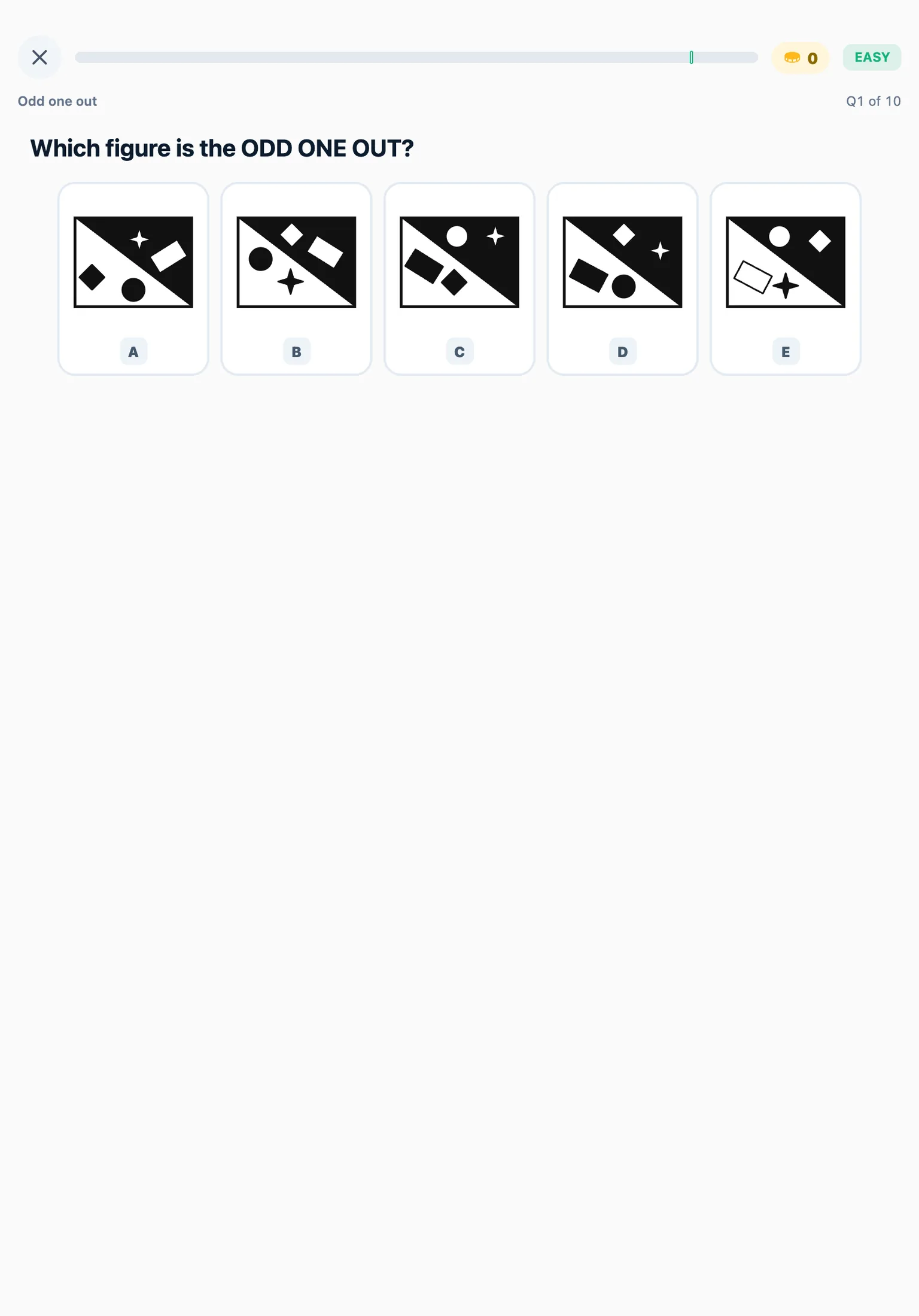
Lines of symmetry: how many folds make a match?
A line of symmetry is a fold that makes both halves match. Count the dashed lines on each shape and watch how different shapes give different counts.
Symmetry lab
Imagine folding the shape along each dashed line. If both halves land exactly on top of each other, that line is a line of symmetry. A square has 4, a rectangle has 2, and an L-shape has none. If four shapes have 2 lines and one has 4, the one with 4 is the odd one out.
Angle types: sharp, right, wide and reflex
Angles come in four types. A right angle is a square corner, a sharp angle is smaller than that, a wide angle is bigger but less than a straight line, and a reflex angle bends back inside the shape. Pick a shape and filter by type.
Angle lab
rightsharpwidereflex
A right angle is a square corner, exactly a quarter turn. Sharp is smaller than a quarter turn and wide is bigger, up to a straight line. A reflex angle is bigger than a straight line, and it is the dent in a star or an L-shape. If four shapes only have right angles and one has an angle bigger or smaller than a right angle, that shape is the odd one out.
Turned shapes and mirror images
A turned shape is the same shape. A mirror image is a different shape, because no turn will change one into the other. Test this with the L-shape below, then try the trap.
Turn or mirror lab
Four of the L-shapes are the same shape turned different ways: upright, a quarter turn, upside down and three quarters. The other L-shape is a mirror image, so its foot points the other way. However much you turn it, it never matches the others. The mirror image, option D, is the odd one out.
The turning trap
Turned shapes look different at first glance. Tap a shape to see whether it is the odd one out, then stand them all upright.
Four of the shapes are flags, each turned a different way. A flag is still the same flag when it is upside down. The square is not a flag at all, so it is the odd one out. The square, option D, is the answer.
Try 8 odd one out questions
Pick a level and answer eight questions. Keys 1 to 5 choose a shape, and the explanation after each answer names the rule and says why each other shape belongs. At the end you can try the set again, or move to a different level.
Why odd one out answers go wrong
Most wrong answers come from picking a difference that is not the rule. A shape can look odd because it is turned, shaded differently or has more shapes in the box, while still following the rule the other four share.
- Picking the turned shapeA shape that faces a different way is the same shape. Imagine turning it back before you decide.
- Picking by shadingShading only matters when four boxes match and one does not. Check whether another shape differs in a bigger way.
- Stopping at the first differenceMany shapes differ in several ways. Look for the check that splits the five shapes into four and one.
- Missing a mirror imageIf four shapes look the same, check the direction. A mirror image is the odd one even though it looks nearly the same.
How to practise odd one out at home
This type becomes quick when a child can name the check out loud. Short, regular practice helps more than one long session.
Tests differ in how many shapes they show and which checks they use, so read a sample paper for your own test. Our 11+ non-verbal reasoning papers guide and guide to preparing for non-verbal reasoning help with that.
- Name the checkBefore choosing, your child says what the four shapes share, in a full sentence.
- Sort with countersDraw the five shapes on cards and sort them into two piles. It makes the four and one split easy to see.
- Ten minutes, oftenA short daily go beats one long session.
- Mix the question typesMove on to matrix questions, series questions and analogies once odd one out feels easy.
Pip tracks which types your child misses, and the idea behind that is explained in our guide to adaptive learning.
Free printable odd one out worksheet
Choose a band and press Print for two A4 pages: eight questions, then an answer page with the rule for each. There is no sign-up, and the New worksheet button makes a fresh set each time.
Odd one out questions: frequently asked questions
What is an odd one out question in non-verbal reasoning?+
It shows a group of shapes, usually five. Four of them share a property and one does not. You choose the shape that breaks the rule the other four follow.
How do I find the rule in an odd one out question?+
Try one check at a time: the number of sides, whether the edges are curved, lines of symmetry, types of angle, dents, shading and the number of shapes in the box. A good rule splits the five shapes into a group of four and a group of one.
Does turning a shape make it the odd one out?+
No. A shape that is turned is still the same shape, so turning is never the rule. Imagine turning the shape back upright before you decide whether it is different.
What is a mirror image in an odd one out question?+
A mirror image is the flipped version of a shape, like a left hand and a right hand. It looks almost the same, but no turn will make it match the original. If four shapes match and one is a mirror image, the mirror image is the odd one out.
What are the types of angle?+
A right angle is a square corner. A sharp angle is smaller than a right angle and a wide angle is bigger but less than a straight line. A reflex angle is bigger than a straight line, like the dent in a star.
What is a line of symmetry?+
It is a fold line that makes the two halves match exactly. A square has 4 lines of symmetry and a rectangle has 2. Some shapes, such as an L-shape, have none.
What should I do when two shapes both seem to be odd?+
Check which difference splits the five shapes into four and one. If shading makes two shapes look odd, there will be another check, such as the number of sides, that picks out just one.
How many shapes does an odd one out question show?+
Many practice formats show five shapes labelled A to E, but this changes between tests. Check a sample paper for the test your child is sitting.
How can my child practise odd one out at home?+
Try ten minutes a day. Ask your child to say what the four shapes share before choosing, and to cross out each shape that follows the rule. A free printable worksheet is on this page, and Pip has an Odd One Out skill with levels that rise as your child gets them right.
Is odd one out the same as a series question?+
No. A series question asks what comes next in a row, while an odd one out question asks which shape does not fit the others. Our guide to series covers the row version.
Is the printable worksheet free?+
Yes. Choose a band, press Print and you get a question page and an answer page, with no sign-up.

The Pip team builds Pip, the 11+ and KS2 practice app for children in years three to six. We write these guides from real exam formats and past papers.