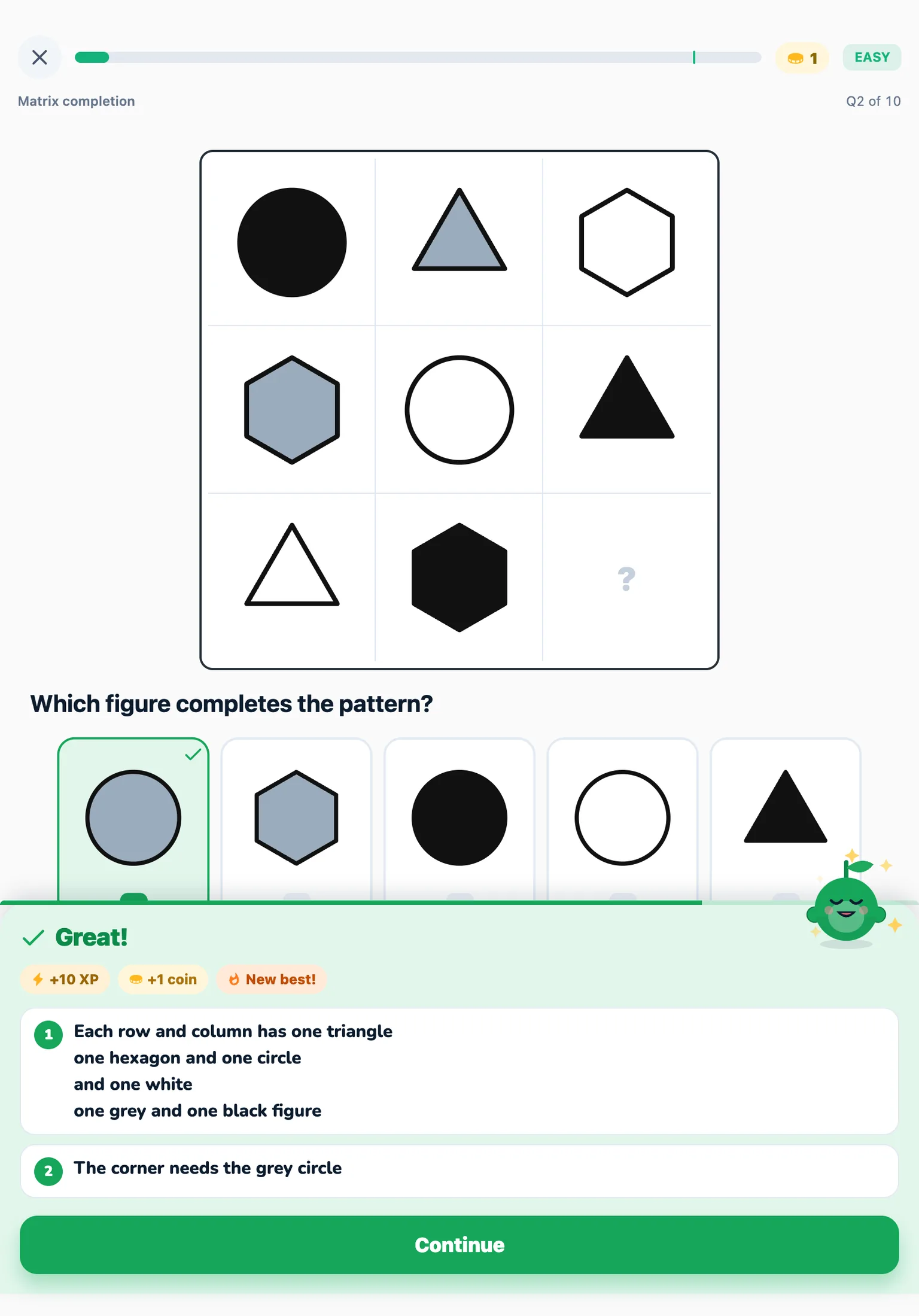
A matrix question shows a grid of shapes with one square missing. Every row and column follows a rule, so you find the rule, picture the missing square, then pick the option that matches. This guide covers 2 by 2, 3 by 3, star and triangle grids, and it sits inside our non-verbal reasoning guide.
Which shape goes in the ? square?
Every square follows a rule. Find it, and the missing square is no secret.
- A matrix is a grid with one square missing. The rules run along the rows and down the columns.
- Look at one feature at a time: shape, shading, size, number or turn. Say the rule in words.
- Predict the missing square before you look at the options, then cross out every option that breaks a rule.
- If two options are left, check the rule you have not used yet.
What is a matrix question in 11+ non-verbal reasoning?
A matrix question is a grid of shapes with one square missing. You work out the rules that run along the rows and down the columns, then choose the option that fits the gap. Practice papers often give five options labelled A to E, but the layout changes from test to test, so check your own sample paper.
Grids come in four common shapes. Our hub shows the one-of-each style in Example 1 of its non-verbal reasoning practice questions, and this page goes further with every type.
- 2 by 2Four squares. Often one thing changes along the row and one down the column.
- 3 by 3Nine squares. Rules can run along the rows, down the columns, or both.
- StarTwo rings of triangles. The outer ring decides the inner ring.
- TriangleOne triangle split into four parts. The parts turn or combine.
Rule finder: how to spot the rule in a matrix
Tap a row or a column to see what stays the same, what changes and what goes up by one. A rule is whatever behaves the same way on every line, so spotting it is mostly a matter of looking along one line at a time.
Find the rule
Look along row 1: all three shapes are circles. Row 2 is all squares and row 3 is all triangles, so the shape depends on the row. Now look down column 1: every square is white. Column 2 is always grey and column 3 is always black, so the shading depends on the column. Row 3 means a triangle and column 3 means black, so the answer is a black triangle, option C.
Each row and each column has a circle, a triangle and a diamond once. The number of shapes goes one, two, three across the grid, and every shape is grey. The yellow dot moves from square to square, but no rule uses it. Row 3 already has a triangle and a diamond, so it needs a circle, and column 3 needs three shapes. The answer is three grey circles, option D.
Row 1: the first square has the top and bottom lines and the second has the right and bottom lines. Lay one on the other and the third square has the top, right and bottom lines. Row 2 works the same way. In row 3 the first square has the right and left lines, and the second has the right line and a slanting line from bottom left to top right. Put them on top of each other and you keep the right line, the left line and the slanting line. That is option A.
In row 1 the first square shades the top and top right points. The second square shades the bottom right and bottom points, so every shaded point has moved two places round. That is a turn of 120 degrees clockwise. Row 3 starts with the top and bottom left points. One turn gives the top and bottom right points, and a second turn gives the bottom right and bottom left points. That is option A.
How to solve a matrix, step by step
Use five steps: pick a feature, look along a row, look down a column, say the rule in words, then predict the square before you look at the options. Press play on the example below, or step through it yourself.
- Pick one feature. Shape, shading, size, number of shapes or turn. Look at only that one and ignore the rest.
- Look along a row. Is it the same all the way along, all different, or does it go up by one?
- Look down a column. A rule can change direction, so check both ways every time.
- Say the rule in words. If you cannot say it out loud, you have not found it yet.
- Predict, then cross out. Picture the missing square first. Cross out every option that breaks a rule. If two are left, check the rule you have not used yet.
Worked example
Each row and each column has a circle, a triangle and a diamond once. The number of shapes goes one, two, three across the grid, and every shape is grey. The yellow dot moves from square to square, but no rule uses it. Row 3 already has a triangle and a diamond, so it needs a circle, and column 3 needs three shapes. The answer is three grey circles, option D.
Pip 11 Plus has a Matrices skill for 2 by 2, 3 by 3, star and triangle grids. Pip Teaches shows the rule first. Levels rise as your child gets grids right, and any type they miss comes back.
- Pip Teaches shows the rule first
- Missed types come back
- Phone and tablet



Free, with optional Pro
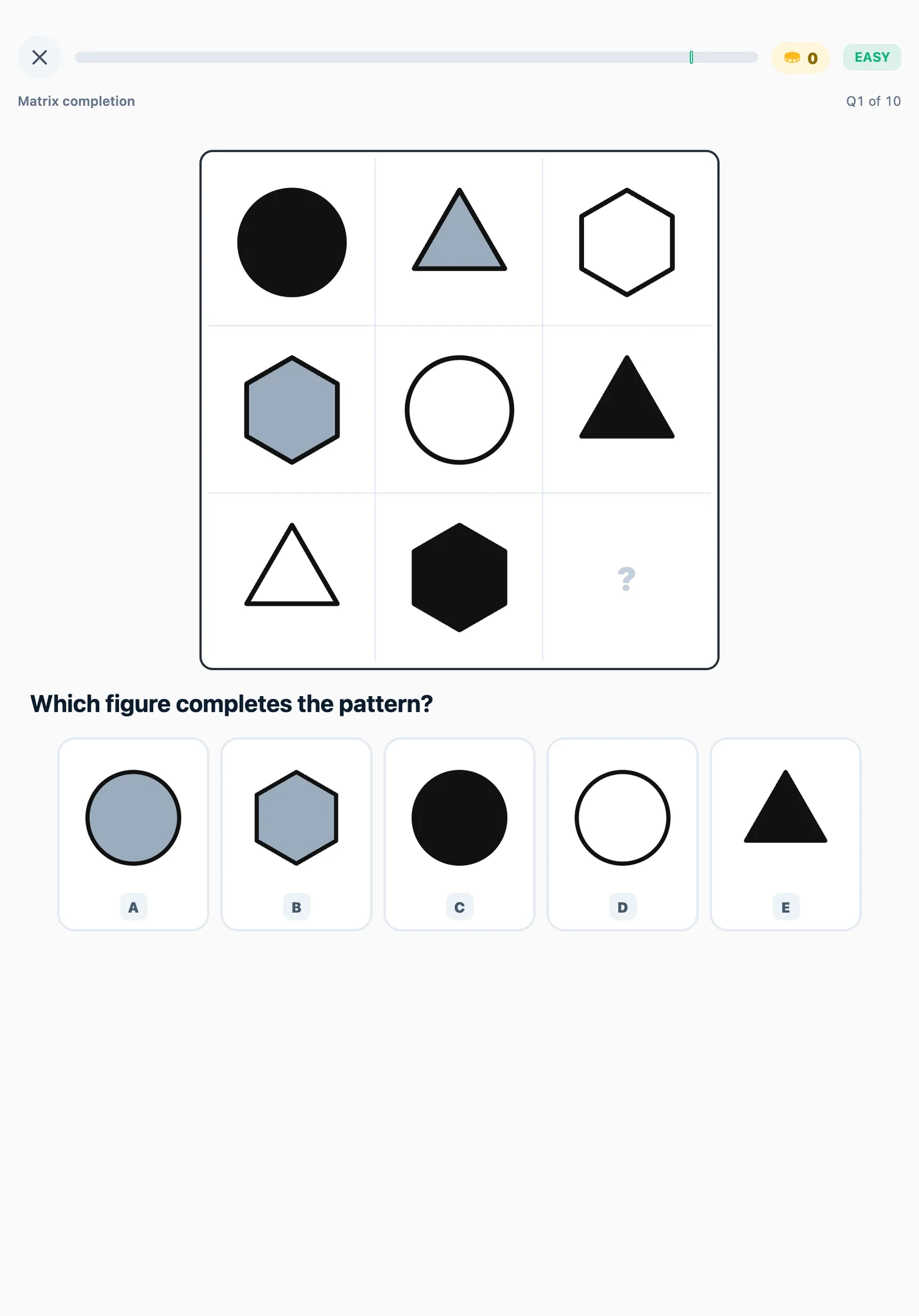
Types of matrix rule you will meet
Most matrices use a small set of rules: the same all the way along, one of each, going up by one, turning, or combining parts. Once you know the six below, a new grid is usually two of them at once.
- The same all the way alongEvery square in the row has the same shape, shading or size. Here the shape is a circle in every square, and only the shading changes.
- One of eachEach shape, shade or size turns up once in every row and once in every column. Like a sudoku grid.
- Goes up by oneThe number of shapes grows by one each step: one, two, three.
- TurnsEach square is the one before it, turned by the same amount. Here the star turns 120 degrees clockwise.
- Put on topLay the first square on the second and keep every line. The third square shows the result.
- Cancel outA line that is in both squares disappears. Only the lines that are in one square, but not both, are kept.
Combining parts: put on top, cancel out, take away
Some grids hide a rule in the lines, not the shapes. Pick a rule below and press the button to see the third square built from the first two.
Parts lab
2 by 2 matrices
A 2 by 2 matrix has only four squares, so it usually has one or two simple rules. Cover the options and try to say the rule first.
Row 1 is a white diamond, then a black diamond. Row 2 starts with a white diamond. Column 1 is white and column 2 is black, so the missing square is a black diamond. The shape and the size stay the same. That is option C.
Star matrices
A star is two rings of triangles. The rule usually links the inner ring to the outer ring. Here, each inner triangle is the opposite shade of the outer point it sits under.
The outer points go dark, white, dark, white, dark, white, starting at the top and going clockwise. The missing inner triangle sits under the bottom point, and the bottom point is white. Every inner triangle is the opposite shade of its outer point, so the missing one must be dark. The right-hand star shows it filled in.
Triangle matrices
A triangle matrix splits one big triangle into small parts. The usual rule is a turn: each square is the one before it, turned 120 degrees clockwise, so the shaded corner moves from the top to the bottom right and then to the bottom left.
Top corner, then bottom right, then bottom left.
Try 8 matrix questions
Pick a level and answer eight questions. Keys 1 to 5 choose an option, and the explanation after each answer names the rule and says why each wrong option fails. At the end you can try the set again, or move to a different level.
Why matrix answers go wrong
Most wrong answers finish the row but break the column, or the other way round. Pick a wrong option below and check it against the row, then the column, to see where it lets you down.
Wrong-answer lab
- Reading only the rowsCheck down the column too. An option that suits the row can still break the column.
- Following the busiest featureA small dot or a mark in the corner may have no rule at all. If you cannot say its rule, ignore it.
- Stopping at the first fitOne option fits one rule. Check the survivors against the second rule before you choose.
- Getting overwhelmedNine squares with five features is a lot. Look at one feature, then the next.
Why 3 by 3 matrices feel hard, and how to practise at home
A 3 by 3 matrix feels hard because more than one rule runs at once and the eye is pulled towards the busiest feature. The fix is the same five steps, done slowly, until they feel automatic.
Matrix reasoning also turns up in IQ-style puzzles for children, and the skill is the same: find the rules, predict the square, then check. Tests differ in how many options they give and in which grids they use, so read a sample paper for your own test. Our 11+ non-verbal reasoning papers guide and guide to preparing for non-verbal reasoning help with that.
- Say the rule aloudBefore choosing an option, your child says each rule in a full sentence.
- Cover the optionsHide the answer row, draw the missing square, then uncover and compare.
- Ten minutes, oftenA short daily go beats one long session.
- Mix the question typesMove on to series questions, odd one out questions and analogies once grids feel easy.
Pip tracks which rule types your child misses, and the idea behind that is explained in our guide to adaptive learning.
Free printable matrices worksheet
Choose a band and press Print for two A4 pages: six questions, then an answer page with the rule for each. There is no sign-up, and the New worksheet button makes a fresh set each time.
Matrix questions: frequently asked questions
What is a matrix in non-verbal reasoning?+
A matrix is a grid of shapes with one square missing. Each row and column follows a rule, and you choose the option that completes the grid. Common sizes are 2 by 2 and 3 by 3, with star and triangle versions too.
How do I solve a matrix question?+
Pick one feature, such as shape or shading. Look along a row, then down a column, and say the rule in words. Picture the missing square before you look at the options, then cross out every option that breaks a rule.
Do the rules run along rows or down columns?+
They can do either, and often both at once. A grid might use shape by row and shading by column, so check both directions every time.
What should I do when two options both seem to fit?+
Check the rule you have not used yet. Two options that both fit one rule will usually differ on the other rule, so the last difference between them tells you which to pick.
Why do 3 by 3 matrices feel harder than 2 by 2?+
They have more squares and usually more rules running at the same time. Looking at one feature at a time makes them manageable.
What are star and triangle matrices?+
A star matrix uses two rings of triangles, and the shading of one ring often decides the other. A triangle matrix splits one triangle into parts that turn or combine from square to square.
What is a red herring in a matrix?+
A red herring is a detail that moves about but follows no rule, such as a small dot in the corner. If you cannot say the rule for a feature, it is probably a decoy and you can ignore it.
How many answer options does a matrix question have?+
Many practice formats give five options labelled A to E, but this changes between tests. Check a sample paper for the test your child is sitting.
How can my child practise matrices at home?+
Try ten minutes a day. Ask your child to say each rule aloud, cover the options and draw the missing square first, then compare. A free printable worksheet is on this page, and Pip has a Matrices skill with levels that rise as your child gets grids right.
Is matrix reasoning the same as in IQ tests?+
The style is similar, because both ask you to find the rules in a grid and complete it. 11+ papers are written for the test itself, so practise with the format your child will meet.
Is the printable worksheet free?+
Yes. Choose a band, press Print and you get a question page and an answer page, with no sign-up.

The Pip team builds Pip, the 11+ and KS2 practice app for children in years three to six. We write these guides from real exam formats and past papers.