A reflection question shows a figure and a dashed mirror line, and asks which option is the figure as a mirror would show it. Every square lands the same distance from the line, on the other side. It is one of the question types on our non-verbal reasoning questions page.
Every square lands the same distance from the line, on the other side, and keeps its colour.
This page gives you a method that works every time, a mirror lab to play with, free questions at 6 levels and a printable worksheet. If the figure is folded or turned instead of mirrored, our guides to paper folding and cube rotation cover those.
- Find the mirror line first. Its direction tells you which way the figure flips.
- Each square goes the same distance from the line, on the other side.
- Squares keep their colour and their size.
- A turned figure is not a mirror image. Wrong options often turn or copy it.
What is a reflection question?
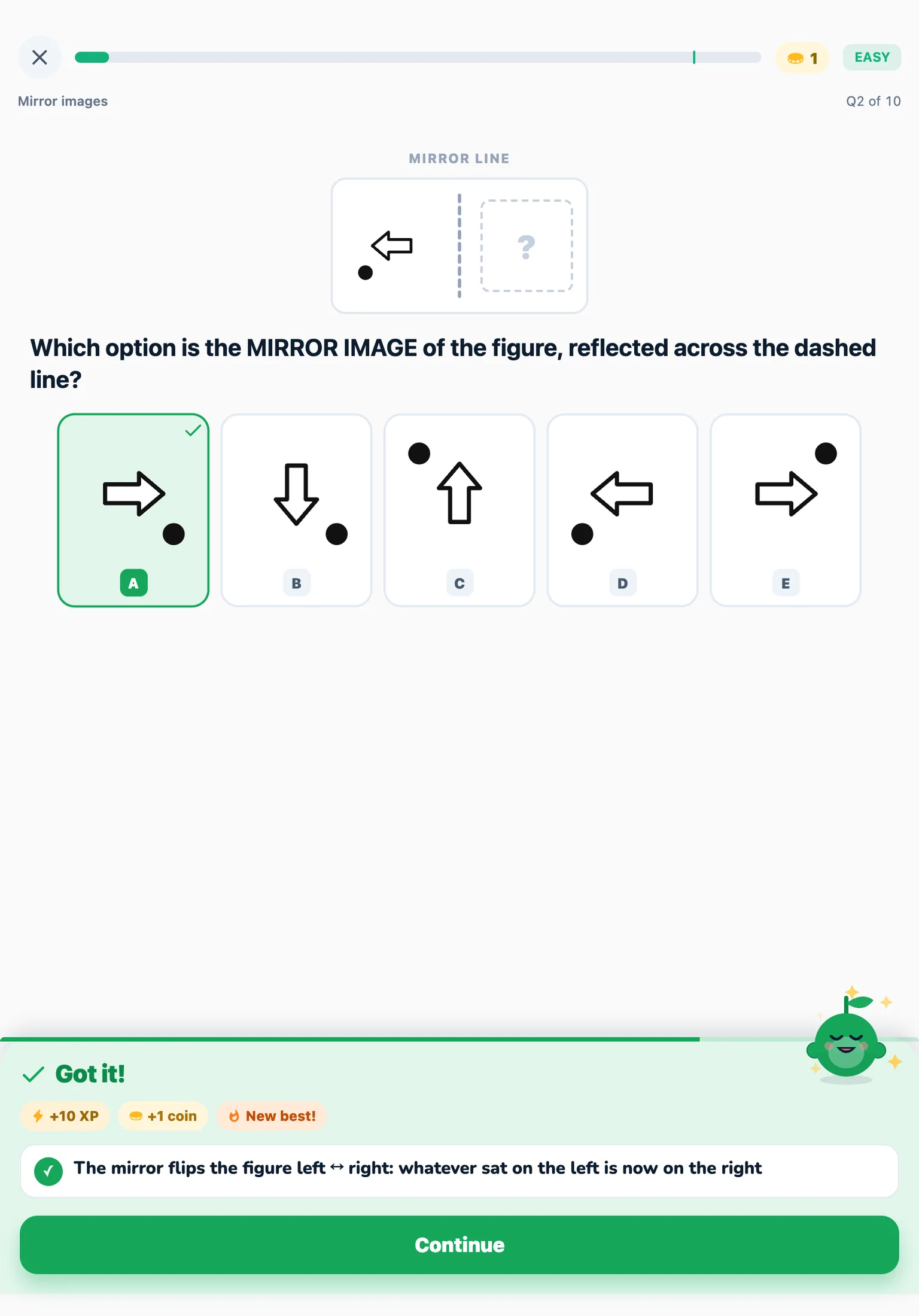
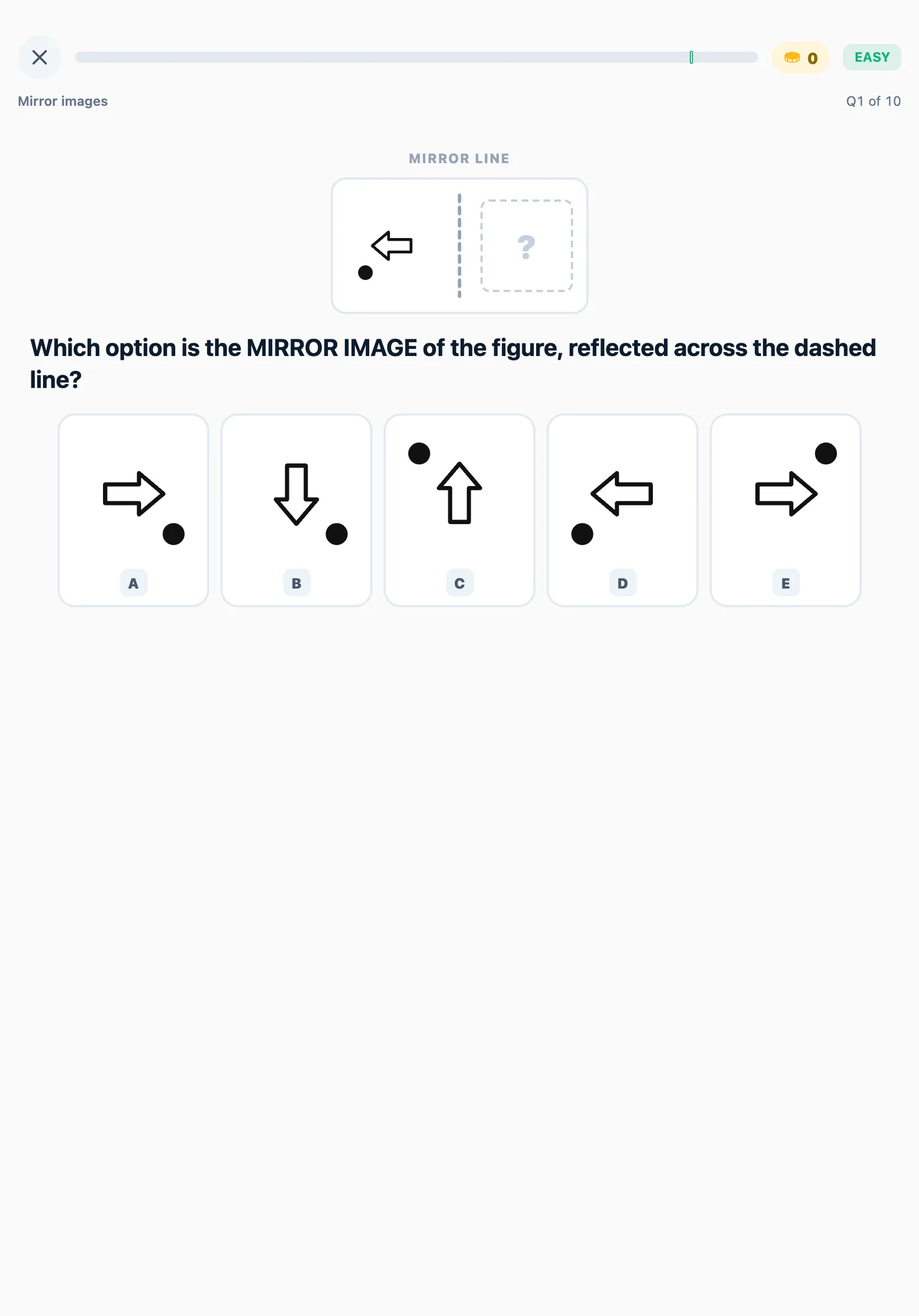
A reflection question is a figure on one side of a dashed line, an empty box on the other side, and five options. The right option is the figure as it would look in a mirror standing on the line. It is also called a mirror image or a flip.
Look at the three panels at the top. The same shape folds over three different lines. Over a vertical line, left and right swap. Over a horizontal line, up and down swap. Over a diagonal line, the figure swaps across the corner.
The mirror image is the same size and the same colours. Only its position and which way it faces change.
How do you solve a reflection question?
Find the mirror line, work out which way the figure flips, check the squares nearest the line, and cross out the options that break the rule. Press play to watch the steps on one question.
The same question in words
The figure has four rows and four columns. Black squares are in row 1 at columns 2 and 3, in row 2 at column 2, and in row 3 at columns 2, 3 and 4. Row 4 is empty. The mirror line is vertical, on the right of the figure.
- The line is vertical, so left and right swap and each square stays in its row.
- In row 3 the black squares are 3, 2 and 1 squares from the line. They land 1, 2 and 3 squares away on the other side.
- Do the same for rows 1 and 2. Row 1 reads the same in reverse. Row 2 has its square moved to column 3.
- Cross out any option that is the figure copied, flipped the wrong way, turned or one square out.
Answer: the option with black squares in row 1 at columns 2 and 3, in row 2 at column 3, and in row 3 at columns 1, 2 and 3.
If you are stuck, use the squares closest to the line. They are the easiest to place and they cross out the most options.
What is the distance trick?
Count how many squares each square is from the line, then put it the same number of squares away on the other side. A square 1 away lands 1 away, and a square 3 away lands 3 away.
- Count squares from the line. The column next to the line is 1 away. The next is 2 away.
- Move the same count across. A square 1 away lands 1 away on the other side. A square 3 away lands 3 away.
- Keep the row and the colour. With a vertical line, only the side changes.
The gold rulers show the idea. Each ruler joins a square to its mirror square, and the dashed line cuts it exactly in half. If the line does not cut the ruler in half, the square is in the wrong place.
Pip Teaches shows the rule before the questions. Levels rise as your child gets them right, and the reflection types they miss come back until your child gets them right.
- Pip Teaches first
- Missed types return
- Phone and tablet



Free, with optional Pro
What kinds of mirror line are there?
There are four: a vertical line, a horizontal line, and two diagonals. Read the line before anything else, because it tells you which way the figure flips.
- Vertical lineThe line goes up and down. Left and right swap. Up and down stay put.
- Horizontal lineThe line goes across. Up and down swap. Left and right stay put.
- Diagonal, down to the rightThe figure swaps across the corner. Rows become columns.
- Diagonal, down to the leftThe same swap, using the other diagonal. Check which way the line slopes.
Diagonal lines cause the most slips. Take a square in the second row and fourth column. Over the diagonal that slopes down to the right, it lands in the fourth row and second column. Rows become columns. For a different kind of shape puzzle, try shape analogies.
Can you try the mirror yourself?
Yes. Tap squares in the first figure to make your own, choose a mirror line and press Fold it over. The other side always shows the exact mirror image. Turn on the distances to see why.
The starting figure in words
The lab starts with the figure from the worked example: a four by four figure with a vertical mirror line on its right.
- Press Fold it over and the figure swings across the line.
- Press Show distances to see a gold ruler for each square.
- Change the line to horizontal. Now the figure flips up and down instead.
- Try a diagonal line and watch rows become columns.
Whatever you draw, the mirror image keeps the same number of squares and the same colours.
What is the difference between flipping and turning?
A flip is a mirror image, and a turn is not. If you can slide and turn the new figure back onto the old one without lifting it off the page, it was only turned. A mirror image needs a flip.
The same idea in words
The starting figure is a bold letter F: a tall stem with two arms pointing right. Choose a move and compare.
- A vertical flip points the arms left. That is a mirror image.
- A horizontal flip puts the arms at the bottom. That is also a mirror image.
- A quarter turn or a half turn moves the arms round but never swaps hands. That is not a mirror image.
The F is useful because it has no line of symmetry, so a flip always looks different from the original.
How do you read a clock in a mirror?
Subtract the time you see from 12:00. A mirror clock showing 7:50 is really 4:10, because 12:00 take away 7:50 is 4:10. The numbers are back to front and the hands swing to the opposite side.
The 4:10 example in words
The real clock shows 4:10. The hour hand is just past the 4 and the minute hand points at the 2. In a vertical mirror the minute hand points at the 10 and the hour hand sits just before the 8.
- Read where the minute hand points on the mirror clock: the 10, which is 50 minutes.
- Read the hour hand. It is nearly at 8, so the hour is 7 and it is almost 8.
- The mirror clock reads 7:50. Take that from 12:00 to get 4:10.
Drag the slider to try other times. This works for a vertical mirror only.
What happens to letters and words in a mirror?
In a vertical mirror, a word reads in reverse and each letter is flipped left to right. In a horizontal mirror, the word stays in order and each letter is flipped upside down. Some letters look the same after the flip, and some turn into something that is not a letter.
TAXI in words
In a vertical mirror, TAXI shows as I, X, A, T from left to right. All four letters are the same flipped, so only the order changes.
- Letters that look the same in a vertical mirror: A, H, I, M, O, T, U, V, W, X and Y.
- Letters that look the same in a horizontal mirror: B, C, D, E, H, I, K, O and X.
- A coral letter in the lab is one that no longer looks like a letter.
These lists are for the plain block letters shown here, so check how a paper draws its letters.
Try it: 8 reflections
Pick a level, answer eight questions and see how many you get. Level 1 uses one vertical line. Levels 5 and 6 are the hardest and use all four lines and two colours.
What each level uses
- Level 1: a small figure and a vertical line.
- Level 2: vertical and horizontal lines.
- Level 3: bigger figures.
- Level 4: diagonal lines.
- Level 5: all four lines and two colours.
- Level 6: the biggest figures and the trickiest wrong options.
A level 1 question in words: a three by three figure has black squares at the top left, and the mirror line is vertical on its right. Its mirror image has the same squares at the top right.
Why are the wrong options wrong?
Each wrong option breaks the reflection in its own way. It copies the figure, flips the wrong way, turns it, moves one square or swaps the colours. Spotting the break is the quickest way to cross it out.
- Option 1 is right matches the reflectionThe mirror image.
- Option 2 is wrong flipped the wrong wayIt is flipped across the wrong line. The mirror line here is a vertical line.
- Option 3 is wrong one square wrongIt is the reflection with one square added.
- Option 4 is wrong copied across, not flippedIt is the figure copied across the line, with nothing flipped.
- Option 5 is wrong turned, not flippedIt is the figure given a quarter turn clockwise. That is turned, not flipped.
The same mistakes cause most lost marks:
- Copying across. The mirror image is flipped, not just moved next to the line.
- Flipping the wrong way. Check whether the line is upright or flat before you flip.
- Turning instead of flipping. A turned figure fits the original, a mirror image does not.
- Slipping by one square. Check the squares nearest the line first.
- Forgetting the colours. Grey stays grey and black stays black.
How do reflections appear in the 11 plus?
They are a standard non-verbal reasoning question: a figure with a mirror line and a row of options. Papers differ by publisher and by school, so ask the school which format your child will sit. The skills on this page cover the usual layouts.
Harder papers use diagonal lines, two colours, and options that differ by a single square. Easier ones use an upright line and a small figure.
How can you practise at home?
- Name the line first. Ask "is it upright, flat or diagonal?" before anything else.
- Use a real mirror. Hold a small mirror on the dashed line on the page to see the answer.
- Do five a day. A short quiz on this page, then stop.
- Move up a level. Go up when most answers are right, not before.
- Learn the full picture. Our guide to preparing for non-verbal reasoning shows how reflections fit in, and matrices are a good question type to try next.
Is there a free printable reflections worksheet?
Yes. Choose a difficulty, press New worksheet for a fresh set, then print. You get six questions on one page and the answers with the reasons on the next page.
Frequently asked questions
What is a reflection in non-verbal reasoning?+
A reflection question shows a figure and a mirror line. You pick the option that shows the figure as it would look in a mirror placed on that line. Every square of the figure appears on the other side of the line, the same distance away, and keeps its colour.
What is the difference between a reflection and a rotation?+
A reflection flips the figure like a mirror image, so left and right (or up and down) swap. A rotation turns the figure round without flipping it. If you can slide and turn the new figure back onto the old one, it was a rotation, not a reflection.
How do you find the mirror image quickly?+
Find the mirror line first. Then take the squares nearest the line, work out how far each is from it, and put each the same distance away on the other side. Check two or three squares against the options and the wrong ones fall away.
What changes in a vertical mirror and what stays the same?+
With a vertical mirror line, left and right swap, so every row is read in reverse. Up and down do not change, so each square stays in the same row. With a horizontal line it is the other way round: rows swap order and columns stay put.
How do diagonal mirror lines work?+
A diagonal line swaps rows and columns across the corner. A square that is in the second row and fourth column lands in the fourth row and second column. Look at which way the line slopes, because the two diagonals give different answers.
Why do the wrong options look so close to the right one?+
Each wrong option breaks the reflection in one named way. It may be the figure copied across without flipping, flipped the wrong way, turned instead of flipped, one square out, or with the colours swapped. Checking one square at a time finds the break.
How do you read a clock in a mirror?+
A clock seen in a vertical mirror has its numbers back to front, and the hands swing to the opposite side. The real time is 12:00 take away the time you read. If the mirror clock shows 7:50, the real time is 4:10, because 12:00 take away 7:50 is 4:10.
What happens to letters and words in a mirror?+
In a vertical mirror a word reads in reverse order and each letter is flipped left to right. Letters such as A, H, I, M, O, T, U, V, W, X and Y look the same when flipped, but B, C, D, E and K do not. In a horizontal mirror the word stays in order, and letters such as B, C, D, E, H, I, K, O and X look the same.
How many options are there, and is only one right?+
The practice questions on this page give five options, A to E, and exactly one of them is the mirror image. Each wrong option breaks the reflection in its own way, which is why checking one square at a time works so well.
Is practice with these questions free?+
Yes. Everything on this page is free with no sign-up, including the mirror lab, the quiz and the printable worksheet. Pip also has a reflections skill in the app, which is free to start with optional Pro.

The Pip team builds Pip, the 11+ and KS2 practice app for children in years three to six. We write these guides from real exam formats and past papers.